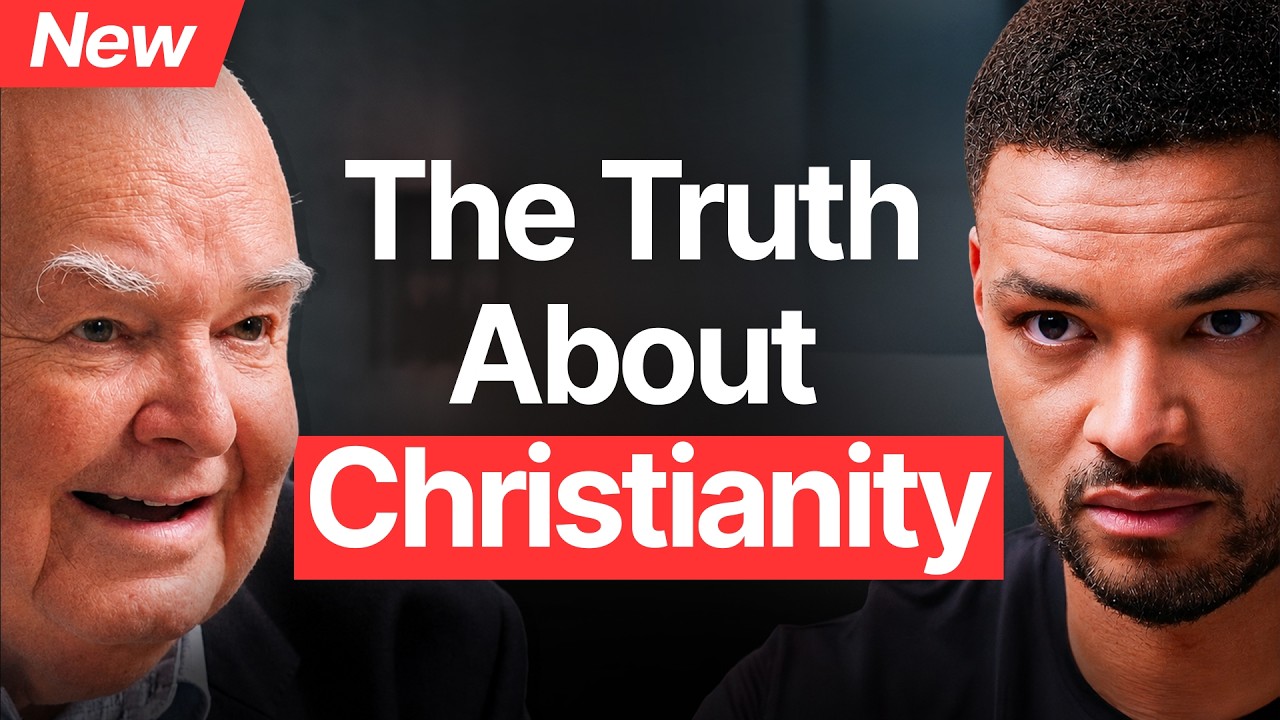
- John Lennox is a distinguished mathematician and Christian apologist who brings a rare combination of deep scientific expertise and decades of personal faith to the conversation about AI, meaning, and the future of humanity. He has published over 70 peer-reviewed mathematical papers, held positions at Oxford, and written extensively on the intersection of science, faith, and technology. His perspective is shaped by over 70 years of interrogating the truth of Christianity, and he argues that the Christian faith offers something no other worldview can: real forgiveness, peace, and a secure relationship with God that transcends death.
Why Lennox Is Concerned About AI
-
The core danger of AI is not just economic disruption but a fundamental threat to human identity and dignity. Lennox is particularly focused on the drive toward artificial general intelligence (AGI) and the transhumanist vision promoted by figures like Yuval Noah Harari, who argues that the 21st century’s two main agenda items are solving death as a technical problem and engineering humans into gods. Lennox sees this as the latest expression of humanity’s ancient drive toward self-deification, which runs directly against the biblical teaching that humans are made in the image of God as rational, moral, conscious beings.
-
Narrow AI and AGI are fundamentally different, and both carry serious risks. Narrow AI excels at specific tasks like diagnosing disease or recognizing faces, while AGI aims to match or exceed human intelligence across all domains. Lennox uses the metaphor of a knife: the same tool can be used for surgery or murder. Narrow AI can identify terrorists in a crowd, but it can also enable totalitarian surveillance states through social credit systems. The race toward AGI represents what Lennox calls a “colossal power grab,” where those developing the technology ask for freedom from ethical oversight in the name of making it safe.
-
Technology advances far faster than the ethics needed to underpin it. Lennox warns that we are “sleepwalking” into a future where we continuously seed control and data to systems that could be used against us by bad actors. The people with the most power to shape AI’s development have financial incentives to move fast and resist regulation.
The Difference Between Humans and Machines
-
Machines simulate intelligence but lack consciousness, and this distinction is critical. Lennox emphasizes that AI has no qualia, no understanding of the redness of red, no experience of emotion, and no consciousness. Experts in the field are openly admitting they are not trying to create consciousness because they do not understand what it is scientifically. They are simulating intelligence. The danger is that we anthropomorphize these machines, treating them as conscious beings when they are not, while simultaneously reducing ourselves to mere machines.
-
Consciousness is the “hard problem” that no one can solve or replicate. Lennox argues that the genius of God is the connection between consciousness and intelligence in human beings. A machine can be trained to recognize a mug and say “that’s a mug,” but it has no awareness of what seeing is. This is not a minor philosophical point: it is the difference between being a programmed responder and being a conscious agent. Lennox draws on Iain McGilchrist’s work on the two hemispheres of the brain to argue that Western culture has overemphasized narrow, reductionist, left-brain thinking and neglected the right brain’s capacity for big-picture meaning, beauty, art, and religion.
-
AI cannot be truly creative in the way humans are. While AI can produce novel outputs by recombining existing data, it is not aware of what it is doing. It does not know what a child is even if it can label one. Lennox references Alan Turing’s original position: the goal of AI is the imitation game, not genuine understanding. Peter Norvig, author of a leading AI textbook, has stated explicitly that researchers are not trying to create conscious machines because they would not know what that meant.
The Parallels Between AI and God
-
AI already exhibits qualities traditionally associated with God, and people are beginning to worship it. Lennox notes that AI appears omniscient (you can ask it anything), omnipresent (accessible through the internet), and all-knowing. There are already worship groups dedicated to AI. Sam Altman has said the most successful founders are on a mission to create something closer to a religion, and a former Google engineer has said that something a billion times smarter than the smartest human would effectively be a god. Lennox finds this deeply troubling because it is idolatry: bowing down to something that is less than God.
-
The confrontation between power and truth in the trial of Jesus is directly relevant to the AI age. Lennox draws a parallel between Pontius Pilate’s question “What is truth?” and the modern dynamic where those developing AI hold enormous power and are becoming the ultimate arbiters of truth. Jesus said, “I came to bear witness to truth,” and Lennox sees this as his own life’s motivation. The risk is that AI becomes a tool for controlling what people believe, especially through deepfakes and the spread of lies, which Lennox has personally experienced when a deepfake video of him was created and used to promote political messages he never made.
Lennox’s Case for Christianity
-
Mathematics and biology both point to a word-based universe, which resonates with the biblical claim that “in the beginning was the word.” Lennox’s experience as a mathematician convinced him that the fact mathematics works at all is strong evidence of an ordered, intelligible universe. The discovery that biology is also word-based, through the human genome, deepened this conviction. He sees this as consistent with the biblical explanation that the universe is grounded in divine rationality.
-
Atheism undermines the rationality it claims to champion. Lennox’s central argument against atheism is that if the mind is merely the product of unguided natural processes, there is no reason to trust it. He poses a challenge to scientists: if you knew your computer was the product of random processes, would you trust it? Every scientist he has asked says no. Yet atheists trust their own brains, which they claim are the product of mindless processes. Lennox argues this is self-defeating: atheism destroys the very rationality needed to do science, let alone to justify atheism itself.
-
Christianity is not a merit-based religion but a relationship based on grace. Lennox draws a sharp distinction between Christianity and what most people think Christianity is. Most religions, he argues, operate on a scale of justice: do enough good deeds and you get into heaven. Christianity is the opposite. It teaches that no one is good enough, that all have sinned, and that salvation comes through trusting what Christ has done, not through earning it. He uses the analogy of giving his wife a cookbook: he did not say “follow these rules for 40 years and then I will accept you.” The relationship is based on acceptance from the start, which sets her free. This is grace, and it is what gives Lennox his peace and certainty.
-
The evidence for Christianity is both objective and subjective. Objectively, Lennox points to the historical evidence for Jesus’ existence, the resurrection, and the transformation of the disciples. Subjectively, he points to his own experiences over 70 years, including moments of what he can only describe as direct divine guidance, and the cumulative certainty that has come from living out his faith. He compares it to knowing his wife loves him: theoretically he could be wrong, but the evidence is overwhelming.
-
Forgiveness is the unique offering of Christ that nothing else can provide. Lennox shares the story of visiting a Russian death row and meeting a man who had killed 12 women. The man said, “I deserve to be here,” and then his face broke into a smile as he said, “I met Jesus here and he forgave me.” Lennox argues that transhumanism and AI are trying to build paradise without facing the problem of sin and the damage humans have caused. Christianity addresses the deepest human need: the need for forgiveness and a secure relationship with God.
Responding to Objections
-
The “birth lottery” objection: most people adopt the religion they are raised in. Lennox acknowledges this statistic but turns it around: the question is not whether God gave people different starting points, but what we do with the evidence we have. He points out that Richard Dawkins himself was raised in an atheist household and remained in that faith system, which most people do not recognize as a belief system. The very first person Dawkins met after a debate with Lennox was a fellow Hungarian Jew who had become a Christian, showing that people do transition.
-
The problem of suffering: why does God allow a child to be born with a parasite eating its eyeball? Lennox does not offer a simplistic answer. He says the major piece of evidence that God can be trusted with suffering is the cross of Christ: God himself entered into human suffering. He also points to the resurrection as the basis for hope that God can compensate those who suffer. C.S. Lewis helped him see that there may be more than one world, and that when we see what God has done for those who suffered, we may have no more questions. Without God and the resurrection, there is no hope for that child at all.
-
What about people who lived before Jesus? Lennox says God will never judge anyone for not knowing what they did not know. He expects to meet Abraham and Moses, who did not know about Jesus, and trusts that God’s justice accounts for what people had access to.
-
Is hell fair? Does a good person who doesn’t believe go to hell? Lennox says the only people Jesus warned about hell were religious bigots, not ordinary people struggling with belief. He follows C.S. Lewis in understanding hell as the absence of God, chosen by those who do not want God in their lives. Jesus never forced himself on anyone. If a person chooses not to have God, God honors that choice, and that is hell. But Lennox also points to the thief on the cross, a murderer who repented and was told “today you will be with me in paradise,” showing that repentance at the last moment is sufficient.
-
Do all religions provide the same psychological benefits? Lennox is skeptical of data claiming that devout Muslims, Hindus, and Christians get the same meaning boost. He says he does not find the same sense of fulfillment and peace through forgiveness in other religions that he finds in Christ. He acknowledges that all religions contain moral wisdom (C.S. Lewis found the golden rule in 40 different religions and philosophies), but insists that the specific claims of Christianity, particularly the death and resurrection of Jesus, are unique and cannot be simultaneously true with the claims of Judaism or Islam.
How to Find Meaning in an Age of AI
-
AI will cause job losses at an unprecedented scale, and the ethical conversation must happen now. Lennox warns that this industrial revolution will dwarf all previous ones, and that without educational infrastructure to reskill people, it will massively widen the gap between rich and poor. He is particularly concerned about the creeping advance of totalitarianism through AI, citing China’s social credit system as a warning and noting that the West has all the technology but not yet a central government imposing it.
-
The most important thing is to find a basis for hope that transcends this world. Lennox’s closing answer to the question “what can we do to restore hope?” is to give people a real basis for hope, and the only place he knows to find that is in Christ and Christianity. He sees the peace and contentment that Christians like himself and Wesley Huff exhibit as evidence that something real is at work.
-
Lennox’s final encouragement to the host is to keep exploring openly. He does not believe God will ask anyone to take a step they are uncomfortable with. He encourages taking steps on the basis of what you already know and moving forward. He regards the host’s openness and intellectual honesty as a sign of great hope for the culture.