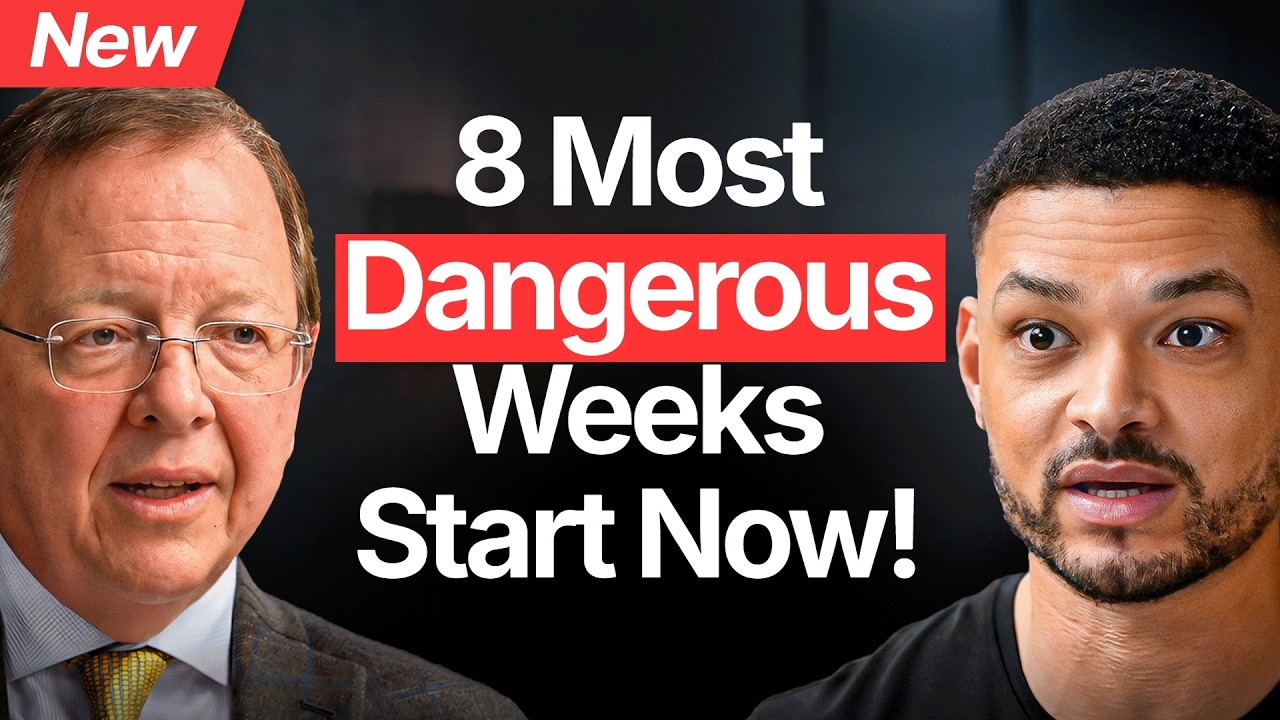
Professor Robert Pape, a political violence scholar who has advised every White House since 9/11, argues the United States is entering the eight most dangerous weeks in living memory — the period between the November midterm elections and the seating of the new Congress in January — because three escalation traps are converging simultaneously: a domestic transfer-of-power crisis amid record support for political violence, an Iran war that President Trump has promised to escalate after the elections, and a likely Russian escalation against Ukrainian civilian infrastructure once Putin concludes Trump cannot deliver Ukrainian territory.
The three converging crises
Domestic transfer of power: The midterms will determine whether Republicans retain control of both House and Senate; if Democrats win one or both chambers, they gain subpoena power, impeachment authority over cabinet officials, and the ability to paralyze the Trump administration — creating what Pape calls a “spiral down” with no political bottom.
Violent populism at historic highs: Pape’s nationally representative surveys show over 40 million Americans now support using the military to suppress Democratic protesters against the Trump agenda, and over 60 million support using force to prevent Trump from being president — numbers double what they were in September 2024, when assassination attempts against Trump and the killing of Charlie Kirk occurred.
The most dangerous moment is the transition: As in November 2020–January 2021, the two-month period of vote counting, certification, and transfer of power is when political violence peaks; Pape warns this cycle is worse because the combustible material (tens of millions supporting violence on both sides) is far larger.
The escalation trap: roulette, not chess
Pape distinguishes chess (where a player ahead offers a draw) from roulette (where a loser doubles down on riskier bets to recover losses); strong powers in escalation traps behave like gamblers, not chess players.
Trump’s bets so far: Strike on Supreme Leader → failed (Iran gained control of Strait of Hormuz, 20% of world oil); six-week air campaign → failed (Iran held the Strait); blockade → failed (six months later, Iran has not caved, gas prices rising).
The deadline: The new Congress convenes January 3 — the “bookie” demanding repayment of borrowed political chips (MAGA support, party control, personal and family financial exposure via crypto and prediction markets).
Humiliation dynamics: Presidents do not abandon their party, agenda, and legacy; Lyndon Johnson in Vietnam doubled down as support collapsed, chasing losses up the escalation ladder — Trump faces the same trap.
Iran war: the 3-day plan and beyond
The plan on Trump’s desk: A 72-hour “Instant Thunder”–style aerial campaign (modeled on the 1991 Iraq war opening) targeting missile sites, drone hubs, IRGC command centers, energy infrastructure, refineries, bridges, and leadership — 84 target sets designed to paralyze the Iranian state.
Preparation steps already taken: Embassy personnel and families withdrawn from Saudi Arabia and frontline Gulf states; CENTCOM ordered to execute within 96 hours of a “go code.”
Why it likely fails: Instant Thunder was planned for 3–6 days but ran 43 days without paralyzing Iraq’s military; Iran’s decentralized structure means remnants retain strike capability (missiles, drones, cyber) and will lash out at Gulf infrastructure, as Houthis already did at Riyadh Airport terminals.
Civilian casualties and inspired attacks: The target set guarantees thousands of Iranian civilian deaths (5,000–15,000 in 1991 analogue), generating a massive pool of revenge sentiment — enabling inspired (non-state-directed) suicide attacks like the Tel Aviv-bound co-pilot who waited 2.5 hours to strike near target.
Ground troops follow: Once air campaign fails to fully paralyze, Marines move in for “limited ground operations” against remnants — locking in a “forever war” with no exit.
Ukraine/Russia: Putin’s dark winter
Putin’s minimum demand: Formal annexation of four oblasts (Donetsk, Luhansk, Zaporizhzhia, Kherson) requires conquering remaining white-space territory — after four years and 250,000+ Russian dead, he has gained ~1% of Ukraine and remains far from that goal.
Zelensky cannot surrender: Surrendering annexed territory would likely get him killed by his own military/people — so Trump cannot deliver Putin’s demand.
Escalation timeline: Around Thanksgiving (week 4), Putin realizes Trump cannot deliver → shifts to “Plan B”: massive strikes on electric power in Kyiv, Kharkiv, Odesa to knock out 90% of power for 1–2 months — his own escalation trap, since losing the war threatens his survival.
Domestic violent populism: the wildfire analogy
Combustible material: 40M+ Americans support violence for Trump’s goals; 60M+ support violence against Trump’s goals — the dry wood.
Sparks are unpredictable: January 6 was sparked by Trump’s tweet that Pence “let them down” — the crowd chanted “Hang Mike Pence.”
Focal point events spread: Ballot-counting clashes between federal agents and protesters could act as sparks; once ignited, violent populism spreads across cities like wildfire (as in France, where riots spread beyond Paris and recurred weekly).
Interaction with economic pain: Iran war drives up gas, diesel, housing costs → fuels protests in Europe and US → more clashes → more federal deployment → more escalation.
Interaction effects and the 2027 horizon
Cyber attacks on US infrastructure: Summer 2026 water/power outages in Minnesota and other states attributed by US intelligence (via New York Times) to Iran — story suppressed, suggesting intelligence community managing public perception.
Insurrection Act threshold: Trump told Time magazine (Oct 1) he might invoke the Insurrection Act and would not take it off the table — allowing US military/National Guard deployment against citizens, suspended only by courts unless a true emergency exists.
Emergency powers cascade: By weeks 6–8, simultaneous Iran ground war, Russian cyber attacks on Europe, and domestic unrest create a “true emergency” — Trump declares expanding emergency powers, not ending by Christmas.
WWIII trigger: Russian cyber attacks on European homelands (power, internet, banking) → European publics demand retaliation → Europe strikes Moscow directly → great powers attacking each other’s homelands = World War III (distinct from proxy wars of Cold War).
Devastating 2027: If momentum continues unchecked, the eight-week crisis becomes a multi-year catastrophe with troops in US streets, forever war in Iran, and great-power war in Europe.
Three firebreaks to stop the momentum
Firebreak 1 — Congressional no-escalation pledge: Every current lame-duck member and newly elected member declares: no escalation in Iran by the Trump administration until the new Congress is seated, unless Iran strikes first.
Firebreak 2 — Gubernatorial/mayoral moratorium: Every governor and mayor calls for a two-month moratorium on all federally armed agents operating in their cities unless the governor/mayor requests them — removing the key spark for violent populism during vote certification.
Firebreak 3 — Mediator “hands off civilians” declaration: Pakistan, Qatar, and India (the three countries mediating across these conflicts) call on all parties to cease direct targeting of civilian infrastructure and residential areas by states.
Public preparedness and Pape’s assessment
UK “Be Ready” campaign: Government advises 3-day stockpiles of water, tinned food, battery torches, radios, power banks, first aid, and physical cash (ATMs fail in cyber attacks) — driven by anticipation of Russian cyber retaliation against European infrastructure.
Pape does not stockpile: Three days of supplies cannot handle recurring attacks; the realization hits on day one that stockpiling won’t prevent panic — only the three firebreaks buy real time.
What ordinary people can do: Email, text, and call political leaders demanding adoption of the three firebreaks — this is how the public navigates the journey rather than letting events control them.
Social media as force for prevention: Pape credits substantive public conversations (like this podcast) with raising the profile of true risks — after his July appearance, momentum for a disastrous SenCom drone-network strike on Iran collapsed when real consequences reached decision-makers.
Officials are listening: People in positions of power (US and abroad) have contacted Pape after his appearances; they believe the risks and are listening — the best influence is not always behind closed doors but in communicating true consequences publicly.