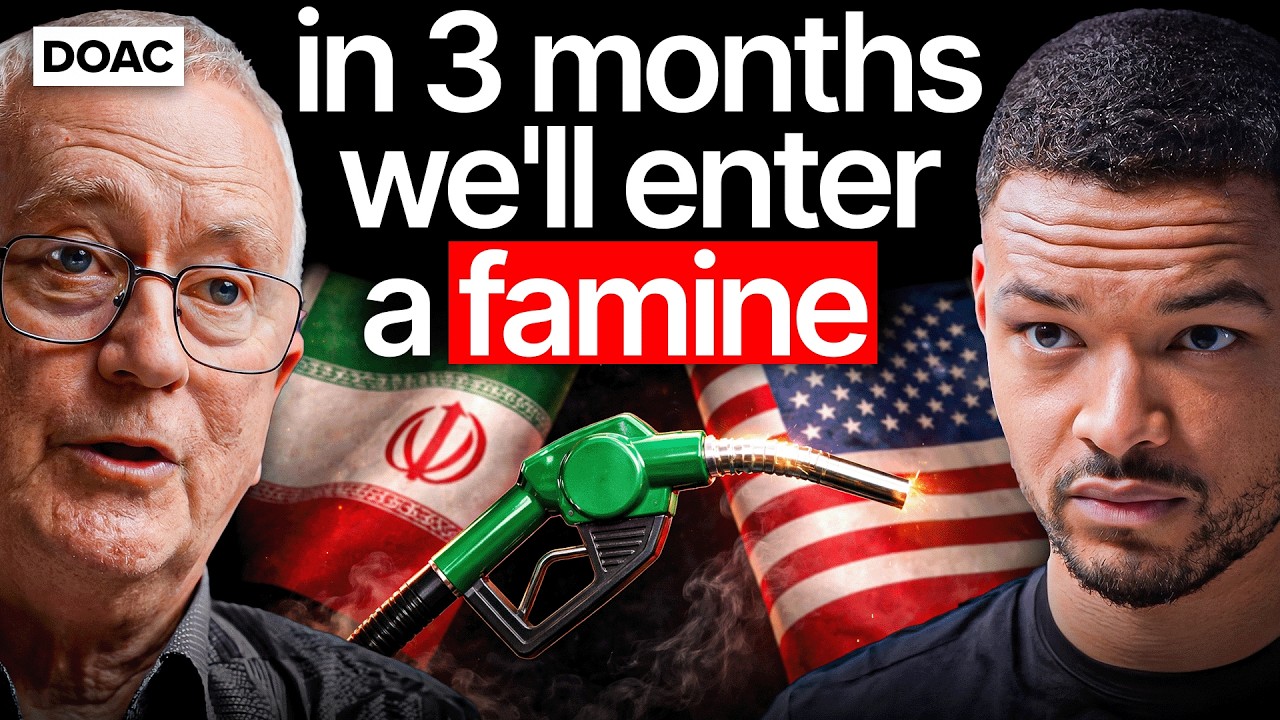
Professor Steve Keen, an economist famous for predicting the 2008 financial crisis, argues that the US-Israel war on Iran is the most dangerous economic event in modern history—not because of oil prices alone, but because the Strait of Hormuz is a chokepoint for fertilizer, helium, and sulfuric acid, and a prolonged blockade could trigger a global famine within 2–3 months and collapse semiconductor production worldwide.
The war is rooted in Israel’s long-standing ambition to destroy Iran as a regional rival, combined with Trump’s narcissistic need for attention and a “pump and dump” scheme to manipulate oil prices for personal and political gain.
Iran has been preparing for this conflict for 40 years, decentralizing its military into 31 independent provincial units, making a decapitation strike ineffective and a ground invasion suicidal.
Five possible scenarios range from nuclear annihilation to Iran neutralizing Israel’s nuclear arsenal, with Keen considering the latter the most desirable and likely outcome.
Beyond the war, Keen warns that an AI-driven financial crash is imminent within 24 months, that Bitcoin will go to zero due to its unsustainable energy demands, and that the only individual protection is self-sufficiency: solar power and growing your own food.
He argues capitalism has failed by prioritizing competition over cooperation, and that the West should learn from China’s model of balancing top-down planning with bottom-up innovation—while rejecting the cult of personality in leadership altogether.
Why This War Is Different From Anything Before
The Strait of Hormuz is the single most critical chokepoint on Earth, through which 20–30% of the world’s fertilizer, ~30% of global helium, and significant oil and sulfuric acid supplies pass.
Iran has effectively blocked this strait, meaning these supplies are already being disrupted.
Unlike oil, there is no substitute for helium, which is essential for manufacturing every semiconductor chip on the planet.
South Korea gets 65% of its helium from Qatar and produces two-thirds of the world’s memory chips; its government has launched an emergency investigation.
Leading helium expert Phil Cornblutch warned of a minimum 2–3 month shutdown, up to 6 months before supply normalizes, and noted helium cannot be stockpiled because it leaks through containers.
Fertilizer is even more urgent: without it, global food production could fall 10–25%.
India is projected to run out of fertilizer within 2–3 months, triggering famine.
The Haber-Bosch process, which creates fertilizer from petroleum and nitrogen, depends on feedstocks from this region.
Without fertilizer at all, the planet could only support 1–2 billion people, not the 8 billion alive today.
Oil is still critical: Keen’s data shows global GDP growth and energy consumption are virtually lockstep; a 5–10% fall in energy supply would mean a 5–10% fall in global GDP.
Australia has only 30 days of oil supply; when it runs out, food cannot be transported from farms to cities.
Why Israel Wanted This War—And Why It’s Backfiring
Israel’s motivation is expansionist and religious: Zionism claims a right to the entire region, and Iran has been the primary rival blocking that ambition for 40 years.
Iran has also been the major backer of Palestinian survival, directly opposing Israel’s displacement campaign in Gaza.
Israel believed it could accomplish with American help what it could never do alone—but drastically underestimated Iran’s preparedness.
Iran’s military is structured to survive decapitation: it is divided into 31 independent provincial commands, each with its own weapons, production, and fail-safe systems.
The country is larger than France, Germany, Italy, and Spain combined, with extreme mountainous terrain that makes ground invasion a nightmare.
Iran has no functioning navy or air force left, but possesses an unknown number of deeply buried missile facilities that may be able to penetrate Israel’s Iron Dome.
Trump’s role is driven by narcissism and market manipulation:
Keen, who has personal experience with narcissistic personality disorder, explains that Trump cannot tolerate being seen as a loser or being upstaged—he needs to be the center of attention at all times.
The “negotiations” and pauses (such as the announced April 6th deadline) are likely a pump and dump scheme: Trump makes announcements that move oil prices, and his inner circle trades on foreknowledge of those moves.
Trump’s pattern—threaten, pause, claim victory, repeat—mirrors his tariff strategy and is designed to project strength while extracting concessions.
Would require hundreds of thermonuclear weapons (Hiroshima was 20 kilotons; modern weapons are up to 20 megatons) to neutralize a country the size of Western Europe.
Would cause nuclear winter and potentially end civilization.
Keen notes that if this becomes normalized, it sets a precedent for nuclear use in Ukraine and elsewhere, leading to mutually assured destruction.
Scenario 2: Iran destroys Gulf state power infrastructure — Keen considers this highly likely.
Iran has already struck Saudi Arabian LNG facilities, destroying 2 of 14 critical units; one-quarter of the world’s LNG passes through the strait, and 10% of that capacity is gone for an estimated 5 years, with only five companies on Earth able to rebuild.
Dubai loses an estimated $1.4 billion per day when its airport shuts down (aviation and tourism account for ~30% of Dubai’s GDP).
If Saudi Arabia, Qatar, and Dubai become uninhabitable, the foreign workers (from India, Pakistan, Philippines) who maintain the energy infrastructure will flee, eliminating the region’s entire energy contribution to the global economy.
Scenario 3: The Samson Doctrine — Israel unleashes its nuclear arsenal as an existential last resort.
Israel has never confirmed or denied possessing nuclear weapons and has not signed the Nuclear Non-Proliferation Treaty.
If Israel faces defeat, the Samson doctrine (from the biblical story of Samson bringing down the temple) means taking the rest of the world down with it.
Keen finds this the most terrifying scenario because it depends on one leader’s psychology—Netanyahu or a successor deciding that death is preferable to defeat.
Scenario 4: Iran disables Israel’s nuclear weapons — Keen’s preferred and most probable outcome.
Iran may have the capability to destroy Israel’s buried launch facilities with advanced rocketry.
This would eliminate the only confirmed nuclear arsenal in the Middle East and make the world safer.
Keen argues Israel’s technological edge is smaller than assumed; Iran’s educated, sophisticated culture has surprised Western intelligence.
Scenario 5: Iran develops nuclear weapons — less desirable than Scenario 4 but still a deterrent.
If Iran is destroyed without having nukes, every future rival of the US will rush to develop them, leading to a nuclear war-dominated world.
The Fragility of Everything
The global system is far more fragile than people assume, and this war is exposing that fragility in real time.
A single conflict can threaten 20–30% of global food, energy, and technology production simultaneously.
Most people, including most economists, do not understand how tightly coupled energy, food, and production systems are.
Mainstream economics trivializes these dependencies: Keen has spent his career criticizing the field for ignoring money, energy, and physical constraints.
The cost of living crisis is about to get dramatically worse:
Keen recounts a conversation with an Uber driver working three jobs at 2 a.m. to support his family—if prices rise 20%, that person has no more hours to give.
In a breakdown, money ceases to function as a mechanism for accessing food; physical resources and proximity to production become the only thing that matters.
The Coming AI Financial Crash
AI is creating a classic Schumpeterian boom-and-bust cycle, and the bust is coming within 1–2 years.
Big tech companies (Meta, Amazon, Microsoft, Alphabet, Oracle) are on track to spend $720 billion on AI infrastructure in 2026 alone—a 5:1 ratio of spending to revenue, which is historically unsustainable.
90% of AI-specific startups have already failed in 2026; 95% of enterprise AI pilots never make it to production.
The pattern mirrors the railway bubble and the dot-com bubble, but on a much larger scale.
AI is already eliminating jobs, especially entry-level white-collar positions:
Anthropic reported a 13% decline in entry-level hiring.
Keen’s own hiring behavior has changed: candidates he would have hired six months ago are now being replaced by AI agents.
He categorizes future hires into three groups: deep experts, AI-proficient workflow designers, and people with irreplaceable human-to-human skills.
Junior roles and recent graduates are the most vulnerable.
Jevons paradox may partially offset job losses: as coding becomes cheaper, more companies become “tech companies,” increasing demand for skilled programmers—but not for average workers.
The long-term danger is structural unemployment: AI and robotics could eliminate the need for labor in production entirely, leading to either a Star Trek future (abundance for all) or a Hunger Games future (elite controls robots, everyone else is oppressed).
Keen argues universal basic income will become necessary to prevent social collapse.
Bitcoin Will Go to Zero
Bitcoin’s security model depends on massive energy consumption: each transaction requires enormous computational work to maintain the public ledger.
Keen argues that as climate constraints force humanity to reduce energy consumption, cryptocurrencies and international travel will be the first things cut.
He also questions whether the mineral resources exist to support a fully solar/wind energy system, let alone one that also powers global cryptocurrency mining.
His conclusion: Bitcoin has no long-term future because the biosphere cannot sustain its energy demands.
What Individuals Should Do
Invest in solar power for your home: energy independence is the only insulation against systemic collapse.
Keen acknowledges Elon Musk’s contributions to solar and rocketry while condemning his role in getting Trump elected.
Grow your own food if possible: physical proximity to food production matters when supply chains break.
Keen admits he has “brown thumbs” and no personal experience with this, but calls self-sufficiency the core lesson.
Don’t rely on financial hedges: gold, Bitcoin, and traditional assets are all vulnerable in a systemic collapse.
Keen himself has no personal investment strategy—he is focused on systemic reform rather than individual survival within a broken system.
Stop electing narcissists and megalomaniacs: the cult of personality in leadership is itself the problem.
Keen suggests looking to Athenian democracy, which used sortition (random selection) rather than elections, to avoid empowering demagogues.
What a Better System Looks Like
Capitalism has failed by over-indexing on competition and ignoring cooperation.
Successful societies need both: cooperation for long-term infrastructure and social cohesion, competition for short-term innovation.
The West should learn from China’s model of combining top-down planning with bottom-up entrepreneurship—while China’s one-party system carries its own risks of suppressing dissent.
Keen points to historical examples like Cadbury’s and the Mondragon cooperative as proof that profitable enterprises can be built on cooperative principles.
The closest label for what he advocates is socialism, though he acknowledges the word is politically tainted in the West.
The fundamental problem is philosophical: neoliberal economics treats the planet as infinite and ignores physical constraints.
“Planet Earth will tell us what it thinks of that this century.”
Production may eventually need to move off-planet, but while we remain on Earth, we must respect the biosphere’s limits.