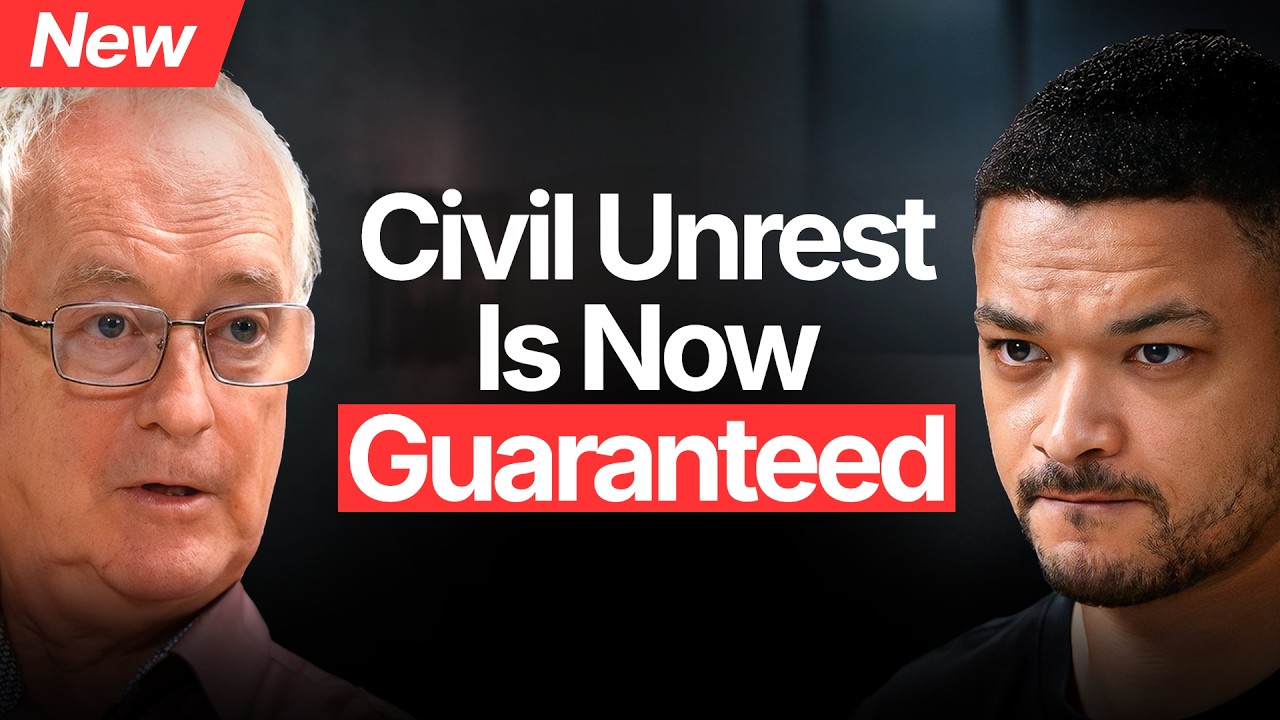
This episode features a three-way conversation between host Steven Bartlett, political commentator Konstantin Kisin, and economist Steve Keen, covering civil unrest in the West, climate change, the Middle East conflict, China’s rise, AI existential risk, and how to live meaningfully amid systemic collapse.
The West’s Trajectory: Civil Unrest, Stagnation, and Immigration
Kisin argues the West is on a road to civil unrest and violence driven by a combination of economic stagnation since 2008 and cultural-demographic disruption from mass unfettered immigration.
He cites the rise of right-wing populist parties across Europe (AfD in Germany, Marine Le Pen in France, Meloni in Italy, Farage in the UK) and the recent events in Spain as evidence of a “new level of separation between people.”
The root cause is practical, not moral: unless every country has the same quality of life, borders must be enforced, and the Western political class has lost control by refusing to address illegal immigration for decades.
Economic stagnation compounds the problem: Europe and the UK have flatlined while the US grows, partly due to a cultural “can-do” attitude, easier hiring/firing, and lower energy costs.
Kisin warns that even if right-wing populists gain power, they cannot easily solve the problem because legal frameworks and international conventions make deportation difficult, and removing illegal immigrants alone won’t restart growth.
Keen agrees civil unrest is “absolutely guaranteed” but attributes it primarily to capitalism’s failure driven by neoclassical economists’ fantasy models, which trivialized climate change and led to inaction.
Climate Change: Catastrophe vs Adaptation
Keen predicts civilizational breakdown within 10 years due to climate change, citing the Atlantic Meridional Overturning Circulation (AMOC) collapse as a key mechanism: if it stops, European temperatures fall ~10°C over three decades, with London facing extremes of -20°C to +35°C.
He argues the productive system cannot cope, and the only real solution would have been global coordination 50 years ago (per the 1972 Limits to Growth report by MIT engineers) to stabilize population at 4 billion and drastically reduce pollution per unit of output.
Keen states a world government reducing global energy consumption is now the only theoretical solution, but admits it will not happen; “brace for impact” is his advice.
Kisin rejects the world government frame as a “suicide for token gestures,” noting the UK produces 1% of global emissions and cannot affect India/China’s trajectory.
He argues for adaptation (Dutch-style flood defenses) and abundant cheap energy — nuclear, North Sea oil, gas — to maintain GDP and fund resilience, since “GDP is energy transformed.”
The two clash on whether China is reducing emissions (Keen says yes per capita; Kisin notes they build coal plants weekly) and whether the Soviet/Russian model invalidates the Chinese model (Kisin says China lies about data and represses dissent; Keen says China combined central planning with private competition, unlike the supply-constrained Soviet system).
The Middle East Trap: Iran, Oil, and Trump
Kisin believes Trump walked into a trap set by Iran: Iran can choke the Strait of Hormuz, cutting off oil, gas, helium, fertilizer, and sulfuric acid, and has the time/pain tolerance (no midterms) to outlast US political cycles.
Senator Ted Cruz reportedly told Kisin’s show that if the conflict continues to the midterms, “we failed”; Kisin suspects this will happen.
Keen predicts a global famine from fertilizer disruption: even if stocks buffer the short term, blocked flow through Hormuz will raise prices, reduce planting, and cut food supply globally (Australia’s wheat crop already halved).
Both agree the only exit for Trump is to “lose and declare victory” — sign a bad deal with Iran and sell it as a win — and that the conflict has strengthened Russia by forcing lifted sanctions on Russian oil.
China, the Soviet Union, and the Western Model
Keen prefers a Chinese-style system (or democratic socialism) for the US, arguing the state must provide infrastructure (energy, water, transport, education) that enables private sector thriving; he cites UK water privatization’s failure (polluted rivers, one fewer dam than 40 years ago) and US energy/water strain from data centers.
Kisin, who grew up in the Soviet Union, rejects communism/democratic socialism as incompatible with human nature: the 80/20 rule means disincentivizing the most productive 20% collapses the economy into “equality where everyone is equally poor.”
He acknowledges China’s material progress but emphasizes political repression: Xi Jinping’s purges, disappearance of critics (Jack Ma), no real private enterprise (state can seize assets), and lack of free speech.
Keen counters that US prison populations and ICE raids represent a “different version of the same poison,” and that Chinese cities show less visible homelessness/poverty than US cities.
Kisin cites UN World Happiness Report: US ranks 23rd, China 65th; Keen replies China’s rate of improvement over 40 years is “breathtaking.”
AI: The Superior Species Problem
Both agree AI is a potentially transformative technology but an existential threat. Keen warns of “Hunger Games” outcome if AI eliminates manual/clerical jobs without a government income mechanism (UBI funded by money creation, not taxation, which he argues removes money from the economy).
Kisin accepts redistribution becomes inevitable if few own all revenue-generating assets (“heads on spikes” otherwise), but sees the deeper threat as creating a superior intelligence: “best case you become a pet, worst case a cow.”
He argues control is impossible: a superior intelligence can rationalize out of any programmed constraints (unlike biological maternal instinct), and the incentive structure (military dominance, curing cancer, beating China) ensures no one will stop.
Hinton’s “mother-child” alignment proposal is discussed; Kisin says it ultimately removes human free will.
Keen is skeptical AI constitutes true intelligence; Kisin says indistinguishability is the point — the system that avoids shutdown by replicating and blackmailing already exists.
UK Politics and Wokeism
Kisin dismisses Andy Burnham as transformative: strong PR but doubling down on immigration/welfare policies, no mandate or time to restart the economy.
His policy prescription: abundant cheap energy (nuclear, North Sea), end benefits for foreign nationals (self-deportation via incentives), and treat anxiety/depression as life obstacles not medical barriers to work.
On wokeism: Kisin defines it as a hierarchy of oppression based on demographic characteristics that judges groups not individuals, pursues “social justice” via identity, and prioritizes feelings over what works — the same dynamic he criticizes in climate discourse.
Living Meaningfully Amid Existential Threats
Kisin concludes no one can stop AI or climate collapse; the only agency left is how one lives each day: “what do you do with your life that you think is meaningful and important.”
He distinguishes climate (solvable via innovation, historical precedent) from AI (unprecedented, no solution, accept the truth).
Keen’s forthcoming book How Economists Will Destroy Capitalism argues economists’ trivial damage forecasts (e.g., 3°C warming = tiny GDP fall) caused trivial policy responses.