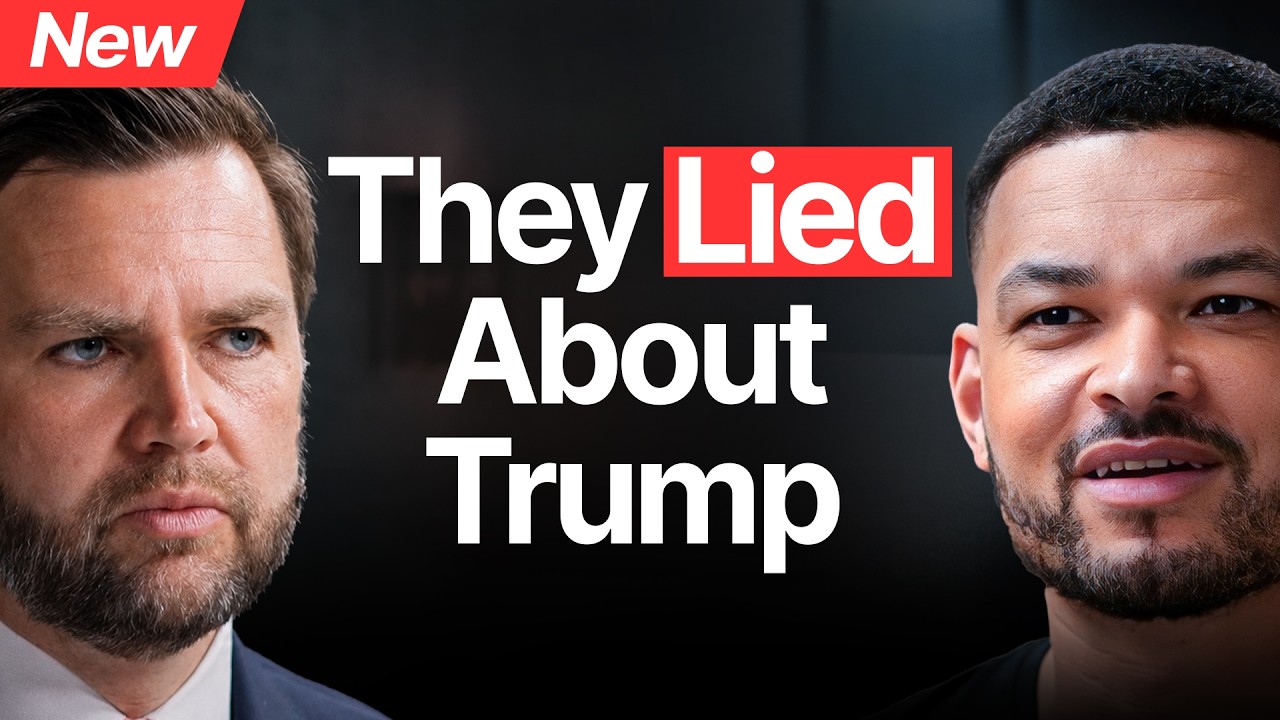
US Vice President JD Vance sits down for a wide-ranging interview covering his journey from childhood poverty in Appalachia to the vice presidency, his evolving relationship with Donald Trump, the recent Iran peace deal, the role of faith in his life, and the future challenges posed by artificial intelligence.
How Childhood Shaped Who You Became
Vance grew up in a working-class family in Eastern Kentucky and later Ohio, marked by economic hardship, family instability, and his mother’s severe opioid addiction.
His grandmother, whom he calls “Mamaw,” was the stabilizing force in his life, raising him largely on her own and instilling toughness and discipline.
His mother, Beverly, struggled with addiction for much of his childhood, cycling through prescription drugs and heroin, nearly bankrupting his grandparents, but has now been clean and sober for 11 years.
His grandfather, Papaw, served as his mother’s anchor; after his death, her addiction spiraled further.
Vance was adopted by his mother’s third husband, Robert Hamill, who left the family when Vance was around 12, adding to a pattern of father figures disappearing from his life.
He describes his childhood home as chaotic, with frequent fighting, thrown plates, and relationship instability that he later recognized as deeply unhealthy.
How Childhood Trauma Shapes Adults
Vance credits his grandmother as the “anchor” that child psychology literature identifies as the key difference between kids from chaotic environments who thrive and those who don’t.
She was both a mother and father figure, extraordinarily tough, and kept him on track through sheer willpower.
He recalls her threatening to run over a neighborhood kid who was leading him astray, and he believed her completely.
The trauma of his upbringing left him with deep mistrust, an assumption that the world is unstable, and an avoidant attachment style in relationships.
He describes intrusive thoughts during happy moments, like imagining a drunk driver hitting his wife while she’s driving to the grocery store.
The flip side is a high empathy quotient: having seen people at their best and worst, he tends to assume the best about individuals even when circumstances are chaotic.
He never went to couples therapy, finding it too uncomfortable and too focused on blaming others rather than taking personal agency, but he and his wife Usha have worked through their differences over time.
Why You Joined The Marine Corps
Vance enlisted in the Marine Corps in 2003, motivated by a sense of patriotic duty after 9/11 and a feeling that his generation needed to answer the call the way World War II veterans had.
He served in Iraq from 2005 to 2006 and came away with deep respect for the institution and the people but growing disillusionment with political leadership.
He remains angry at George W. Bush for what he sees as exploiting the nation’s patriotic reservoir to justify a war based on bad information.
He believes Bush drew down a “social contract built on trust” by misleading the public about Iraq, and that the percentage of young Americans willing to die for their country has dropped significantly since 2003.
The War With Iran
Vance describes a recently announced ceasefire and peace agreement with Iran, which he says is genuine and backed by a signed term sheet, unlike previous false starts.
The primary US objective was always to degrade Iran’s conventional military power so that whoever leads Iran no longer has a “loaded gun” aimed at the West.
There was initial hope that the Iranian street would rise up and install a pro-Western government, but that did not materialize; instead, the focus shifted to military degradation and negotiation.
The Iranian political system has three poles: political leaders, clerics (who hold ultimate authority through the supreme leader), and the military (particularly the IRGC). Two months ago, it was unclear who was in charge, but the system has since coalesced enough for meaningful negotiation.
What’s Inside The Iran Term Sheet
The term sheet includes several key provisions:
The Strait of Hormuz reopens, with demining and a cessation of Iranian attacks on shipping; a naval blockade is lifted.
Iran commits to giving up its highly enriched uranium stockpile, submitting to a long-term nuclear inspections regime, and working with the US and the IAEA to destroy the material.
In exchange, the US offers to lift sanctions (currently a 60-page stack) and reintegrate Iran into the world economy, contingent on verifiable commitments never to develop nuclear weapons.
A permanent cessation of hostilities is contemplated.
Vance acknowledges that verification details are still being worked out, but expresses confidence that the deal is real and that Iran’s leverage through the Strait of Hormuz was weakening over time as oil traffic resumed.
Trump’s Message To Netanyahu
Trump publicly criticized Israeli Prime Minister Netanyahu, calling him “a very difficult guy” and expressing anger that Israel launched attacks shortly before the Iran deal was to be signed.
Vance says the US and Israel are close partners but have different interests and are not always aligned; he is clear that the US is the senior partner.
He does not trust any country unconditionally, including Israel, and believes the US must always pursue its own interests first.
When asked what Netanyahu wants, Vance says he doesn’t know and hasn’t had that conversation, though he speculates that some in Israeli society might want to turn Iran into a failed state, which would not be in America’s interest.
Why Your Views On Trump Changed
In 2016, Vance wrote a piece in The Atlantic calling Trump “cultural heroin” and privately referred to him as “America’s Hitler.” He believed Trump would be a failed president and that American institutions were fundamentally sound.
He changed his mind based on what he observed from the outside: Trump was not a failed president, American institutions were not functioning well, and the military and expert class that Vance had trusted had presided over decades of failed wars and poor pandemic response.
Once he got to know Trump personally, he found him warm, generous, hospitable, and far smarter than the media portrayed him, with an instinctual understanding of people that Vance considers unmatched.
Vance endorsed Trump very early in the 2023 campaign cycle, and they grew close through shared work on issues like the East Palestine, Ohio train derailment.
The Call To Become Vice President
Trump asked Vance to be his running mate in an in-person conversation in Milwaukee on the morning of the July 13, 2024 assassination attempt, just hours before the formal nomination deadline.
Vance had been discussing Pokémon cards with his son when the Secret Service arrived to move the family into a protective bubble, and his life changed instantly.
He admits he had no idea what he was signing up for, particularly the impact on his children. His nine-year-old son struggled with the attention and loss of normalcy, telling his father, “I just want everyone to go back to treating us like they used to.”
Vance wrote in his book Communion that he sometimes feels like he ruined his son’s life without asking him, but has worked to contextualize the sacrifice by emphasizing the unique experiences and blessings the role brings.
Why Faith Came Back Into Your Life
Vance was raised in an evangelical household but became an atheist in his early 20s, driven by intellectual arrogance and a desire to rise above his upbringing.
He describes his atheism as “the perfect philosophy for the creed of a kid who just wanted to get ahead,” focused on credentials, prestige, and income rather than character.
While at Yale Law School, he realized he was not a good person or a good boyfriend despite his achievements, and began to notice that the most virtuous people he admired were Christians whose faith motivated character and service rather than ambition.
His return to faith was gradual, first intellectual then emotional and practical; he eventually got baptized and now takes his family to church every week, even though his wife Usha is not Christian.
What AI Means For America’s Future
Vance is less worried about AI causing mass unemployment than about AI dramatically increasing inequality, drawing a parallel to the Industrial Revolution, which made rich people much richer and led to fascism and communism in Europe.
He is skeptical of the dystopian predictions from AI CEOs, noting they have an incentive to make their products seem more powerful and transformative than they may be.
He believes the real danger is that a small number of companies accumulate trillions in wealth while average workers stagnate, creating the kind of relative poverty that destabilizes societies.
He is also deeply concerned about AI-powered surveillance and the potential for social credit systems that restrict people’s freedoms based on opaque algorithms.
On redistribution, Vance is skeptical of simply taxing the rich and giving to the poor, calling that a “liberal concept” that makes the poor subservient. Instead, he advocates for “predistribution” — giving workers a seat at the bargaining table through mechanisms like collective bargaining.
He references Pope Leo XIII’s encyclical on capital and labor as a Christian model for social harmony, where workers can bargain and capitalists respect them.
He supports the idea of the US taking a stake in major AI companies, similar to a sovereign wealth fund, as a way to give the public a direct stake in the wealth created.
He also raises the cultural dimension: as AI transforms the content we consume, there needs to be a mechanism for ordinary people to have input, the way Hollywood once consulted religious leaders to ensure content reflected broadly shared values.
What Mamaw Would Think Today
Vance’s grandmother died when he was 21, before he achieved any of his later success. He believes she would be amazed by the pageantry and the White House but would also worry about him “getting too big for his britches.”
Her lesson was to never think you’re better than anyone because of a title or money, and Vance says he has to constantly remind himself of this.
His biggest regret is that Mamaw never met his wife Usha; he sees similarities between them — both incredibly smart, blunt, and from very different worlds.
He did not cry when she died, holding it together for his family, but grieved deeply afterward and still feels the emotion on the surface.
Are Aliens Real?
Vance says he believes aliens could be real, pointing to his broader worldview that includes belief in mystical experiences, miracles, and things that cannot be explained by a purely rational framework.
He has committed to reviewing classified UFO information but hasn’t yet done so due to the demands of the job.
He shares personal anecdotes, including a light bulb exploding during a moment of frustration after his grandmother’s death and a glass falling and shattering inexplicably during a conversation, which he interprets as possible signs of a reality beyond the purely material.