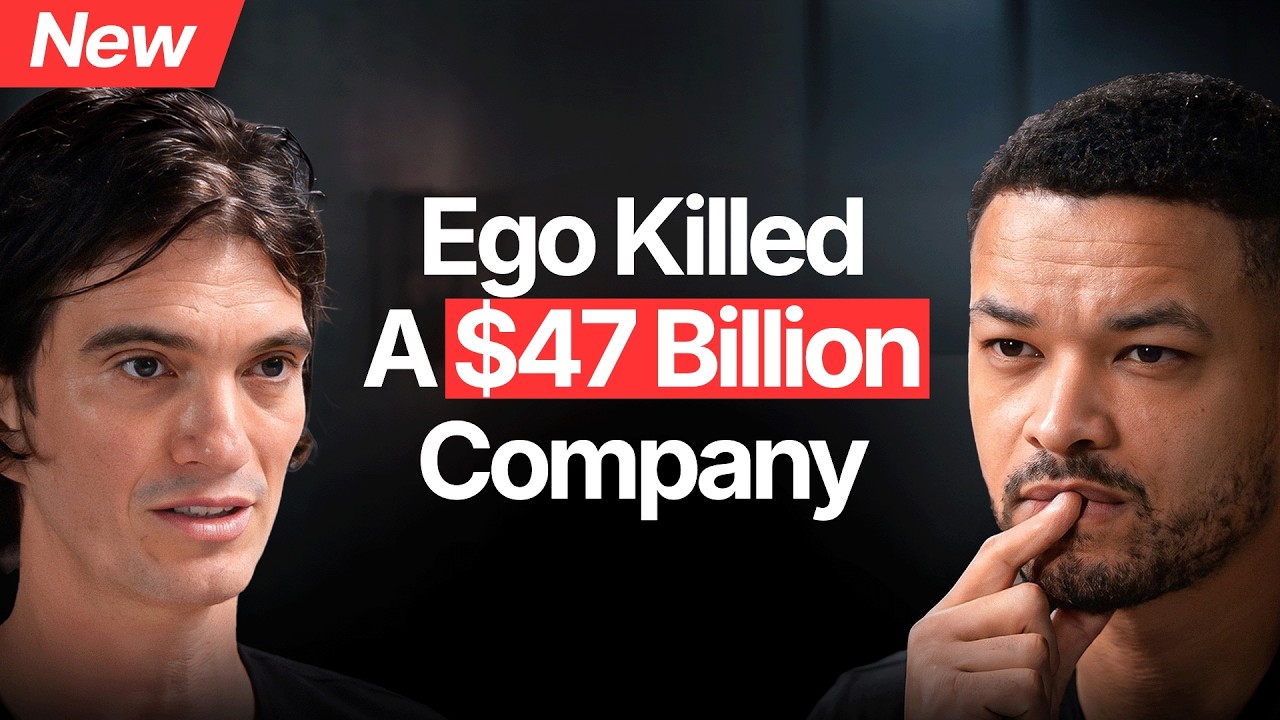
Adam Neumann, founder of WeWork and Flow, recounts his journey from a traumatic childhood through WeWork’s meteoric rise and catastrophic collapse to his current philosophy on leadership, partnership, and personal growth. The conversation traces how early instability forged resilience, how spiritual practice reframed his definition of success, how unchecked ego and misaligned investors derailed WeWork, and how his wife Rebecca became the anchor that allowed him to rebuild.
Early life and the origins of resilience
Neumann grew up with a bipolar mother who threatened suicide and threw dishes; at age 12 he physically wrestled a knife from her to prevent her killing herself in front of him and his sister.
Between second and fourth grade he was sexually abused by an older teenager, a fact he did not recognize as abnormal until Rebecca pointed it out years later.
His parents divorced when he was in second grade; his mother moved him and his sister to the U.S., where they had no extended family and she worked long hours as an oncologist.
He internalized a drive to “become very successful and take care of us,” which initially manifested as a desire for money — wanting to be a millionaire at 16, a billionaire at 21.
Three failed businesses preceded WeWork; the turning point was meeting Rebecca, who told him chasing money would never fulfill him and challenged him to find his superpower and attach it to a meaningful mission.
Spiritual practice and redefining success
Rebecca introduced him to Kabbalah; the core lesson was the interplay of “meant to be” and free choice: you choose a path, face the consequences, learn, and transform catastrophe into blessing.
His definition of success shifted to the deathbed test: how much love surrounds you in your final minute, and whether you feel full or regretful; hell is the gap between your soul’s potential and where you actually arrived.
He believes belief is only measured when everything is crashing — not when valuations are soaring — and that the darkest moment of night is a second before dawn.
A daily technology Shabbat (24–25 hours off all screens) is his most effective practice for clarity, idea generation, and reconnecting with family; he challenged the interviewer to try it once in September.
Green Desk to WeWork: mission-driven growth
Green Desk began in 2008 when a landlord challenged Neumann to do something with an empty floor; they subdivided it, filled it in a week, and cash-flowed within a month.
The WeWork vision was drawn on a glass wall in 2010: a circle encompassing work, live, give, share, travel, health, social life, friends, fintech — “a factory of dreams,” not desks and chairs.
First principles thinking drove cost and speed: when floor quotes came in at $30–45k, Neumann broke down materials and labor, offered contractors 15% margin, and got the first floor done for $12k, eventually building an internal construction company.
Culture was the engine: mission greater than self created urgency; team believed they were part of something bigger; leaders emerged from within as the company scaled from one building to two buildings a day across 130 cities, 50 countries, 70 languages.
Neumann admits his superpower is creation (zero-to-one), not protection; he needs partners who can say “not now” to keep focus on three to five priorities instead of ten to fifteen.
SoftBank, Masa Son, and the $4.2B investment
In December 2016, Masa Son met Neumann for 12 minutes in a car ride; Son smelled “dreams,” not waffles, and within 28 minutes committed $4.2B across WeWork global, China, Japan, and Southeast Asia at a $20B valuation.
Neumann walked back to HQ (36 blocks) and let ego take over: valuation math, personal net worth, money — the mission evaporated and he became blinded, making worse decisions as the company grew faster than he could grow.
Mark Benioff advised him to reject Masa, go public at $5B, learn to be a public CEO, and let valuation grow organically; Neumann didn’t listen because trust wasn’t deep enough.
In March 2018, Masa offered to buy the company for $20B all-cash ($10B to investors, $10B to balance sheet), keeping Neumann and management at 30% with a path to 51%; Benchmark-led special committee negotiated for seven months, pushing for $32B, and the deal collapsed when SoftBank’s stock fell.
Forced IPO, resignation, and the bank ambush
With the buyout dead, WeWork was forced into an IPO it wasn’t ready for: systems couldn’t show unit economics (building vs. floor vs. corner profitability), tech wasn’t SOX-compliant, and Masa begged Neumann not to go public.
The S-1 filed August 2019 showed $3B cumulative losses; Neumann trademarked “We” and licensed it back (he disputes the narrative), but the core issue was founder unreadiness, not the filings.
Neumann stepped down as CEO voluntarily in September 2019, retaining board control, after a major bank promised $2B funding and assured his $460M personal debt would be handled; 9 minutes later the bank sent a default notice demanding repayment in 15 days or they’d seize his super-voting shares and take control.
Masa paid the $460M debt, took control of the company, and Neumann walked away with a settlement that was later halved to $1.5B after SoftBank invoked force majeure during COVID.
Rebecca as the rock and the power of partnership
Waking up crying that he’d lost everything, Rebecca reminded him: her mother owned a mortgage-free house in upstate NY, they could live there, and if he wanted back in business she’d support it; if not, they’d move to Costa Rica and surf.
That moment — realizing he had a partner who would stand with him in the dark — was the first time he felt like an adult instead of the terrified child.
During the final settlement negotiation, Rebecca rejected the delayed-payment deal four days before her scheduled C-section, telling Neumann’s lawyer “your wife didn’t agree”; the money hit the account at 4:30 AM, she gave birth at 8:00 AM.
Neumann’s criteria for life partner, friends, and business partners: choose for the worst day, not the best; do they make you the best version of yourself? Will they stand with you when only your dark side shows?
Lessons for founders and the philosophy of Flow
If business grows faster than the founder can grow, something cracks — ego, money, relationships, systems. Founders must do the internal work (meditation, Shabbat, honest self-inventory) to expand capacity before chasing external scale.
Hard work is not hours in the office; it’s time on the business, on yourself, on your marriage, on your kids. 100% commitment means no room for doubt, fear, or hedging — but 100% looks different for everyone (Buffett keeps an open calendar).
Investors must be chosen for how they behave when the founder is at their worst, not their best. A16Z (Marc Andreessen, Ben Horowitz) backed Flow with $470M and Neumann put in $350M personally; board meetings are 9-hour deep dives ending with “tell me what I can do better.”
Flow applies WeWork’s lessons: connected technology that knows profitability per square foot, management deals instead of long leases, schools as the #1 amenity, and a culture of influence over control — great talent wants inspiration and feedback, not top-down commands.
Five closing lessons: (1) Choose partners for the worst day. (2) Life is about how you get up, not that you fall. (3) Choose a partner who makes you the best version of yourself. (4) Control comes from influence earned daily, not power. (5) Know yourself so you can live your destiny.