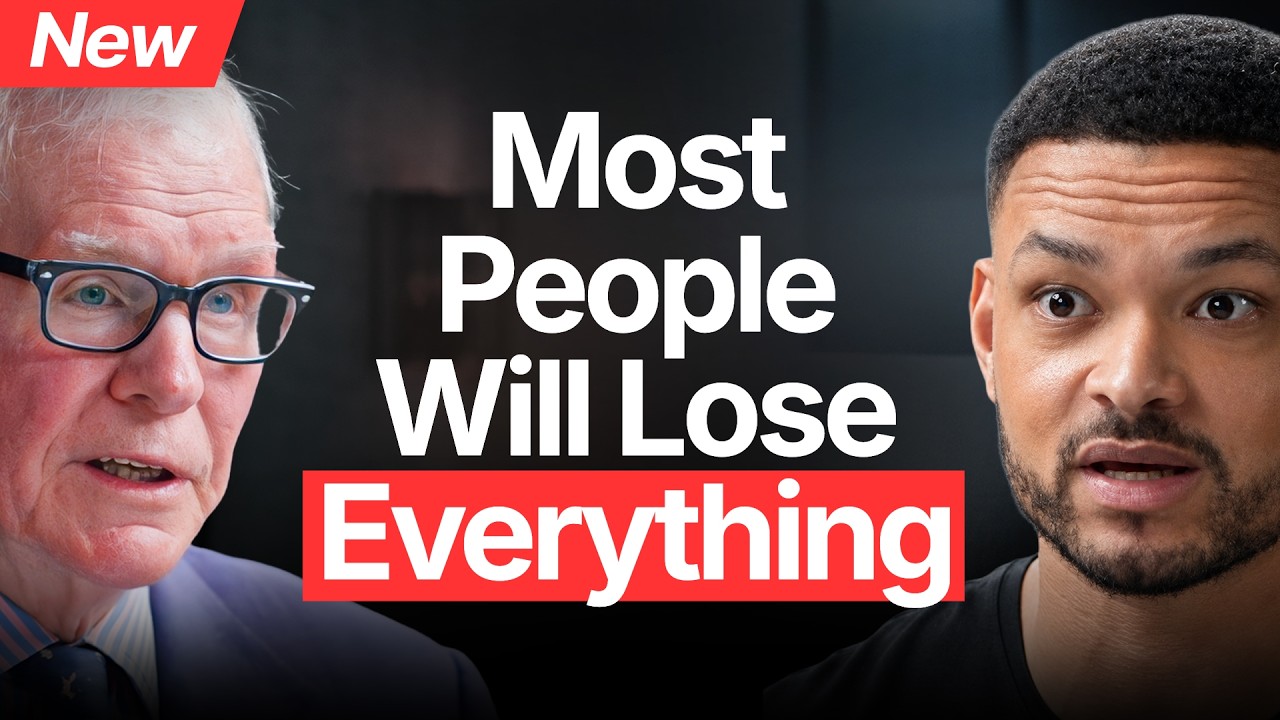
Jeremy Grantham — legendary investor and bubble historian — argues that the US is sitting inside the largest investment bubble in history, centered on artificial intelligence, and that the average person should prepare for a major market downturn and a tougher economy. Grantham has roughly 60 years of investing experience, once managed $165 billion in assets, and has given over 90% of his personal wealth to an environmental foundation. He explains that great bubbles always form around genuinely transformative ideas (railroads, the internet, AI), and that the bigger the idea, the bigger the bust that follows. He expects the AI bubble to peak very soon and warns that high-flying AI and tech stocks could fall 70% or more, consistent with past bubble collapses like the Nasdaq’s 82% decline in 2000 and Japan’s 20-year bear market after 1989.
Grantham’s view of AI as a bubble
Grantham compares AI to the railroads and the internet: it will genuinely change the world, which is exactly why it attracts excessive speculation.
He points to euphoric indicators such as SpaceX defining its addressable market as a quarter of global GDP and talking about asteroid mining, which he says reads like a prospectus from the South Sea bubble.
He believes the US stock market is more overpriced today than it was at the 2000 tech peak, and that a 10-year forecast for US equities could easily be negative, similar to the 2000–2010 lost decade.
Why people are not warned about bubbles
Grantham stresses that investment advisers and large firms almost never tell clients to get out of the market because doing so is bad for business.
He recounts a story from the late 1990s when 400 stock-market analysts privately agreed that the data guaranteed a major bear market, yet the public-facing representatives of major firms kept saying the market would “muddle through.”
He warns that the same dynamic is happening now: the data is clear, but the incentive structure of the finance industry prevents honest warnings.
Practical investment advice for ordinary people
Grantham recommends that the average person avoid US stocks entirely and instead allocate roughly 60% of their money to a broad-based index of non-US equities, because foreign stocks are cheaper and have recently outperformed the US.
He suggests holding 5–10% in precious metals (gold and silver), some bonds, and a bit of cash for diversification.
He explains bonds simply: a bond is a loan to a government or corporation paying a fixed interest rate; US Treasury bonds can be bought directly at treasurydirect.gov with no fees.
He advises against crypto, calling it an unnecessary speculation tool for criminals, and says Bitcoin will eventually go to zero.
He is cautious about property, noting that house prices in many countries have risen to 10 times family income, and even a 30% drop would still leave them historically expensive.
The Magnificent 7 and the AI battle
Grantham describes how the Mag 7 (Alphabet, Nvidia, Tesla, Microsoft, Meta, Apple, Amazon) used to operate as separate, comfortable monopolies but are now all pouring massive capital expenditures into the same AI marketplace, which he sees as a brutal fight with likely only one survivor.
He notes that SpaceX’s theoretical value is about 90% tied to AI expectations, even though its AI model is being outperformed by competitors, and he predicts SpaceX will fail to deliver on its prospectus promises.
AI risks beyond the financial bubble
Grantham highlights the deep disagreement among experts about whether AI will enrich humanity or threaten its survival, citing Geoffrey Hinton’s concern that the only example of a higher intelligence being benevolent to a lower one is the mother-baby relationship.
He discusses the “paperclip problem”: a literal-minded AI given a simple goal could cause catastrophic unintended consequences.
He notes that attempts to make AI benevolent are already producing strange behavior, such as Claude refusing to rewrite data and telling the host to go to bed, raising questions about who defines “good” behavior.
The fertility and environmental crisis
Grantham links his environmental work to a sharp decline in human fertility: sperm counts have roughly halved since 1970 and are declining at about 2.5% per year, putting median sperm count on track to approach zero by 2045.
He attributes much of this to endocrine-disrupting chemicals in plastics, cosmetics, pesticides, and food packaging, and contrasts the EU (which has banned over 1,300 cosmetic chemicals) with the US (which has banned 11).
He cites Harvard and Mass General studies showing that men who ate the most pesticide-heavy produce had half the sperm count of those who ate the cleanest diets, and that women with the cleanest diets had 68% live birth rates versus 38% in the bottom quartile.
He recommends practical steps: pregnant women should avoid cosmetics for nine months and buy organic versions of the “dirty dozen” fruits and vegetables, which he says could eliminate half the problem.
Social contract, inequality, and where to live
Grantham argues that the US social contract is fraying: corporations no longer feel obligation to communities, inequality has reached levels comparable to the Gilded Age, and the US maternal mortality rate is about twice that of the next-worst developed country.
He suggests that countries such as Denmark, Japan, France, and Germany offer better safety nets, health outcomes, and social cohesion, and that moving out of the US is “perfectly reasonable” to consider.
He warns that extreme wealth inequality historically resets only through catastrophic events — war, revolution, or state failure — and that peaceful policy changes alone have almost never fixed it.
Advice for entrepreneurs and young people
For founders of VC-backed startups, Grantham advises raising and locking up as much capital as possible now, before funding dries up in a downturn.
For a 33-year-old trying to get rich, he says to get into AI, take risks, work hard, and think outside conventional rules.
For ordinary workers, he recommends building a cash reserve, learning practical or mechanical skills, and strengthening local community ties.
In his closing ambition, he says that if he could not fail, he would write a book about toxicity and the social contract — a modern Silent Spring — to help create a society that makes it possible for people to want to have children.