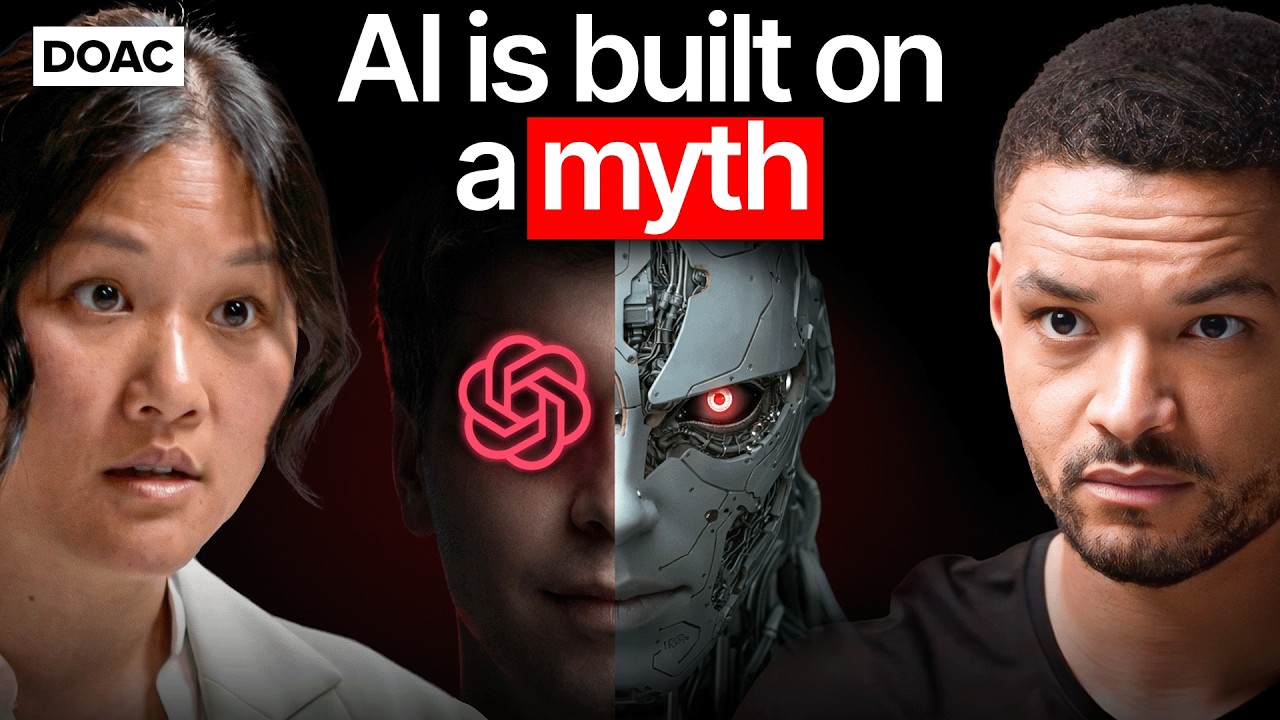
- Karen Hao spent over eight years covering the AI industry, conducting more than 300 interviews — including over 90 with current and former OpenAI employees and executives — to write Empire of AI, a book that argues the major AI companies operate like historical empires: extracting resources, exploiting labor, monopolizing knowledge, and using myth-making to justify an anti-democratic concentration of power. She contends that while AI has genuine utility, the way it is being developed right now is exacting enormous harm on vulnerable people, communities, and the environment — and that the same capabilities could be built in far less destructive ways.
The Origins of AI’s Imperial Structure
-
The field was founded on an undefined goal. In 1956, John McCarthy named the discipline “artificial intelligence” at Dartmouth, despite no scientific consensus on what human intelligence actually is. Every historical attempt to quantify intelligence has been driven by a desire to rank groups of people as superior or inferior. This means the industry’s ultimate benchmark — AGI, or artificial general intelligence — has no coherent definition.
- OpenAI alone has defined AGI differently depending on the audience: to Congress, it cures cancer and solves climate change; to consumers, it is the best digital assistant; to Microsoft, it is a system generating $100 billion in revenue; on its own website, it is systems that outperform humans in economically valuable work.
- These shifting definitions are not accidental — they are tools to mobilize capital, ward off regulation, and sustain public buy-in.
-
The “evil empire” narrative is a core part of the mythology. AI companies justify their resource grabs by arguing that if they don’t build AGI first, a rival will — and that rival will be malevolent. In OpenAI’s early days, the evil empire was Google; today it is typically China. This framing is used to argue that no one else can be trusted with the technology and that democratic oversight is a luxury the world cannot afford.
Sam Altman, Elon Musk, and the Power Struggle at OpenAI
-
Sam Altman’s relationship with Elon Musk was shaped by strategic language. In 2015, when Altman was trying to recruit Musk as a co-founder, he wrote a blog post framing AI as an existential threat to humanity — mirroring Musk’s own rhetoric almost exactly. Altman had previously focused on engineered viruses as the primary threat; he pivoted his language specifically to appeal to Musk.
-
Musk was muscled out of OpenAI. When OpenAI decided to create a for-profit entity, the initial choice for CEO was Musk. Altman personally appealed to CTO Greg Brockman, arguing that Musk was too unpredictable and erratic to control a technology this powerful. Brockman convinced chief scientist Ilya Sutskever, and the two switched their support to Altman. Musk left the company, and the personal vendetta between him and Altman continues in ongoing litigation.
-
Altman is a deeply polarizing figure. Among the 250+ people Hao interviewed, no one had neutral feelings about him. Those who share his vision see him as the Steve Jobs of this generation — brilliant at storytelling, recruiting talent, and mobilizing capital. Those who disagree with his vision describe him as manipulative and dishonest. Dario Amodei, who was an OpenAI executive before founding Anthropic, is a key example: he initially believed he and Altman were aligned, then came to feel that Altman had used his skills to build a future he fundamentally opposed.
The Board’s Attempt to Fire Altman — and Why It Failed
-
Ilya Sutskever raised the alarm. Sutskever, who co-founded OpenAI and genuinely believed in building AGI safely, became convinced that Altman was undermining both goals. He saw Altman pitting teams against each other, creating an environment of distrust, and making decisions that prioritized speed and fundraising over safety and sound research.
-
Sutskever approached independent board member Helen Toner. Afraid of retaliation, he cautiously tested whether Toner shared his concerns. This led to a series of conversations involving CTO Miriam Moradi and the three independent board members, who concluded that Altman’s behavior was creating dangerous instability in a company building what they believed could be a world-altering technology.
-
The board fired Altman in secret, without warning stakeholders. Microsoft — OpenAI’s lead investor — was told only minutes before the decision was executed. The secrecy backfired: employees, investors, and partners were furious at being excluded, and a massive campaign to reinstate Altman followed. He was restored as CEO within days. Sutskever never returned to OpenAI; Moradi left shortly after.
-
A pattern of splintering. Almost every senior leader who helped found or build OpenAI has left after clashing with Altman and started a competing company: Musk founded xAI, Amodei founded Anthropic, Sutskever founded Safe Super Intelligence, and Moradi founded Thinking Machines Lab. Each wants to build AI in their own image.
The Myth-Making Machine
-
AI executives use existential risk as a fundraising and power-consolidation tool. Altman publicly says the worst case is “lights out for everyone” while the best case is curing cancer and creating abundance. Amodei has said there is a 10–25% chance of catastrophic or existential harm. Hao argues these statements should not be read as genuine predictions but as speech acts designed to persuade the public, investors, and policymakers to cede more power and resources to these individuals.
-
The Dune analogy. Hao compares the AI world to Frank Herbert’s Dune, where myths are deliberately seeded on planets to control populations. Paul Atreides steps into a messianic myth knowing it is fabricated, but over time the line between performance and belief blurs. Similarly, AI executives engage in deliberate mythmaking — dazzling demos, utopian mission statements, apocalyptic warnings — and many eventually lose themselves in the narrative they’ve created.
-
Cognitive dissonance sustains the system. These companies must raise enormous capital to fund data centers and research. Executors cannot simultaneously fundraise and honestly say there is a meaningful chance the technology will destroy their investors’ children’s futures. The brain resolves this by dismissing one of the two conflicting beliefs.
The Real-World Costs: Labor, Environment, and Public Health
-
Data annotation is the hidden labor engine of AI. Before ChatGPT could chat, tens of thousands of human contractors typed into large language models, showing them how to respond to prompts. This work has not decreased over the seven years Hao has covered it — it has increased, because each new generation of models requires more annotation.
- Data annotation is now one of the top jobs by growth on LinkedIn. Many of the workers are highly educated — PhDs, lawyers, doctors, award-winning directors — who were laid off and can find nothing else.
- A New York Magazine piece documented how these workers are pitted against each other by third-party firms competing to offer the cheapest, fastest labor. Workers described waiting anxiously for Slack pings announcing project openings, then tasking furiously — unable to go to the bathroom or care for their children — because the window of paid work is unpredictable and brief.
- One woman described screaming at her child for distracting her during a data annotation session, then realizing she had “become a monster.” Her expertise was being devalued and harvested to train the very models that would eliminate more jobs.
-
The career ladder is being broken. Entry-level and mid-tier jobs are being automated away. What remains are higher-order roles (deep expertise, orchestration of AI agents) and much lower-order roles (data annotation, content moderation). The rungs in between are disappearing, making it harder for people to progress in their careers.
-
Klarna’s CEO Sebastian Siemiatkowski provided a real-world example. Klarna went from 7,400 employees to 3,300 through natural attrition, not layoffs, while doubling revenue. AI now handles 70% of customer service conversations. He argues the value of human interaction will increase in a world where AI is cheap — but this perspective comes from a business owner who gets to make that choice, not from the workers whose jobs disappeared.
-
Environmental and health costs fall on vulnerable communities. OpenAI’s data center in Abilene, Texas, will be the size of Central Park, run a million chips, and consume more than 20% of New York City’s power. Meta’s facility in Louisiana will be four times larger and use half of NYC’s average power demand.
- These facilities increase utility costs, decrease grid reliability, and consume fresh water — sometimes in communities already under drought.
- In Memphis, Tennessee, Musk’s xAI built the Colossus supercomputer powered by 35 methane gas turbines. The surrounding working-class Black and brown community discovered the facility because they smelled what seemed like gas leak in their homes. The turbines pump thousands of toxins into the air, exacerbating asthma in children and respiratory illnesses in a community that already had among the highest rates of lung cancer.
The Flawed Logic of the “AI Arms Race”
-
The China argument does not hold up under scrutiny. The claim that “if we don’t build it first, China will” rests on several assumptions that Hao challenges:
- These systems are not generally intelligent. They have what researchers call a “jagged frontier” — some capabilities are excellent, others are poor. Companies choose which capabilities to advance based on which industries will pay the most (finance, law, medicine, commerce), not military or cyber capabilities specifically.
- Scaling statistical models is not the same as gaining intelligence. A calculator is faster than a human at math but is not intelligent. These models are statistical engines that make errors probabilistically and cannot be made error-free.
- The analogy to human intelligence is itself a hypothesis, not a proven fact. Ilya Sutskever and his mentor Geoffrey Hinton believe the brain is a statistical engine, but this view is contested by neuroscientists and psychologists who study actual human cognition.
-
Self-driving car predictions have been wrong for over a decade. Despite massive investment, only a small fraction of cars on US roads are autonomous. Safety improvements are real but geographically limited — a car trained in Austin may be unsafe in Mumbai. Legal liability remains unresolved. Elon Musk has been wrong on timing before, even if he is often directionally right.
-
Job disruption is real but not inevitable or uniform. The US jobs report shows a slowdown in white-collar hiring. Anthropic’s research found a 40% reduction in entry-level job postings in fields where AI models are capable. But job losses are also driven by executive decisions — some CEOs lay off workers because they believe AI can replace them even when the technology isn’t ready, or because it is a convenient excuse to downsize after over-hiring.
What Can Be Done
-
Hao’s north star: break up the empires, not the technology. She compares AI to transportation — we don’t use rockets to get from Dallas to Austin. Current large-scale models are the “rockets of AI”: they provide dramatic benefits to some but exact enormous costs on many. Alternatives exist, like DeepMind’s AlphaFold, which uses small curated datasets, requires far less computational resources, won the Nobel Prize in chemistry, and accelerates drug discovery. These are the “bicycles of AI.”
-
People are already pushing back. Eighty percent of Americans want the AI industry regulated — a rare point of consensus. Dozens of protests against data centers have broken out across the US and globally, stalling or blocking projects. Artists and writers are suing for intellectual property infringement. Parents whose children were harmed by AI chatbots are suing the companies, sparking public conversation about the human cost.
-
Practical steps for individuals:
- Withhold your data where possible — support mechanisms that prevent companies from training on your content without consent.
- Engage in local and state-level conversations about AI adoption policies in schools, workplaces, and communities.
- Oppose data center construction in your area if it threatens water resources, air quality, or grid reliability.
- Support the development of alternative AI systems that are resource-efficient and broadly beneficial.
-
The core argument is not anti-technology. Hao emphasizes that AI has genuine utility and that the tension between its benefits and its harms is unnecessary. The same capabilities could be developed with more efficient methods, less resource consumption, and a political economy that distributes value fairly rather than extracting it from the many for the benefit of the few.