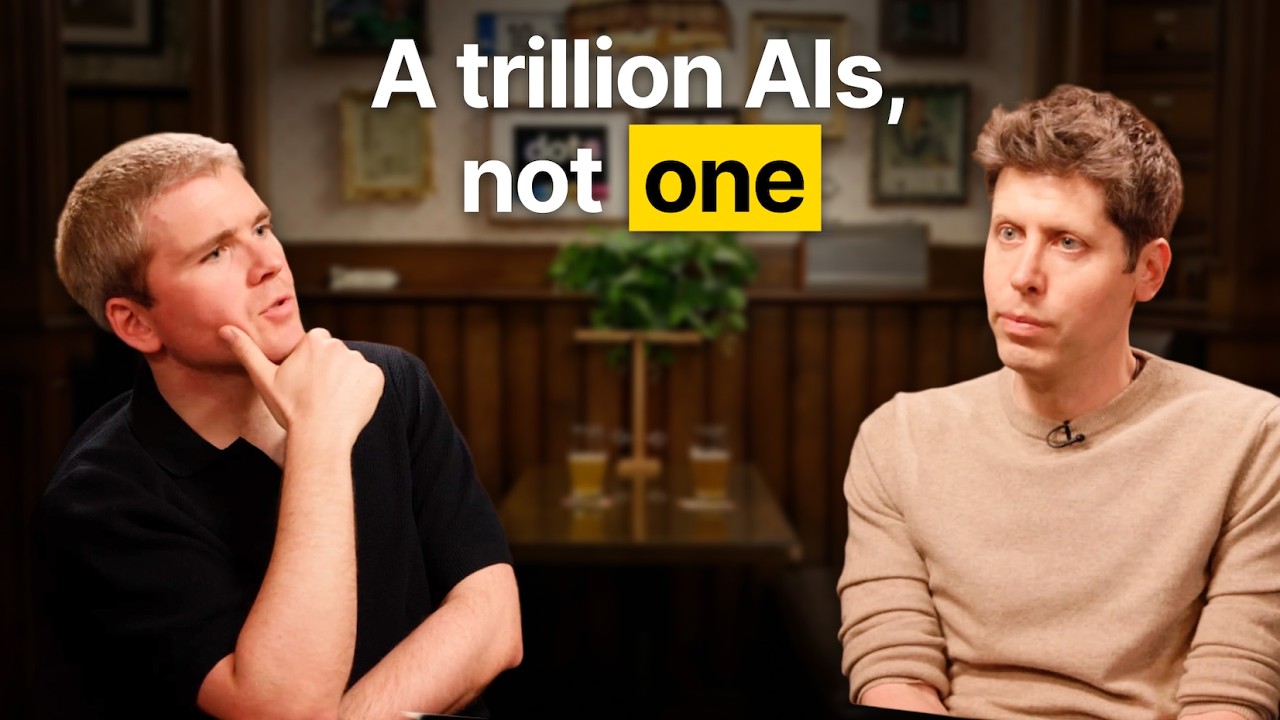
Sam Altman and a counterpart discuss the trajectory of AI capabilities, safety, and deployment over drinks, covering vulnerability discovery, agent architectures, compute economics, scientific discovery, and the shifting relationship between humans and AI systems.
AI-driven vulnerability discovery and software architecture
AI models are rapidly improving at finding vulnerabilities in existing codebases, and widespread automated scanning will reveal far more serious vulnerabilities than previously expected.
Fixing software alone is insufficient; architectures must be redesigned for a world where models continuously grow more capable, and a new generation of startups is already building new stacks (routers, operating systems, application architectures) assuming this trajectory.
The global software upgrade will likely involve both rewriting critical systems in safer languages (e.g., Rust) and re-architecting fundamental primitives, creating massive demand for software consulting and new infrastructure companies.
Early-internet energy and generational shift
The current creative unleash — especially among children building complete 3D games in minutes — mirrors the early internet era, but with a key difference: today’s kids will never be “mind-blown” because they expect the computer to make anything they imagine.
A telling moment at OpenAI: when Codex went down, experienced engineers realized they had partially forgotten how to code without AI assistance, analogous to earlier generations relying on assembly or punch cards.
Cyber capabilities, iterative deployment, and the “sales pitch” problem
Models are becoming very good at cyber offense, but the field has done a poor job explaining why the downsides are worth it; the prevailing narrative (cure cancer, then surveillance state, then joblessness) is a terrible sales pitch.
OpenAI’s commitment to iterative deployment — putting tools in users’ hands rather than hoarding capabilities — is the only viable path: people must experience AI enabling a better life they define for themselves, not just receiving UBI while a few decide the future.
Building a capability overhang (keeping advances internal) is dangerous; the exploits get headlines, but prevented exploits (using models for defense) do not, and early evidence shows defenders can use models effectively for patching and scanning.
Sandboxing, monitoring, and alignment as the ultimate safety layer
Sandboxing works to a point, monitoring (chain-of-thought, activation inspection) works further, but ultimately safety requires high-confidence alignment: models that faithfully follow operator intent and value human control indefinitely.
A theoretical model a million times smarter than the best human researcher cannot be trusted in a sandbox unless alignment is certain; the sandbox itself must be built by aligned models.
Agent teams (not “swarms”) are a promising direction: they mirror society’s robustness through pluralism, offense-defense dynamics, and competing incentives, and a trillion slightly-superhuman agents are preferable to one trillion-IQ monolith.
Agent teams, test-time compute, and the widening productivity gap
Agent teams became viable only after chain-of-thought and test-time compute allowed throwing massive compute at single problems; previously, even GPT-4 could not productively use more than ~$1 of compute per task.
The delta between frontier AI users (math, hacking, research) and typical corporate usage has widened dramatically; most organizations are not yet using agent teams productively.
OpenAI allocates compute budgets with wide latitude for researchers, rewarding importance not token volume; a “skeptical default” on spend shifts to appreciation when results justify it, but optimization pressure will drive 10x/year efficiency gains in compute-to-results.
Mathematical discovery, publishing tension, and the closing of an era
OpenAI’s models have proven hundreds of theorems (including Navier-Stokes) at ~$10M per major proof initially, dropping rapidly as methods improve; the company holds more unpublished results than it has released.
Humanity deserves fundamental knowledge, but scientists’ careers and fulfillment come from discovery; OpenAI is working on a solution space where the world benefits and researchers still have a meaningful future.
The moment of models knocking down researchers’ hardest problems brought excitement but also melancholy — witnessing the end of an era where humans alone pushed the frontier of understanding, akin to seeing the last working horses in 1950s Ireland.
Compute supply chain, chip design, and the path to cheaper intelligence
The compute shortage reflects supply-chain hysteresis: memory makers remember boom-bust cycles and under-invest despite record margins; the “invisible hand” is slow to respond.
Robotics-enabled self-replicating data centers (fabs, turbines, solar, construction) are within grasp and represent the real recursive self-improvement loop, not just AI-doing-AI-research.
OpenAI designs its own chips using AI for chip design (a well-understood problem for models), and the culture encourages using AI for everything from procurement to research; the goal is driving cost per unit of intelligence down relentlessly.
AI-enabled AI research and the limits of single-model scaling
Current AI research automation can find 5% compute-efficiency wins but cannot yet propose transformer-level architectural leaps; smarter models with better high-level planning and conceptual reasoning are needed.
Altman expects a voluntary limit on how smart single models get, accepting slower progress in exchange for safety; the lack of progress would come from that choice, not inability.
The RSI loop in practice is experimental: researchers don’t just say “make RSI” but debate how to structure agent teams, what questions to ask, and how to maximize returns from test-time compute — no codified standard process exists yet.
Enterprise compute budgets and the coming optimization phase
Most companies currently under-use AI (Stripe at ~1% of OpEx); the steady state for many will be 10–20%+ of OpEx on compute, at which point optimization becomes critical.
OpenAI has driven token costs down aggressively, but the current pricing model (tokens, chain-of-thought length, model size) creates cognitive overhead; a simpler “outcomes-based” pricing was rejected by customers who want predictable, auditable units.
Tokens are a “fake unit” from a business-value perspective (like semiconductor “nanometers”); the industry may need an “intelligence-equivalent” standard, but Altman prefers not to invent a new marketing metric.
Personal agents, agentic commerce, and the death of web forms
Personal agents (Dots, Muse, Grokbot) are close to a “Macintosh moment” — a few ideas away from mainstream indispensability; the winning agent will combine intelligence, context, and tools with reliability.
Computer-use agents (controlling the user’s machine) will likely converge on a norm where users can delegate tasks to their agent across software, despite corporate resistance to losing UI control.
Businesses cling to HTML/apps as moats, but defensibility comes from brand, selection, and fulfillment (e.g., Amazon’s network), not the interface; agentic commerce will let users transact via their preferred chat app.
Every web form is “fake work” — humans never invent new information for forms; agents should fill them automatically, eliminating a vast category of drudgery.
Benchmarks, model personality, and Greg Brockman
OpenAI avoids “benchmaxxing” (optimizing for benchmark scores) and instead targets two hard-to-measure qualities: scientific discovery capability and being enjoyable to work with (a “thoughtful, challenging, respectful senior coworker”).
Recent models have improved significantly on personality (moving past “glazing” and “stroppy” eras), but higher peaks likely exist.
Greg Brockman is described as singular: intensity, monster productivity, extreme dedication, and mission focus — “you just have to be there to understand.”