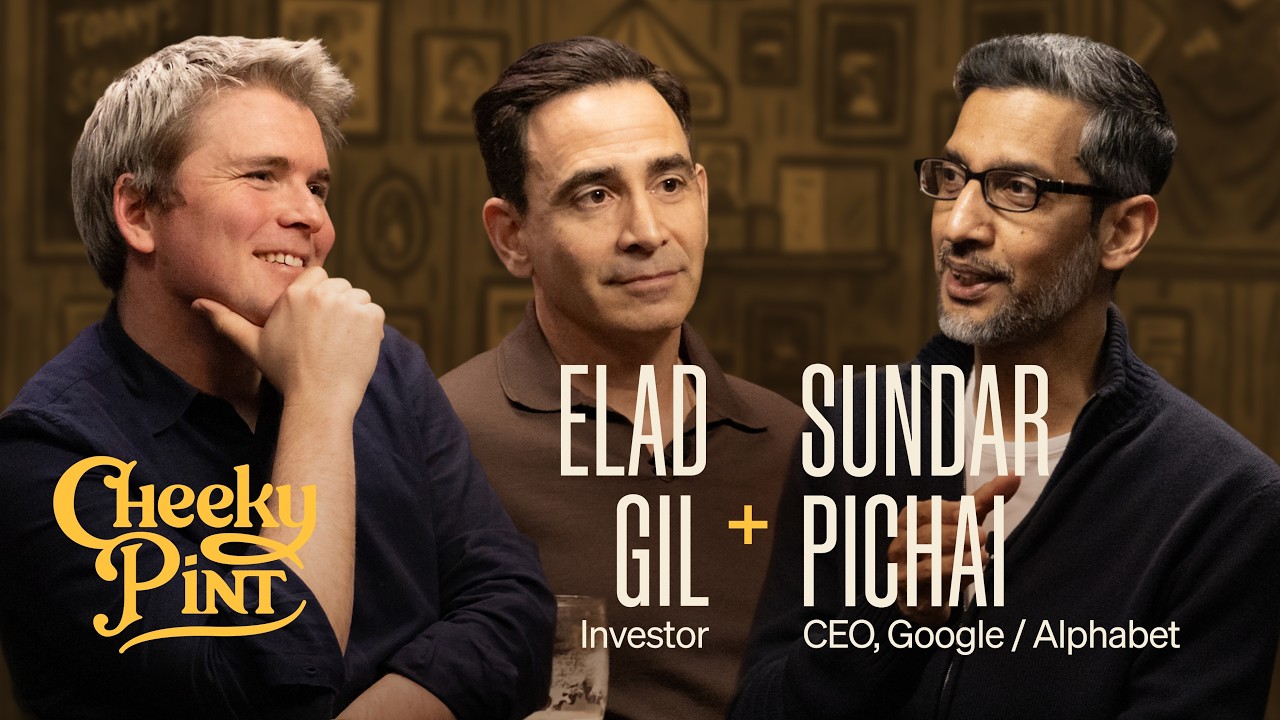
Sundar Pichai, now a decade into his tenure as CEO of Google (Alphabet), reflects on the company’s deep history with AI, its recent resurgence in the AI race, and how it is navigating an era defined by massive capital expenditure, compute constraints, and rapid product transformation.
Alphabet plans to spend $175–185 billion in CapEx in 2026, making it one of the most aggressively investing companies in the world.
The conversation covers the origins of the Transformer architecture at Google, the company’s AI comeback after a period of negative sentiment in 2025, the future of Search, capital allocation across wildly different projects, compute bottlenecks, and how AI is reshaping Google’s internal workflows.
The Transformer story is more nuanced than people think
The Transformer architecture was invented at Google in the context of solving real product problems—specifically improving translation and speech recognition at scale—not as pure research.
The work was closely tied to the development of TPUs because Google needed custom chips to serve inference to billions of users.
Google immediately deployed Transformers internally through models like BERT and MUM, which drove some of the largest-ever measured jumps in Search quality.
Google also built LaMDA, an early conversational AI product that was in many ways a precursor to ChatGPT. An internal engineer famously claimed it was sentient.
Google launched a constrained version called AI Test Kitchen at Google I/O 2022, but held back a full launch because the model was too toxic and the company lacked end-to-end RLHF at the time.
Google’s higher quality bar for consumer-facing products, rooted in its Search quality culture, also contributed to the delay.
Pichai pushes back on the narrative that Google “invented it and didn’t ship it,” arguing the reality involves a combination of product caution, timing, and the inherent unpredictability of consumer internet innovation.
He notes that OpenAI’s ChatGPT launch was itself somewhat low-key—the week of Thanksgiving—and that the coding use case (GitHub Copilot) may have been a clearer signal of the technology’s leap than language alone.
Speed and latency as a core product philosophy
Google has historically differentiated on speed—Search showed query times, Gmail was faster than competitors, Chrome was faster than other browsers.
Today, Gemini on TPUs continues this tradition, with latency budgets measured in milliseconds for sub-teams within Search.
Teams earn “latency credits” for shaving milliseconds, which either get passed to users or can be spent on new features.
Search latency has improved 30% over the last five years even as functionality has grown dramatically.
Pichai distinguishes between product latency (response time) and shipping speed (iteration cycles), saying both matter but latency reflects the quality of the underlying technical architecture.
The future of Search: from answers to agents
Pichai sees Search evolving from a ranked list of results into an agentic platform where users delegate tasks.
Many information-seeking queries will become task-completion queries—planning trips, running research, managing asynchronous workflows.
He compares Search’s evolution to how it adapted to mobile: the product form changes, but the underlying need persists.
He doesn’t frame this as a zero-sum displacement. He points to YouTube thriving despite TikTok and Instagram as evidence that platforms can coexist and grow when they innovate.
Search and Gemini will overlap in some ways and diverge in others; Pichai thinks it’s valuable to invest in both.
Google’s AI comeback
In spring/summer 2025, sentiment around Google was deeply negative—the stock traded around $150, and the prevailing view was that Search was under existential threat.
Pichai felt the company was structurally built for the AI moment: vertical integration from TPUs (in their seventh generation) to research teams to product platforms, all accelerated by a common underlying technology.
The turning point in external perception was likely Gemini 2.5, which demonstrated frontier-level capabilities especially in multimodality.
Google designed the Gemini family to be multimodal from day one, which paid off in areas like image generation (Nano Banana).
Pichai describes the current frontier as intensely dynamic, with two to three labs pushing each other and leadership on any given benchmark shifting frequently.
On AGI beliefs and organizational culture
External researchers have characterized Google as less “AGI-pilled” than other labs—less convinced that AGI is imminent.
Pichai largely dismisses this as semantics, noting that Google’s founders and senior leaders (Demis Hassabis, Jeff Dean, Ilya Sutskever, Dario Amodei) were among the earliest AGI believers.
He attributes the perception to Google’s scale and product responsibility—the company touches billions of people, which naturally makes its language more measured.
Internally, he says there are people “living on the bleeding edge,” using agents daily and witnessing exponential capability gains firsthand.
His own “feel the AGI” moments include the 2012 Google Brain cat recognition demo, seeing self-driving cars at a DARPA challenge around 2014, and recent experiences where he gave an agent a complex coding task and never had to open the IDE.
Staying connected to the product
Pichai actively dogfoods internal versions of Google’s products and blocks focused time for intensive use.
He uses Gemini Live during workouts, querying it for 30 minutes on a single topic to stress-test it.
He monitors X (Twitter) for raw user feedback and follows up directly on issues.
He uses Antigravity (Google’s internal agent manager) to query internal sentiment about launches—asking it to surface the best and worst things people are saying—which has replaced what used to be a much more time-consuming process.
Economic impact and the CapEx question
Pichai is unequivocal that AI will drive massive economic growth, though he acknowledges the path from CapEx to GDP is not straightforward.
He argues that common frameworks comparing token costs to software engineering salaries are flawed because the total market for software and coding is likely far larger than currently estimated—AI can 10X the addressable market by adding supply to a demand-constrained field.
He acknowledges natural dampening mechanisms: compute build-out curves, model improvement rates, and the pace of responsible diffusion into society (using Waymo’s careful rollout as an example).
He believes even a half-percentage-point increase in US GDP growth would be a massive contribution given the economy’s size.
Bottlenecks: memory, power, permitting, and wafers
Google cannot spend $400 billion in CapEx even if it wanted to—the physical supply chain won’t allow it.
Wafer starts are the deepest constraint—fundamental semiconductor manufacturing capacity.
Power and energy are solvable but require faster permitting and regulatory progress. Pichai admires the pace of construction in China and argues the US needs to learn to build 10X faster.
Memory is acutely constrained in the short term. Leading memory makers cannot dramatically ramp capacity quickly, though prices will eventually incentivize expansion.
Data center moratoriums and local resistance add friction.
Pichai sees these constraints as potentially creative—forcing efficiency innovations and compaction cycles.
He also flags security as an underappreciated constraint: AI is dramatically increasing the supply of zero-day exploits (the black market price of zero-days is dropping), which will require more coordination than currently exists.
Hidden gems in Alphabet’s portfolio
Beyond AI, TPUs, and Waymo, Pichai highlights several longer-term bets:
Quantum computing: Google recently published a significant result. Pichai believes quantum will have an edge in simulating nature (molecular modeling, weather, materials) even if classical deep learning has been surprisingly capable (e.g., AlphaFold). He draws an analogy to mobile phones + GPS enabling Uber—applications emerge unpredictably once the platform works.
Robotics: The Gemini Robotics models are state-of-the-art in spatial reasoning. Google is partnering with Boston Dynamics and others, and Pichai thinks AI was the missing ingredient for robotics ideas that were premature 10–15 years ago.
Wing (drone delivery): Scaling toward 40 million Americans having access to Wing delivery in a reasonable timeframe.
Isomorphic Labs: Applying AI across the full drug discovery pipeline, not just molecular design, which Pichai considers the smartest approach he’s seen in biomodeling.
Data centers in space: A very small team exploring where data centers will go on a 20-year horizon.
Capital allocation across radically different projects
Pichai acknowledges that comparing a YouTube recommender improvement to a Waymo scale-up to a speculative AI research bet is extraordinarily difficult.
The compute constraint has made this more acute: TPU allocation is now a central management decision, and Pichai spends a dedicated hour per week reviewing compute allocation by project and team.
Historically, Google’s advantage has been making early, deep technology bets with relatively small initial funding, staying committed for the long term, and evaluating progress against technical milestones (e.g., logical qubit error rates for Quantum, safety and reliability curves for Waymo).
Waymo is a case study: Google increased investment when others got pessimistic, and Pichai’s confidence came from tracking the underlying safety curve and trusting the team to break through plateaus.
He attributes Waymo’s recent breakthroughs partly to the shift to end-to-end deep learning (Transformer-based approaches) a couple of years ago, which replaced hand-mapped heuristics for edge cases.
He notes that Waymo’s system integration complexity—comparable to TSMC or SpaceX—means the craft and accumulated experience of the team matter, not just the underlying AI models.
On whether Google has been under-levered: Pichai says the company has always aimed to be a good steward of capital and would have invested more in Waymo earlier if the technology had been ready. The AI shift is creating more deployable opportunities now.
On R&D budgeting: historically people costs dominated; now compute is a co-equal scarce resource. Google has always had compute planning, but ML compute is now acutely constrained and managed at a granular level.
For Google Cloud, forward planning includes contractual customer commitments (which are sacrosanct) alongside internal needs. The Cloud team operates under the same constrained compute environment.
AI as an orchestration layer for complex products
Pichai is enthusiastic about AI as an orchestration layer, especially for products with large surface areas like Google Cloud.
GCP’s MCP (Model Context Protocol) integration allows AI agents to interact programmatically with nearly all of Google Cloud’s functionality, effectively solving the navigation problem that comes with having so many services.
He sees a parallel with Stripe’s experience: the more functionality a product has, the more valuable an AI layer that has read all the API docs becomes.
He also sees this working internally—AI as the orchestration layer that connects enterprise data sources without requiring massive ERP-style integration projects.
Consumer agentic future and persistence
Pichai is excited about stateful, persistent AI for consumers—agents that run long-running tasks, remember context, and act on a user’s behalf over time.
He cites the example of OpenClaw and similar tools that allow consumers to set up persistent workflows (e.g., daily news roundups).
The primitives are coming together: full coding models underpinning consumer interfaces, secure cloud and local execution, identity and access management.
He estimates that today perhaps 0.1% of the world is living in this agentic future; bringing it to mass adoption is a major frontier.
Google Docs search and product feedback
Pichai acknowledges the problem of search being worse in Google Docs/Slides than in Gmail: keyword search works for emails (where you remember unique terms) but fails for documents where search terms like “2026 budget” are not unique across an organization’s files.
He expects sharp improvements in AI integration across Google Workspace services in the coming months, including better context caching and retrieval.
AI adoption inside Google and across industry
Pichai describes AI adoption in concentric circles: some teams (Google DeepMind, certain SWE groups) have profoundly shifted workflows, while others are earlier in the process.
Internally, teams use Antigravity (called “Jet Ski” internally) as an agent manager, living in a world of delegated workflows.
The Search team recently got access, and Google is actively pushing diffusion across the company.
He identifies the key barriers to broader AI adoption in industry:
Prompting skill: It takes time to get good at prompting, and there’s both general and domain-specific knowledge required.
Code collaboration: AI-generated code has high turnover and large blast radii, making it hard for teams to collaborate on rapidly changing codebases.
Data access: Agents need access to company data, but permissions engines and identity access controls are hard problems that need to be rewritten.
Role definition: Engineering, product management, and design roles may need to converge as AI capabilities expand.
He expects 2027 to be an important inflection point for non-engineering processes going agentic, including financial forecasting.
He envisions a crossover period where AI-generated forecasts are checked conventionally before fully switching over.
He acknowledges that startups and AI-native companies have an advantage in adoption speed, while Google must drive transformation and retraining at scale.
Small things that excite him
Pichai’s current small-team excitement includes:
Data centers in space: A few people with a small budget working toward a first milestone.
Post-training improvements: A single researcher walked him through a technique that he expects to produce a noticeable capability jump in an upcoming model release.