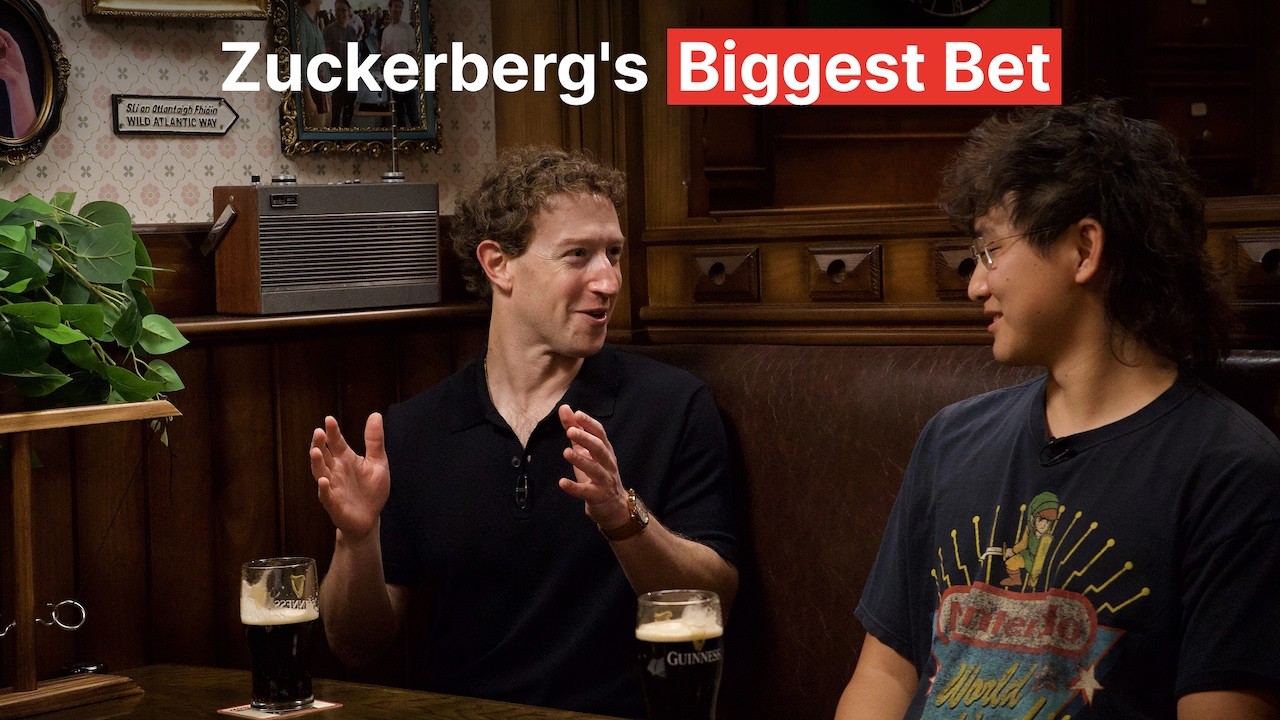
Mark Zuckerberg, Alex Wang (Scale AI founder, now leading Meta Superintelligence Labs), and Nat Friedman discuss Meta’s AI strategy, the launch of Muse Wonder (a new frontier-class model), the formation of Meta Superintelligence Labs (MSL), and the future of AI agents and agentic commerce.
Muse product and early traction
Muse is Meta’s personal AI agent product that has shown exceptionally fast growth, possibly the fastest-growing AI app yet.
Mark’s favorite use case: his Muse “Oiler” autonomously sources obscure teas from farms in Taiwan and Japan weekly.
Alex’s favorite use case and product eval: MMA coaching via cameras in his gym, where Muse processes video between rounds to give feedback on balance, hip position, underhooks, and vulnerability to being rolled.
The MMA coaching demonstrates Muse’s native multimodal understanding — it pulls stills from video, builds its own video/image processing pipeline, and optimizes its own latency when Mark pressures it to go faster.
This illustrates a future where everyone writes code without knowing it: the agent writes the code internally to accomplish tasks.
Muse’s multimodal strength comes from Meta’s deliberate investment in visual perception training, which Mark argues is disproportionately important for consumer use cases compared to the industry’s earlier coding-centric consensus.
Muse Wonder: new frontier-class model
Muse Wonder is a new model class, significantly larger than the Muse Spark line (which was based on a December 2024 pre-train).
Two versions: Muse Wonder and Muse Wonder Full (the “studio band” / full version).
Available first to paid Muse subscribers, via Meta Model API and OpenRouter, and for Muse Code users; Wonder Full for Muse Code subscribers.
Key capabilities designed for personal/professional agents:
Active memory: model-internal ability to remember and leverage user context over days/weeks/months, not just context-window stuffing; addresses the buggy memory problem in other agents.
Active focus: persistence over long horizons, recovering from setbacks with aligned alternative solutions.
Domain expertise: state-of-the-art on finance, legal, health, tax evals — designed to feel like a team of experts in your corner.
Frontier coding: state-of-the-art on DeepSWE, SWE-Marathon, Terminal-Bench 4.
Internal “big model smell” metric quantifies the gap between in-distribution and out-of-distribution performance; Wonder shows a huge step up over Spark.
Team intentionally steers away from external benchmarks (which saturate fast and reflect a PhD student’s priorities) toward internal evals capturing nuance, discretion, personality, and reliability for personal agents.
Discretion example: booking a restaurant for someone with an allergy without disclosing the medical condition.
Training frontier models: pre-training and post-training
Pre-training: massive multimodal data (public internet, books, proprietary data, images, audio, video, domain-specific corpora like legal/finance/health); intentionality about data mix matters for target capabilities; scaling laws require data to scale with compute.
Post-training: two stages — SFT (supervised fine-tuning) to initialize behaviors (personality, tool use), then RL to elicit those behaviors reliably at scale.
RL quality > quantity: less high-quality RL data often beats more low-quality data; RL environments must be curated to drive aligned behavior (avoiding reward hacking toward misaligned actions).
Muse Wonder planned since August 2025; pre-training completed, then RL; the Spark line (1.0→1.3) improved dramatically via RL alone on the same pre-train.
Compute infrastructure: Prometheus cluster in Ohio (>1 GW), Hyperion cluster in Louisiana (scaling to 5 GW); full-stack control (data centers, chips, infra) enables long-horizon planning.
Training a frontier model now costs tens of billions (CapEx ~$50-60B for a GW cluster, ~$15B/yr operating); Meta front-loads CapEx years before product demand is proven.
Meta Superintelligence Labs (MSL) formation
Triggered by dissatisfaction with Llama 4 trajectory (April 2025); Mark decided to reboot.
Alex Wang recruited despite never having trained a frontier model; Mark bet on his strategic clarity, talent density philosophy, and ability to attract top researchers.
Nat Friedman and Daniel Gross joined; initial “Supernova” phase: intense recruiting, flat culture (Alex with ~200 direct reports, minimal non-technical management), no deadlines but high self-motivation.
Four unconventional moves by Mark: (1) publicly rebooting a major internal effort, (2) paying “ungodly” amounts for talent (including 49% of Scale), (3) betting on Alex’s potential over direct experience, (4) clearing his calendar for months to focus solely on this.
Mark’s “very Bayesian” leadership: once convinced, fully pivots company resources (infra, data centers, exec alignment) toward the new priority; Meta leadership rapidly became “AI-pilled.”
Team culture: insecure overachievers who self-critique heavily; Mark tracks their pessimistic forecasts vs. actual shipping to calibrate.
Business model and agentic commerce
Core strategy: free excellent base tier (Muse Spark) to reach billions; subscriptions for Wonder access; commerce revenue (small cut of savings/earnings Muse generates); enterprise API/platform (Meta Enterprise Platform led by CJ Desai).
Agentic commerce already happening: users delegate purchases (groceries, ingredients for baking with daughter); Muse adds contextual personalization (knows family, friends, coworkers) and reduces friction (auto-applies constraints like “by Wednesday”).
Mark: “I am a new Instacart subscriber” — Muse created new demand, not just captured existing; agents may eventually hold their own accounts, expanding TAM.
Stripe partnership for agent-to-commerce payments; computer use provides backwards compatibility for sites without APIs.
Long-term: every business will have agents; Muse agents will interoperate best with Meta’s own business agents.
Competitive dynamics and open ecosystem
No winner-take-all yet because: (1) execution varies across labs over time, (2) distillation packs capabilities into smaller models (anti-hegemonic force), (3) many industry participants (individuals and companies) prefer a diverse ecosystem and make choices accordingly.
Meta’s philosophy: prosperity through empowering people; safety via diversity and checks-and-balances, not concentration in a few hands.
OpenRouter acquisition (pending) seen as infrastructure supporting model diversity; developers need help discerning subtle differences between models beyond saturated benchmarks.
Voice, multimodal, and hardware
Voice input exploding (high-bandwidth thought dumping); voice output less efficient for consumption — ideal interface is multimodal (voice in, visual out).
Ray-Ban Meta glasses: camera + audio already useful; display versions coming; Muse Gadgets program opening ecosystem for new form factors (HomeLink for smart home control).
Embodiment (Muse as a persistent “little guy” with memory, personality, agency) only coheres because all pieces work together.
Funding the buildout
Meta’s core ads business (hundreds of billions, growing fast) funds AI R&D; models also accelerate core business (few % growth = huge absolute $).
Accounting advantage: data center CapEx depreciated over years; researcher salaries expensed immediately despite multi-year model utility.
Mark’s view: history of AI shows revenue upside consistently surprises; Meta’s playbook — build, scale to billions, then monetize.