Toto Wolff, team principal and co-owner of Mercedes-AMG Petronas Formula One Team, discusses how he built the most valuable team in F1 through talent identification, technical innovation within regulatory constraints, entrepreneurial governance, and long-term value creation.
Talent identification: drivers and engineers
Spotting driving talent starts extremely early in karting, where relative age advantages and comfort at speed in wet conditions reveal raw potential.
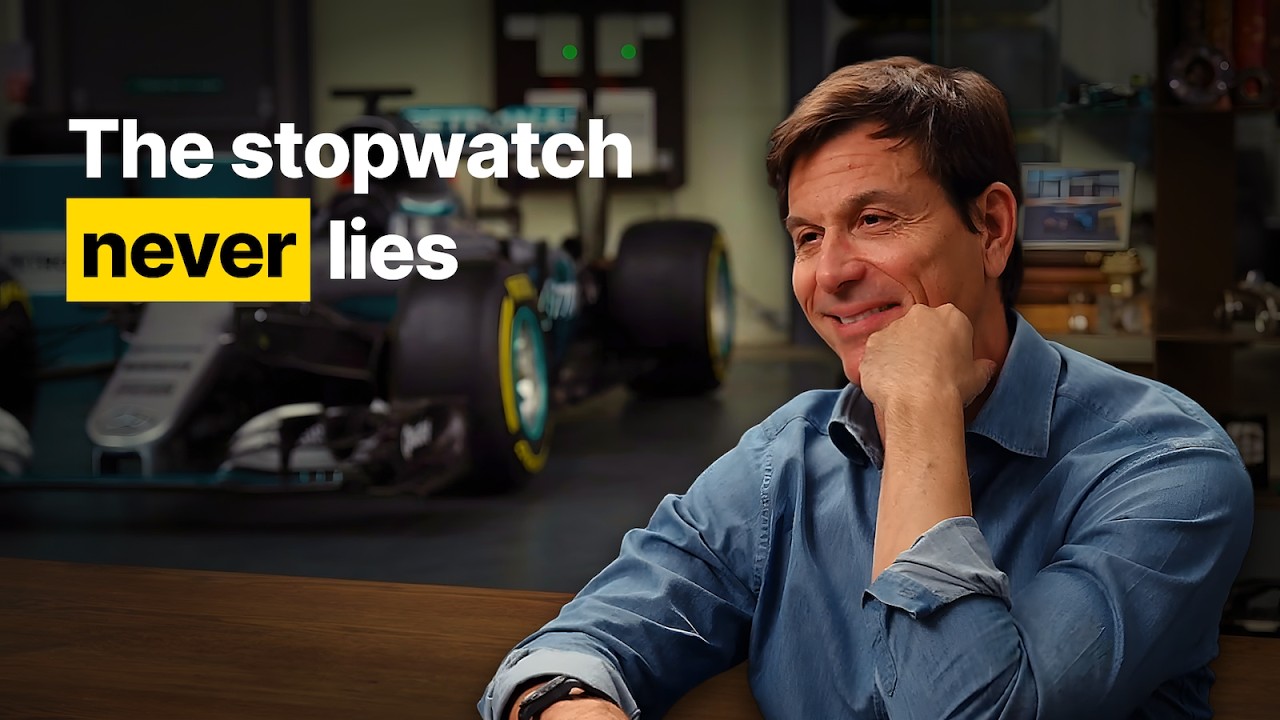
No single physiological metric predicts greatness; the stopwatch is the ultimate KPI, but underneath it lie technical feedback ability, social competence with sponsors, and resilience under pressure.
The defining trait of elite drivers is “connectedness” — a genetic, neurosensory ability to feel the car as an extension of their body, exemplified by Lewis Hamilton detecting understeer originating from the chassis midpoint rather than the front axle.
Wolff recognized his own driving ceiling when he entered racing at 18 without karting fundamentals; he became a professional but lacked the early neural wiring for world-class speed.
Engineering talent selection mirrors driver selection: 2,500-person organization, “no dickheads” culture borrowed from the All Blacks, filtering out brilliant assholes who lack humility, integrity, and collaborative values.
Recruitment pulls from F1 rivals and adjacent high-tech industries, but cultural fit is non-negotiable regardless of technical brilliance.
Technical innovation under cost cap and regulatory constraints
The $200M cost cap forced elimination of speculative long-term R&D; every compute hour must be justified against near-term lap-time gain for current or next season.
Wind tunnel and CFD limits further constrain exploration; Wolff initially opposed the cap knowing Mercedes’ resource advantage, but acknowledges it increased competition.
Innovation lives in gray zones between permitted and banned; Mercedes runs internal “mock trials” where inventors prosecute their own loopholes while engineers defend them, judged by legal counsel and Wolff.
DAS (Dual-Axis Steering) exemplifies the process: push-pull steering wheel changed front-wheel toe to heat tires, deployed after FIA dialogue, banned after one season despite regulatory compliance.
The compression-ratio dispute centered on cold vs. hot measurement; Mercedes exploited thermal expansion within the letter of the rules, fought for principle, but the advantage proved negligible.
Secrets are firewalled to ~20-25 people, but personnel mobility (12-month garden leave in UK, 3 months in Switzerland) makes leaks inevitable over time.
Wolff would prefer open regulations within the budget cap for engineering purity, but accepts restrictions prevent five-second gaps between top and bottom teams.
Managing technical risk and resource allocation
Unlike consumer businesses with unpredictable end customers, F1 operates in a measurable simulation-driven world: CFD, wind tunnel, and mathematical models correlate virtual lap-time predictions with on-track reality.
Engineers must fall in love with results, not their ideas; forceful advocates for failing projects are removed to protect the collective lap-time target over departmental ego.
Decision-making is dispassionate: stop criteria are agreed in technical management, and emotional attachment to sunk cost is culturally suppressed.
From racer to investor to team principal
Wolff’s path: racer → banking intern in Warsaw → steel sales in Eastern Europe → venture investor during dot-com boom → young driver manager → racing team investor (HWA, Williams, Mercedes).
Early investing was hybrid sweat-equity and advisory-for-equity; he helped startups raise capital or IPO in exchange for large stakes, wearing “investment banker” attire he later abandoned.
Key exit timing: CFO warned of absurd valuations on a flight from Bonn; Wolff liquidated the portfolio in late 1999 through 2000 before the crash, retaining only one illiquid Israeli startup.
Personal ownership (90% of his vehicle) made selling easier — generational wealth security outweighed fund-manager incentives to hold for fees and carry.
Best pre-F1 investment: the SMS portal sms.at, built by a teenager hacking telco servers, sold to T-Mobile for €250M within two years.
Entrepreneurial governance vs. hired management
Mercedes board (Dieter Zetsche, then Ola Källenius) gave Wolff a unique mandate: buy into the team (financed by Mercedes), run it entrepreneurially with full decision authority, no corporate hierarchy interference.
Contrast with Ferrari (TP reports to CEO alongside marketing), Red Bull (employed TP reports to shareholders), Audi (corporate hires with salaries/bonuses).
Wolff cannot be fired short of catastrophic failure; 10-year horizon replaces annual bonus cycles, enabling bets like DAS that hired managers would avoid for career risk.
Jim Ratcliffe (INEOS) joined as 1/3 shareholder via sponsorship-for-equity swap pre-COVID; provides contrarian strategic counsel without operational interference.
Three-way ownership (Mercedes, Wolff family, INEOS) aligns on long-term value creation, not trophy-asset flipping.
F1 team valuation and business fundamentals
Mercedes F1 valued at £4.6B (7x increase in years); revenue $1B, 30% EBIT margin ($300M), distributing dividends — rare for sports teams.
Valuation drivers: scarcity (11 teams), global sport growth (42% female fans, 15-25 demographic), profitability, and live-sport resilience to AI disruption.
Wolff values on cash-flow multiples (15x EBIT), not revenue multiples like US sports franchises; believes fundamentals justify higher paper value but refuses to optimize for trophy investors.
Public listing unlikely: weekly mania/depression cycles from race results whipsaw public markets; private control preserves long-term decision quality.
Drive to Survive and fan ecosystem
Netflix series succeeded because F1 is already a credible sport with rules-based competition; entertainment follows sport, not vice versa.
Ferrari and Mercedes declined Season 1, creating underdog narrative that hooked audiences; COVID lockdowns amplified reach across generations.
Fan pyramid now spans hardcore technical followers (Friday practice, aero updates) to casual Drive to Survive viewers; Mercedes maps stakeholders (family, employees, sponsors, fans, social followers) and prioritizes actions by customer impact.
F1 Academy (run by Susie Wolff) converts female viewership into aspirational pipeline for drivers, engineers, and commercial roles.
Governance: Teams, Formula One (Liberty), FIA
Concorde Agreement binds commercial rights holder (Liberty/F1), governing body (FIA), and teams; teams don’t own the league but receive large profit share.
Tensions historically over profit split (renegotiated every 5 years) and calendar venues; recent alignment on “jailing more” for sport’s benefit.
Track design tension: permanent circuits (Spa, Monza) enable overtaking; street circuits (Madrid, Monaco) prioritize spectacle over racing — Madrid already modifying layout for 2025.
Monaco untouchable despite poor racing; “Monaco needs F1, F1 needs Monaco” — legacy and commercial reality outweigh sporting purity.
Succession planning
Wolff rejects legacy-building (no “Toto building”); focuses on family security and team continuity.
Structure will split his role across 2-3 vetted internal leaders; clean break impossible while family retains ownership.
Executive/non-executive chairmanship possible but strictly bounded: no daily interference, no grandstand sniping, contact with drivers only for relationship continuity.
Children uninterested; meritocratic succession required — “you have to earn your spot.”