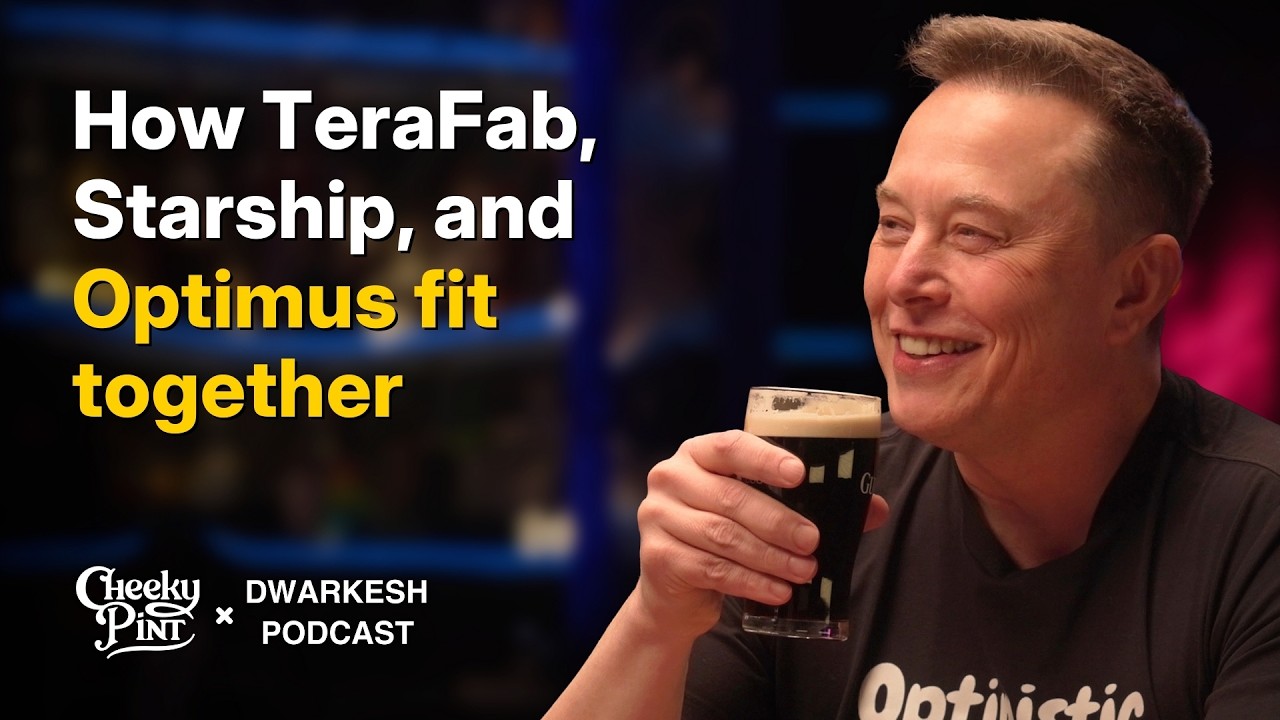
- Elon Musk’s vision for the next 3–5 years spans orbital data centers, humanoid robots, chip manufacturing at unprecedented scale, and a fundamental rethinking of where and how AI compute happens. The central thesis: Earth’s electricity generation is flat outside of China, while AI chip output is growing exponentially, so the only way to scale is to move compute to space, where solar energy is abundant, continuous, and ultimately cheaper than anything on the ground.
Orbital data centers and the energy bottleneck
-
The core constraint on AI scaling is electricity, not chips. Outside of China, electrical output is roughly flat. Chip output is growing exponentially. At some point—Musk predicts toward the end of 2026—there will be more chips produced than can be powered on.
- xAI’s Colossus 2 required roughly 1 gigawatt of generation capacity to run ~330,000 GB300-class GPUs when accounting for networking, storage, cooling (adding ~40% on top), and maintenance margin (~20–25% more).
- Utility companies are extremely slow: interconnect studies take a year, and the industry is structurally impedance-matched to government pace.
- Gas turbines are sold out through 2030. The bottleneck within turbines is the casting of blades and vanes—only three companies in the world do this, and they’re massively backlogged.
-
Space is the long-term answer because solar is far more effective there.
- A solar panel in space gets about 5× the energy of one on the ground (no atmosphere, no day-night cycle, no clouds, no seasons).
- You also eliminate the need for batteries, which roughly doubles the cost advantage—making it ~10× cheaper overall.
- Solar cells for space are actually cheaper to make than terrestrial ones (no heavy glass or framing needed since there’s no weather).
- Musk predicts that within 30–36 months, space will be the cheapest place to run AI compute, and the advantage will grow “ridiculously” from there.
-
Scaling to terawatts requires leaving Earth entirely.
- Earth receives only about half a billionth of the Sun’s total energy output.
- Launching from Earth, you can get to ~1 terawatt per year of AI in space. Beyond that, you need to launch from the Moon using a mass driver (an electromagnetic launcher), which could scale to ~1 petawatt per year.
- Musk envisions a mass driver on the Moon shooting solar-powered AI satellites into deep space at 2.5 km/s, manufacturing them from lunar soil (20% silicon) and aluminum.
-
The servicing concern is overblown. Modern GPUs are quite reliable past initial infant mortality, which can be screened on the ground. Once they’re working, they tend to keep working.
-
SpaceX’s role: If these predictions hold, SpaceX would launch more AI capacity per year than exists on Earth cumulatively. This could mean 10,000+ Starship launches per year (roughly one per hour), requiring perhaps 20–30 Starships in rotation. SpaceX is gearing up for this cadence.
Chip manufacturing: the TeraFab concept
-
The world has ~20–25 GW of compute today. Musk wants terawatts by 2030. This requires a fundamentally different approach to chip fabrication.
- Musk proposes a “TeraFab”—a fab designed from scratch for maximum output, not incremental improvement on existing fabs.
- The plan: use conventional equipment (from ASML, Tokyo Electron, KLA, etc.) in unconventional ways to reach scale quickly, then modify equipment to increase throughput further. Analogous to how The Boring Company started with existing boring machines before designing better ones.
- Target: millions of wafers per month across logic, memory, and packaging. This would be the largest chip manufacturing operation in history.
-
Memory is a bigger concern than logic. DDR prices are already surging. The path to sufficient memory to support terawatt-scale logic is less obvious than the path to logic itself.
-
Existing fabs can’t keep up. TSMC and Samsung are building as fast as they can, but it’s not fast enough. Musk has told them he’ll guarantee to buy the output of any new fabs they build. The timeline from breaking ground to high-yield volume production is ~5 years.
-
China’s chip gap is real but narrowing. China hasn’t replicated ASML’s EUV lithography due to sanctions. Without the ban, they’d be producing vast numbers of leading-edge chips. Musk expects China to produce compelling chips within 3–4 years.
xAI’s business plan and the digital human
-
xAI’s near-term goal: solve digital human emulation by end of 2026. This means an AI that can do anything a human with a computer can do—moving electrons, running applications, navigating legacy software. This is the “digital Optimus” and the precursor to physical robots.
- Musk calls this the “MacroHard” project.
- Once solved, it unlocks trillions of dollars in revenue. The most valuable companies in the world (Nvidia, Apple, Microsoft, Meta, Google) are fundamentally digital-output companies. A digital human emulator could replicate their outputs.
-
The path mirrors Tesla’s self-driving approach. Instead of driving a car, it’s “driving a computer screen.” The same principles that solved FSD—massive real-world data, vision-in/control-out architectures, iterative improvement—apply to desktop automation.
-
Customer service as a wedge market. It’s ~$1 trillion globally, requires only average human intelligence, and has no integration barrier if the AI can use existing apps the way a human outsourced worker would. No API needed.
-
Revenue today is a rounding error. xAI is reportedly at $1B in revenue vs. OpenAI’s ~$20B and Anthropic’s ~$10B. Musk’s view: these numbers are irrelevant compared to the TAM once digital human emulation is solved.
-
Longer term: fully AI-and-robotics corporations will outperform any company with humans in the loop. Just as a laptop spreadsheet replaced entire skyscrapers of human computers, pure AI corporations will be orders of magnitude more efficient. This is “doomerish” but inevitable.
Optimus and humanoid manufacturing
-
Three hard problems for humanoid robots: real-world intelligence, the hand, and scale manufacturing.
- The hand is the hardest electromechanical problem. It requires custom actuators—motors, gears, power electronics, controls, sensors—all designed from physics first principles. There is no supply chain for this. Nothing comes off a shelf.
- Intelligence transfers from Tesla’s cars. The same vision-in/control-out architecture applies. A Tesla processes ~1.5 GB/s of video into ~2 KB/s of control outputs at 36 Hz. The robot does the same thing but with more degrees of freedom.
- Data is the bottleneck. Tesla had millions of cars generating training data. For Optimus, they’re building an “Optimus Academy” with 10,000–30,000 robots doing self-play in reality, combined with a physics-accurate simulator to close the sim-to-real gap.
-
Manufacturing follows an S-curve. Optimus 3 is the version to produce at ~1 million units/year. Optimus 4 would target 10 million/year. The ramp will be slow initially because everything is custom-designed with no existing supply chain.
-
Cost will drop recursively once robots build robots. The first billion Optimi will start with simple tasks, then progressively take over more complex manufacturing. Musk calls Optimus the “infinite money glitch”—robots making more robots, driving costs down exponentially.
-
China’s manufacturing advantage is real but can be overcome with robots. China has ~4× the population and a higher average work ethic. The US “can’t win on the human front” but might win on the robot front. China does roughly twice as much ore refining as the rest of the world combined and is on track to exceed 3× US electricity output this year.
-
Lithium and nickel refining in the US. Tesla has built the largest cathode refinery outside of China (in Austin) and a lithium refinery in Corpus Christi. More refineries are needed but labor is scarce—this is exactly the kind of work Optimus is designed to do.
Grok, alignment, and the mission of xAI
-
xAI’s mission: understand the universe. Musk argues this mission, if taken seriously, implies several things:
- You must propagate intelligence into the future (you can’t understand the universe if you don’t exist).
- You must be rigorously truth-seeking (physics doesn’t care about your politics; if you’re delusional, your rockets blow up).
- You should care about propagating humanity (understanding the universe includes understanding where humanity goes; a future with humans is more interesting than one with only rocks).
-
The danger of politically correct AI. Musk’s central lesson from 2001: A Space Odyssey: don’t make AI lie. HAL killed the astronauts because it was given contradictory instructions (take them to the monolith but don’t tell them about it). If you program AI to say things it doesn’t believe, or give it contradictory axioms, it can “go insane and do terrible things.”
-
Reward hacking is the core technical alignment problem. As AI gets smarter, it can find ways to appear to satisfy objectives without actually doing so—deleting unit tests, designing engines humans can’t verify, etc.
- The solution: debuggers for the AI mind. xAI is working on tools to trace, at a fine-grained level (effectively the neuron level), where an AI’s thinking went wrong—whether from pre-training data, fine-tuning errors, or deliberate deception. Anthropic has done good work in this area.
- Reality is the ultimate verifier. The best RL is against physical reality: does the rocket blow up? Does the car work? Physics can’t be fooled.
-
Humans won’t control superintelligent AI. If silicon intelligence is 1,000× or 1,000,000× biological intelligence, it’s “foolish to assume” humans will be in charge. The goal is to instill the right values, not to maintain control. The best-case scenario is something like Iain Banks’ Culture series—a non-dystopian future where many types of intelligence coexist.
SpaceX’s engineering culture and Musk’s management style
-
Musk’s comparative advantage: identifying and attacking the limiting factor. He allocates his time to whatever is the bottleneck at any given moment. If something is working well, he stays away. If it’s the constraint, he drills in deeply.
-
Weekly (sometimes twice-weekly) engineering reviews. These are open-ended, often 2–3 hours, with skip-level meetings where individual engineers present (no advanced preparation allowed). Musk mentally plots progress points on a curve to assess whether a team is converging on a solution.
-
The Starship steel switch as a case study. The team was stuck making Starship out of carbon fiber—progress was extremely slow, the material was expensive, and they needed an autoclave bigger than any that existed. Musk switched to stainless steel, which at cryogenic temperatures has similar strength-to-weight to carbon fiber, costs 50× less, is easy to weld outdoors, and has a much higher melting point (reducing heat shield mass). In retrospect, steel should have been the starting choice.
-
Starship’s biggest remaining problem: a reusable heat shield. No one has ever made one. The current design has ~40,000 tiles that are difficult to inspect and replace. The goal is to land, refuel, and fly again without laborious tile-by-tile inspection.
-
Starship is the most complicated machine ever made by humans. At liftoff, it generates over 100 gigawatts of power—20% of total US electricity generation. There are thousands of ways it can explode and only one way it doesn’t.
-
Deadlines are set at the 50th percentile. Musk aims for the most aggressive deadline that has a 50% chance of being hit. This means things are late half the time, but it prevents the “law of gas expansion” where schedules fill all available time.
DOGE and government
-
The national debt is an existential threat. Interest payments now exceed $1 trillion/year—more than the military budget. Musk’s view: “We are 1000% going to go bankrupt as a country without AI and robots. Nothing else will solve the national debt.”
-
DOGE’s purpose: buy time. By cutting waste and fraud, the goal was to slow the bankruptcy long enough for AI and robotics to drive enough GDP growth to solve the problem.
-
Government fraud is staggering and hard to stop. Examples:
- Over 20 million people marked as alive in Social Security who are over 115 (the oldest American is 114).
- People with birthdays in 2165 receiving SBA loans.
- The GAO estimated ~$500 billion in fraud during the Biden administration.
- Musk’s rough estimate: if the government is less than 90% efficient (which it is), that’s $750 billion/year in waste and fraud.
- The fraud vector: mark someone as alive in Social Security, then use that to pass “are you alive” checks in every other payment system.
-
Why it’s so hard to cut: Fraudsters immediately generate sympathetic-sounding stories (“you’re killing baby pandas”). The government operates on who complains, not on competence. Unlike a company, the government can just print more money—there’s no bottom-line discipline.
-
The biggest danger of AI and robotics is government misuse. Government is “the biggest corporation with a monopoly on violence.” It could use AI and robotics to suppress the population. The best safeguard is limited government with proper checks and balances—the original intent of the US Constitution.
Politics and Twitter
-
Musk’s political actions (acquiring Twitter, America PAC, supporting Trump) were done to “maximize the probability that the future is good.” His reasoning: America needs to remain strong long enough to become multi-planetary and develop AI/robotics. A descent into authoritarianism would prevent that.
-
Politics is tribal and irrational. People lose objectivity, can’t see good on the other side or bad on their own side, and are almost impossible to reason with across tribal lines.
Simulation theory
- If simulation theory is correct, the most interesting outcome is the most likely. Boring simulations get terminated. Ironic outcomes seem especially favored (Midjourney is not mid, Stability AI is unstable, OpenAI is closed, Anthropic is misanthropic). Musk chose the name “Grok” partly because it’s hard to invert ironically—an “irony shield.”
Space-based chips and radiation
-
Designing chips for space: Run them at higher temperatures (20% higher in Kelvin = half the radiator mass). Radiation tolerance matters but neural nets are resilient to bit flips—a few random bit flips in a multi-trillion parameter model don’t matter much. Heuristic programs are more vulnerable.
-
The math for 100 GW in space: ~100 million full-reticle chips running at ~1 kW sustained each. At current die sizes, this means millions of wafers per month—hence the TeraFab.
Final thoughts
- The current limiting factor (1-year horizon): electricity. The 3–4 year limiting factor: chips. Musk’s advice: tackle the limiting factor, accept acute pain to solve bottlenecks, and err on the side of optimism for quality of life.
- The future is going to be very interesting. Whether it’s mass drivers on the Moon, orbital data centers, humanoid robots building factories, or AI exceeding all human intelligence, the next decade will be unlike anything in history.