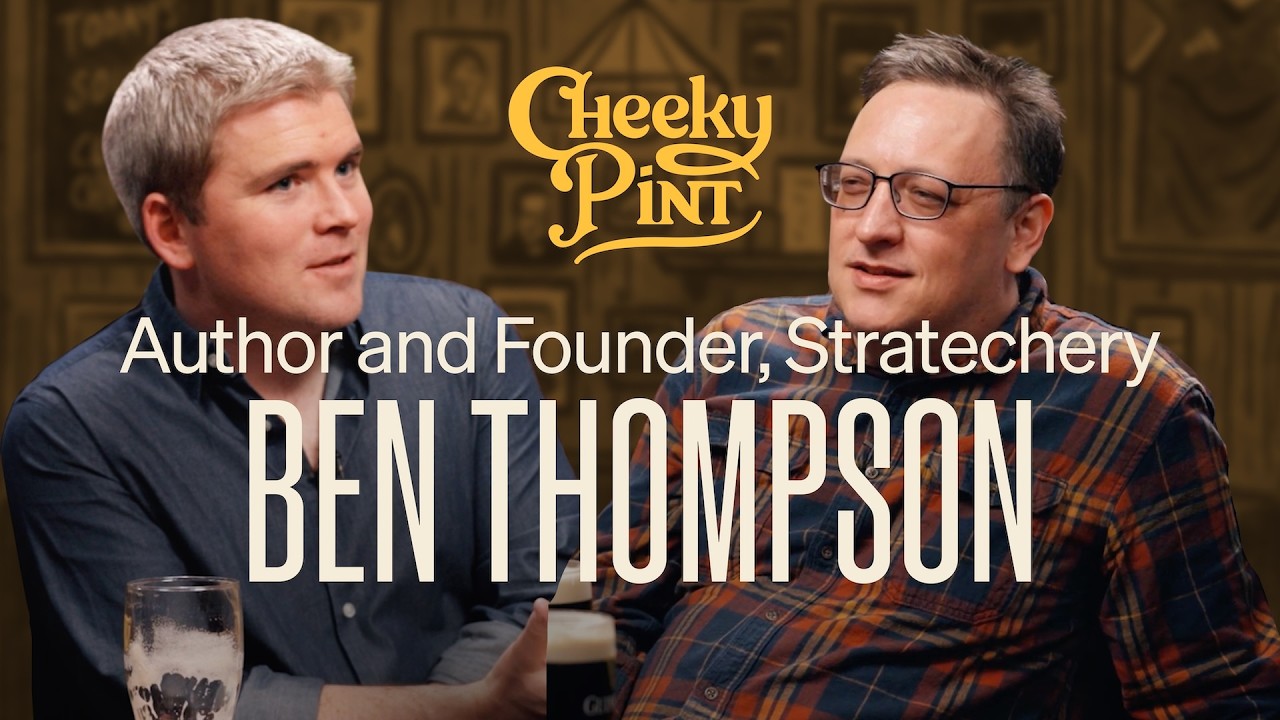
Ben Thompson, founder of Stratechery and one of the earliest premium newsletter creators, discusses AI’s impact on aggregation theory, advertising, SaaS, media bundling, and the semiconductor supply chain, drawing on his experience running a solo media business and his long-standing frameworks for understanding tech platforms.
Taiwan as a place to live and visit
Thompson lived in Taiwan for years and considers it the most convenient place to live, largely because of its mixed-use urban layout, 7-Eleven food culture, and delivery infrastructure.
As a tourist destination, he says it is underrated compared to Japan, though navigating Japan pre-smartphone was much harder due to language barriers.
Taipei’s blocks are commercial on the exterior and residential inside, with small shops and restaurants everywhere, making daily life walkable.
The downside for tourists is that Taipei’s buildings are often unattractive from the outside, and the rise of Uber Eats has led some beloved local restaurants to close their storefronts and operate as ghost kitchens.
He recommends visiting night markets, following your belly rather than Yelp, and exploring the east coast and Taroko Gorge (though the gorge was damaged by an earthquake and may still be closed).
Taipei 101’s tuned mass damper is an underrated engineering marvel, and the National Palace Museum is world-class.
Aggregation theory and AI
Thompson’s aggregation theory holds that on the internet, power shifts to demand aggregators (like Booking.com) rather than suppliers, because aggregators own the customer relationship and benefit from zero marginal cost distribution.
Booking.com is itself aggregated by Google, making it both an aggregator and a supplier simultaneously, and Thompson considers it one of tech’s most underappreciated success stories.
He argues OpenAI’s most valuable asset is ChatGPT itself, and that the company’s failure to build a real business model around it—particularly its late embrace of advertising—has been a major strategic error.
He is strongly pro-advertising, arguing it is an efficient monetization model that enables universal access to products and services, and that Silicon Valley’s knee-jerk skepticism of ads is misguided.
How AI apps should do ads
Thompson is critical of OpenAI’s initial ad implementation, which shows contextually relevant banner ads tied to conversation topics, calling it the “bare minimum easiest solution.”
He argues this approach creates a conflict-of-interest perception and limits the ad market to conversations that happen to match available ad inventory.
Instead, he advocates for Meta-style profiling—building a broad understanding of the user across all their behavior and showing relevant ads disconnected from the specific answer being given.
He notes that Google is in the ideal position: it could use Gemini conversations to improve ad targeting across YouTube, Search, and its other properties without ever showing ads in Gemini itself.
He dismisses privacy concerns about overly accurate targeting as overstated, pointing out that people consistently choose free ad-supported products over paid alternatives.
Meta, TikTok, and the limits of social networks
Thompson argues Meta’s core strength is its feed, which became enormously large and is monetized exceptionally well, but Mark Zuckerberg has never been genuinely interested in advertising and has failed to make the case that ads are a societal good.
He predicted in 2015 that Meta would hit a ceiling if it thought of itself as a social network, because most people don’t have that much interesting to say—his suggested fix was more professional content, but the actual answer was TikTok’s algorithm-driven content harvesting.
TikTok succeeded because it is not a social network at all but a personalized TV experience, and what matters is absolute volume of good content, not hit rate.
On ByteDance and TikTok, Thompson supported forced divestiture from China, not over user data concerns (which he considers overblown) but because of algorithmic censorship—he demonstrated that TikTok suppressed Houston Rockets content after the Daryl Morey Hong Kong tweet.
He considers the eventual TikTok sale a disaster because ByteDance retained control of the algorithm, which was the whole point.
Agentic commerce
Thompson is skeptical that agentic commerce will play out the way most people assume (e.g., “book me a honeymoon”), noting that the most successful “agent” in the world today is Facebook’s advertising system, which autonomously acquires customers at a target cost.
He sees a risk that AI-mediated commerce leads to perfect competition, where everything is measured and optimized, and the unmeasurable qualities that give products soul get devalued—he cites sports analytics as an example of over-optimization at the expense of intangibles.
He acknowledges the counterargument that commoditization of basic goods (like Amazon Basics) has raised the floor for everyone, even if it eliminates differentiation.
On the Stripe-OpenAI agentic commerce announcement versus Google’s approach, he sees OpenAI wanting to be the AOL-like interface for everything, while Google wants to equip everyone and benefit from being the demand aggregator—he thinks Google’s approach is more defensible.
Is SaaS canceled?
Thompson thinks the market’s punishment of SaaS companies is partly justified: seat-based pricing models are vulnerable if headcount growth slows or reverses, and many SaaS applications are not strictly necessary.
He argues American business culture is good at focusing on strengths and outsourcing weaknesses, which historically supported SaaS adoption, but AI may enable small teams and individual entrepreneurs to self-serve or roll their own solutions.
The bigger issue is the shift from growth to stability: SaaS companies valued on growth metrics get revalued on EPS when growth stalls, especially given stock-based compensation structures predicated on continued expansion.
He notes that systems of record (like Workday) are not being replaced by cloud coding, so that category remains safe.
Stratechery and the premium newsletter model
Thompson credits Andrew Sullivan as an inspiration but says Sullivan’s model (50 posts a day, leaky paywall) was unsustainable; Thompson deliberately limited himself to two posts a week so the paid product felt like getting more, not paying to unlock what was taken away.
He hit his one-year subscriber goal in six months, and a transparency post about reaching the goal triggered a 25% subscriber increase in 24 hours as hesitant readers gained confidence the business would survive.
He believes the model’s ceiling is very high because the internet is vast and AI makes it possible for more people to run low-cost, niche businesses—but managing costs is critical.
He is skeptical about bundling in media: bundles are theoretically optimal for everyone but no one wants to join them, because the most valuable participants can make more money going direct. He contrasts this with Spotify, which succeeded as a bundle because it only had to negotiate with four major labels.
More than half of Stratechery consumption is now audio, which drives retention but hurts growth because audio content is not shared the way written links are.
How Thompson uses AI in his writing
His primary use is research: quickly getting up to speed on unfamiliar industries, understanding how things work, and verifying his understanding before writing.
He also uses it for critique—asking AI to evaluate his arguments—but never to generate actual content.
He notes that Google search quality has declined, partly due to a bias toward recency, and AI has become a more efficient research tool for him.
The TSMC break
Thompson has written extensively about what he calls the “TSMC break”: the idea that TSMC’s conservative capacity expansion is becoming the binding constraint on AI growth.
Fabs cost billions, and nearly all their cost is depreciation, so overbuilding is catastrophic—TSMC rationally avoids the risk, but this means the hyperscalers bear the cost of foregone revenue.
TSMC actually decreased capex year over year for two years after the ChatGPT moment, only recently increasing to around $60 billion, which Thompson considers far too little.
He predicts a massive chip shortage around 2029, exacerbated by AI agents’ much higher compute density and Intel having shut down CPU plants.
The solution, he argues, is for hyperscalers to invest in creating credible alternatives to TSMC (Intel, Samsung) for economic reasons—the geopolitical insurance comes free.
He notes TSMC is a benign monopolist that hasn’t raised prices as much as it could, but the market structure problem will increasingly hurt the hyperscalers.
Rapid fire
Homework and AI: Schools should incorporate AI and shift toward in-person exams and discussions; shared experiences and common content become more valuable as AI makes everything else individualized.
Sports in an AI world: Thompson thinks sports and live shared experiences become more valuable because they are common reference points in an increasingly individualized media landscape.
Crypto: He has always been a crypto defender because digital scarcity is fundamentally interesting and becomes more important as AI floods the world with infinite, potentially inauthentic content.
Tech company execution: Apple makes great products but is a poor platform steward and has fallen behind in AI; Google does almost everything suboptimally but its lack of focus gives it resilience and adaptability; Microsoft’s integrated mediocre products consistently beat best-of-breed for mainstream customers; Meta is the best-run with the most underrated ad model; Amazon’s cloud optimization playbook (Graviton, Tranium) is impressive but may not work in a market with massive generational leaps.
Stripe feedback: Thompson credits Stripe’s 2011 billing API as a direct enabler of Stratechery’s subscription model, but reports a specific bug where ACH add-on failures cancel the entire subscription plan, requiring custom workaround logic.
Microtransactions and data markets: He is skeptical of microtransactions for content but sees a need for market mechanisms that pay people directly for data generation, creating a YouTube-like speculative market for AI training data.