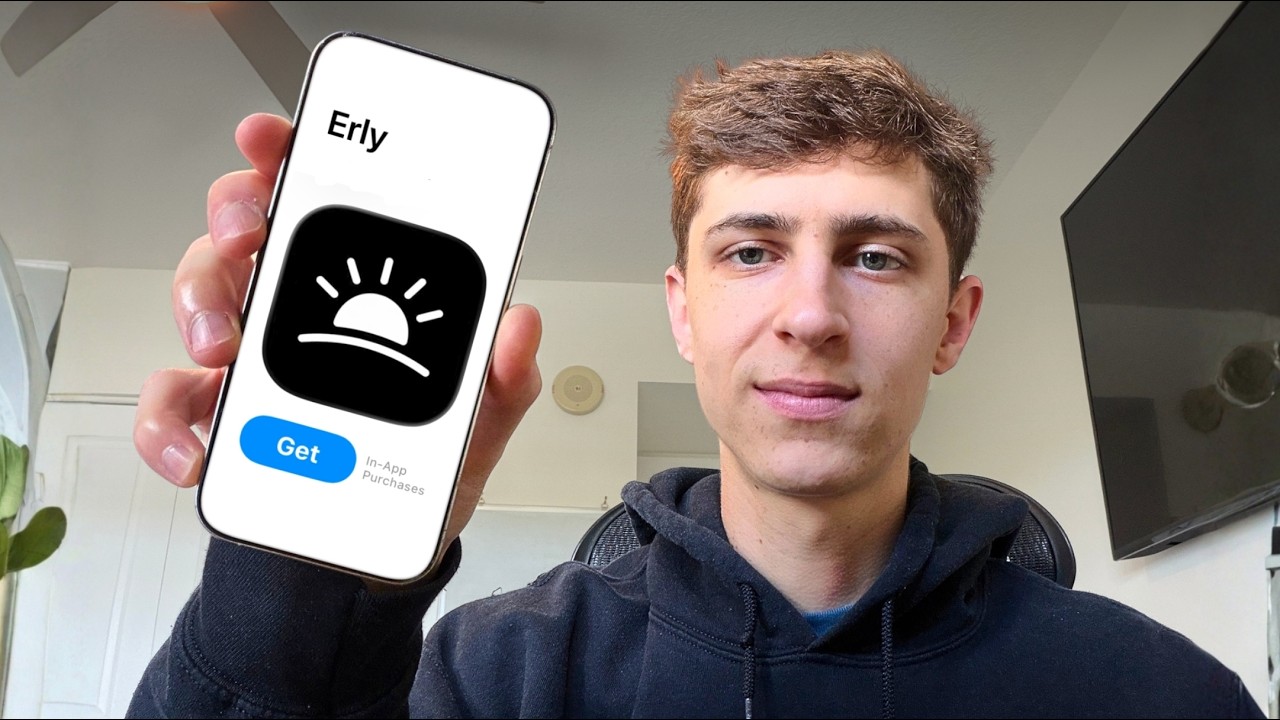
Jake, a 24-year-old former accountant and self-taught developer, built “Early” — an iOS alarm clock app that requires users to do pushups to dismiss the alarm — and grew it from $0 to over $50,000/month in four months with 200,000+ downloads, using influencer marketing as the primary growth engine.
The app: Early
Core concept: alarm clock that only turns off after the user completes a set of pushups, verified via on-device video analysis.
Pricing: free trial, then $29.99/year or $9.99/month.
Recent metrics: ~$50,000 revenue and ~50,000 first-time downloads in the last 28 days; ~200,000 downloads in 2026 to date.
Philosophy: solve a painful problem (waking up) in the simplest possible way; the pushup mechanic is both the differentiator and the viral hook.
Founder background
Studied accounting (undergrad + master’s), earned CPA, worked at a Big Four firm for ~1 year.
Self-taught coding over the last ~4 years; had previous failed ventures.
Key realization from failures: marketing matters more than building; prioritized distribution from day one.
Finding the idea
Personal pain point: struggled to wake up early; started texting a friend nightly committing to send a pushup video by 6 a.m. as accountability.
Noticed other developers succeeding with apps on Twitter; began brainstorming next project.
Initial MVP (3 weeks): accountability app only — set wake-up goal night before, log completion in morning; no alarm feature.
Pivot trigger: realized he didn’t know how to market the accountability version; took a day to reassess direction.
Timing breakthrough: iOS 26 (late 2025) introduced AlarmKit API, allowing third-party apps to hook into the native iPhone alarm reliably for the first time.
Combined the existing accountability concept with the new alarm capability → pushup alarm app.
Validation signals: problem discussed daily in college (roommate conversations); when shown to others, nearly everyone says “I need this” or “my partner/friend needs this.”
Building the app
Timeline: ~19 days from first commit to App Store launch (accountability-only MVP); alarm feature added ~19 days later (total ~1 month to full v1).
Approach: ship fast, validate demand, then invest in marketing; building was the known variable, distribution the unknown.
First influencer video went live 7 days post-launch; saw purchases immediately → idea validated.
Revenue milestones: $1,000 at 3 weeks after first influencer video; $30,000/month at month 3; $50,000/month at month 4.
Growth and marketing: influencer-first strategy
Channel: TikTok and Instagram influencers creating “day in the life” / lifestyle content.
Selection criteria: creators whose existing content naturally includes waking up and/or fitness; app fits seamlessly without feeling like an ad.
Pitch to influencers: “keep making your normal videos, get paid” — win-win for creator, app, and viewer.
Content format: POV day-in-the-life showing alarm going off, pushups, app analyzing, green checkmark “alarm turned off”; subtle, native, often prompts “what’s the app?” comments (pinned by creator).
Deal structure: 2–4 videos/month per creator with a view guarantee; pay ~$2–3 CPM based on guaranteed views.
Risk model: low risk — cap spend, measure results within ~24 hours (peak views); power-law outcomes (most videos do okay, occasional 1M–5M view videos drive the bulk of revenue).
Tracking: extremely difficult to attribute precisely; uses simple view-spike correlation — track all videos historically, when a views spike coincides with a conversions spike, attribute to that video; accepts black-box nature (“put in $5K, get out $10K”).
Outreach: Instantly (mass email for influencer outreach).
Ops: Cal (booking), Agree (contracts), Google Sheets (central workflow).
Business: QuickBooks (accounting), 1Password (password management — “absolute life changer”).
App demo flow
Create alarm → set time, recurrence, choose mission (pushups), pick sound (e.g., birds) → save.
Alarm triggers → open app → “start” → camera analyzes pushups → green checkmark “alarm turned off.”
Cannot be faked; requires actual movement verification.
Final advice: focus on top of funnel
“Focus on top of funnel only.” Marketing — getting views — is the most valuable and scarcest skill; building is easy/commoditized with AI.
If nobody knows the app exists, it doesn’t exist.
Solo founder imperative: ruthlessly limit scope (solve painful problem simply) and pour all energy into distribution.
Pat & Gus reflections: API shifts and the marketing moat
API changes create sudden opportunity windows: AlarmKit enabled a wave of reliable alarm apps; similar patterns with widget APIs, Screen Time APIs, camera APIs — each unlocks thousands of buildable ideas for a short window.
Marketing (specifically organic video content / algorithmic distribution) is the consistent “secret sauce” across nearly every successful founder interviewed; building is getting easier, but creating content that performs is hard, scary, and therefore high-leverage.
Idea database (30+ revenue-generating mobile app concepts) linked in description for further research.