-
Mark Lou
- Background and origin story
- Grew up in a family of engineers with an environment that prioritized good grades and university, creating internal frustration because he did not care about school.
- Graduated after four years of partying and minimal lecture attendance, then watched friends easily land software engineering jobs in Paris.
- Inspired by The Social Network, decided to become an entrepreneur and build a “Tinder for sports lovers” with no business plan or monetization strategy.
- Lived with parents and worked as a part-time waiter for $10 per hour to fund his first venture.
- Pivotal moments and turning points
- Spent one year building an app he never finished, then threw away all code in 24 hours, quit his girlfriend, and moved to South Korea.
- Co-founded an AI startup in 2017 that took six months to build but acquired zero customers, leaving him broke and living in poor conditions.
- Attempted small offline experiments (selling gloves) that produced minimal revenue but reinforced a desire for quick, tangible results.
- Shifted to solving universal problems and validated an escape‑room tool by selling it before building it; made his first online dollar via a cold email and invoice.
- Scaled a “viral bought project” to $1,000, then $4,000 per month, enabling a move to Bali—until COVID-19 wiped out all revenue in 24 hours.
- After lockdowns, marriage, and a return to France, he felt lost, applied for software engineering jobs, and accepted a $9,000-per-month role.
- Rediscovered dissatisfaction with employment, gained a renewed desire for freedom, and was later fired, which prompted a deliberate relaunch as an entrepreneur with a new approach.
- Business growth, current status, or exit details (only if discussed)
- Rebuilt identity as an entrepreneur committed to shipping fast, avoiding long development cycles, raising no money, and hiring no employees.
- Launched six projects in seven months (including Mood to Movie, Habits Garden, a productivity tips tool, a landing page generator, and a link‑in‑bio tool) but remained at about $1,000 per month.
- Shifted to “painkiller” products with paywalls and emphasized launch and virality, growing revenue from roughly $1,000 to $4,000 per month.
- Created a reusable code base for rapid launches and monetized it as a product; within hours of launch earned $500, then thousands more, reaching approximately $40,000 in the first month.
- Hit strong product–market fit with revenue peaking around $135,000 per month before settling near $80,000 per month, driven by product sales, free‑tool marketing, and a YouTube episode.
- Background and origin story
-
Products and Offerings
- Core product(s) and what each one does
- Escape‑room tool designed to help businesses acquire more customers.
- Mood to Movie: an app that matches moods with movie recommendations.
- Habits Garden: a habit‑tracking tool aimed at helping users improve daily routines.
- Productivity tips ranking tool.
- Landing page generator that creates full websites from input text, including images and buttons.
- Link‑in‑bio tool for entrepreneurs to showcase an “entrepreneur resume.”
- Reusable code base/platform sold to developers to accelerate launching new projects.
- Supporting tools, side projects, or experiments mentioned
- Offline glove sales as a small experiment in physical sales.
- Various viral skits and podcast appearances used to drive launch visibility.
- Free tools (e.g., logo generator) with embedded marketing banners to promote core offerings.
- Core product(s) and what each one does
-
Metrics and Financials
- Revenue figures, user counts, and financial milestones
- First online dollar earned after cold outreach to an Australian business.
- Grew a viral project to $1,000, then $4,000 per month before COVID-19 reset revenue to zero.
- Earned $9,000 per month as a software engineer.
- After launching the reusable code base, made $500 in two hours, then $3,000–$4,000 the next day.
- First month of product sales generated approximately $40,000; later months reached $50,000–$65,000, peaking near $135,000 before stabilizing around $80,000 per month.
- Acquired around 10,000 users for Habits Garden.
- Software costs and resource efficiency
- Emphasized rapid shipping and reuse of a single code base to minimize development time and cost per new project.
- Exit or acquisition specifics (if explicitly stated)
- No exit or acquisition discussed.
- Revenue figures, user counts, and financial milestones
-
Strategy and Growth
- Overall vision and positioning
- Focus on solving universal problems, prioritizing painkillers over vitamins, and validating demand before building.
- Position as a solo founder who ships fast, avoids external funding, and maintains full ownership.
- Primary growth engine or method
- Launch‑centric, viral marketing via skits, podcasts, and social content to drive attention at launch.
- Free tools with embedded promotional banners to funnel users to paid products.
- Key tactics, channels, or strategic steps
- Sell before building (cold outreach and invoicing).
- Rapid iteration and small bets rather than long development cycles.
- Public sharing of progress to build an audience for future launches.
- Emphasis on platforms and formats that match personal comfort (text, video, or image storytelling).
- Overall vision and positioning
-
Tech Stack and Infrastructure
- Tools, platforms, and technical approaches referenced
- Stripe for payments and revenue tracking.
- Landing pages and deployable code base to accelerate new product launches.
- Notable technical decisions, trade-offs, or architecture choices
- Chose to reuse a single code base across multiple projects to ship faster and reduce overhead.
- Prioritized speed and simplicity over complex architecture or large teams.
- Tools, platforms, and technical approaches referenced
-
Lessons and Advice
- Direct advice given to other founders
- Start now and ship the smallest viable version of your idea as fast as possible.
- Validate demand before building; selling first reduces risk.
- Share work publicly to build an audience that can accelerate future launches.
- Focus on painkillers—solutions to known, urgent problems—rather than nice‑to‑have features.
- Avoid overthinking; recognize that the internal voice often blocks progress with excuses.
- Hard-won insights and key takeaways
- Each failure contains learning that contributes to later success if you do not quit.
- Freedom without a sense of usefulness can feel empty; alignment between purpose and work matters.
- Product–market fit is recognizable through strong demand, rapid revenue growth, and unsolicited user gratitude.
- Direct advice given to other founders
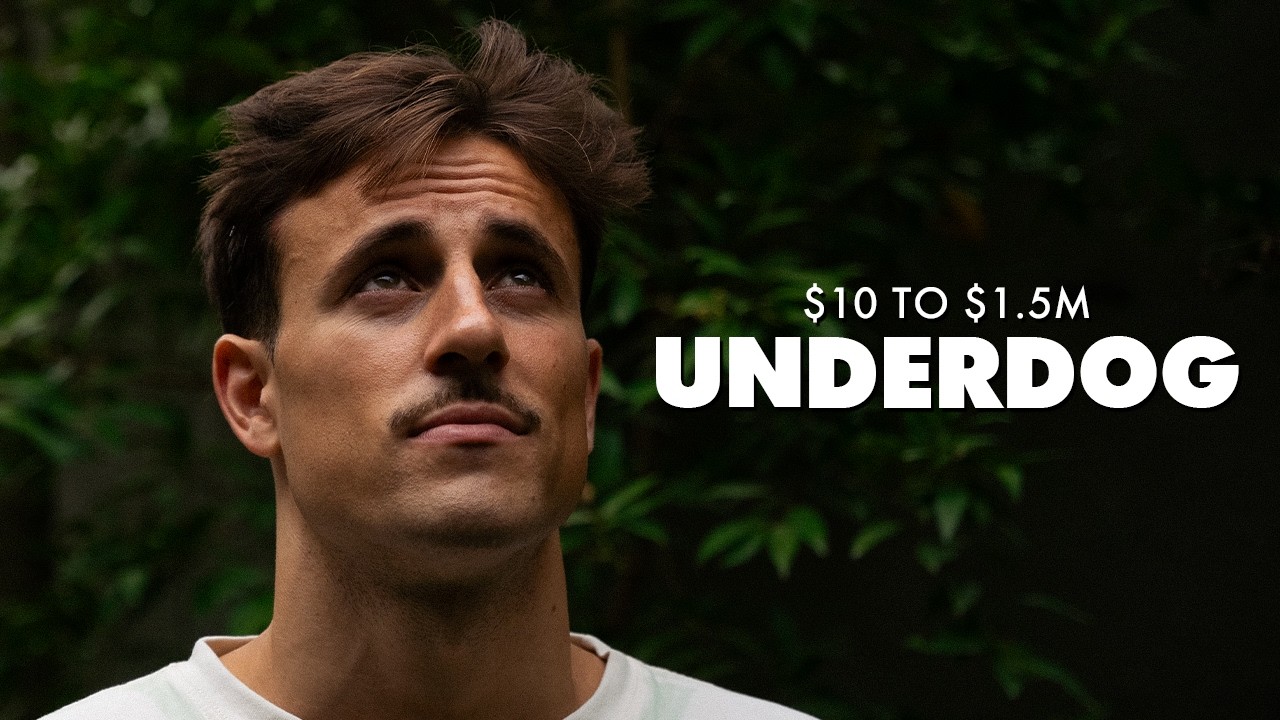
The Underdog: From $10/hr to $1.5M/Year
Starter Story • • 20min • #41