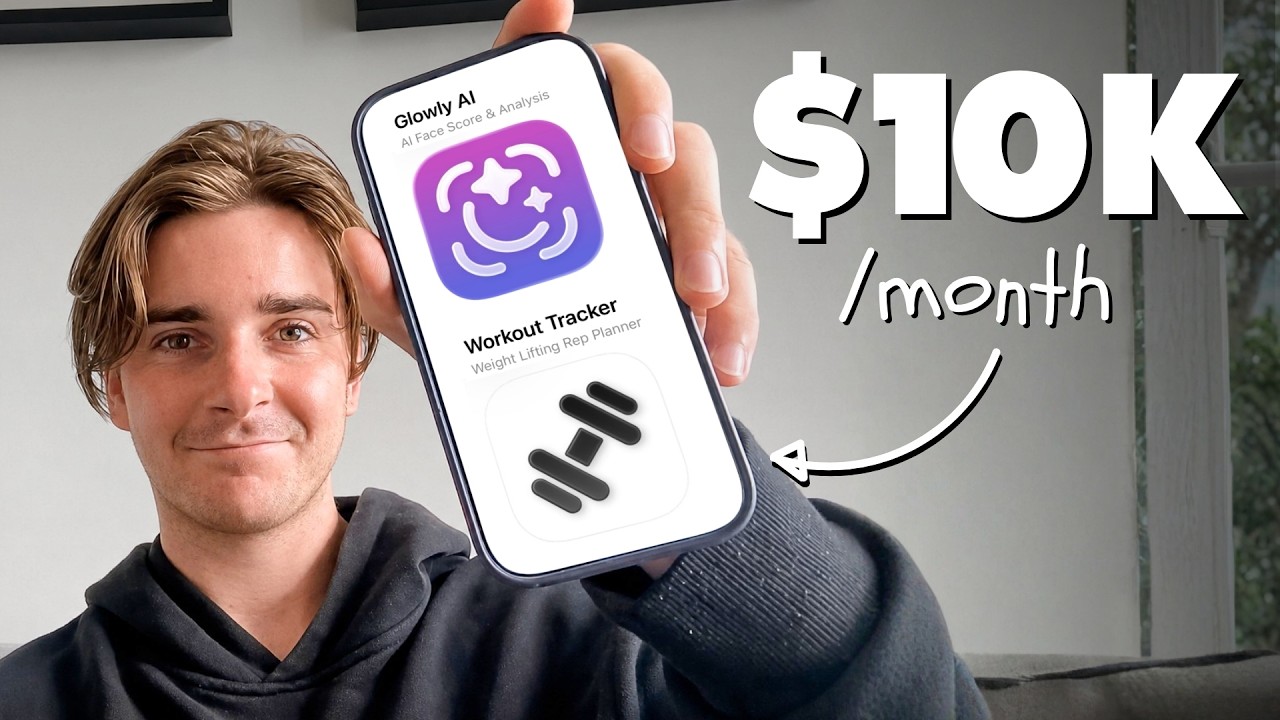
Will, an indie iOS developer, has built two apps — Overlow (fitness tracking, ~$800/mo) and Glowly (looksmaxing face scanning, ~$10k/mo) — that together generate over $10,000/month while requiring only a few hours of weekly maintenance. His “lazy method” centers on maximizing revenue per unit of effort: he validates ideas by cloning proven categories, builds simple apps with a single viral feature, acquires users via AI-generated TikTok ads, and aims to sell each app once it reaches a sellable revenue floor rather than operating it long-term.
Will’s background and the two apps
Started at 16 with dropshipping, selling likes/followers, then a crypto/NFT project; freelance web design after university provided the cash flow to fund app experiments.
Overlow: fitness rep-logging app with a body-scan feature; currently ~$800/mo passive.
Glowly: looksmaxing app — scan face, get analysis, receive improvement tips; currently ~$10k/mo.
Both apps are intentionally simple, built to be sold once validated at revenue levels that attract buyers who can scale further (e.g., via UGC programs).
The “lazy method” philosophy
“Lazy maxing” = finding the easiest possible way to get a desired outcome; Will optimizes for minimal ongoing effort, not maximal scale.
Prefers paid ads over UGC/influencers because ads remove relationship management, payment negotiation, and attribution ambiguity — he makes a few winning creatives, launches them, and lives on the results for 4–5 months.
Goal per app: validate → hit revenue threshold → sell → repeat. He avoids attachment to any single product.
Finding and validating app ideas
Idea source: scroll Instagram/TikTok; what people engage with is “data screaming at you” about demand.
Design mindset: improve an already-working concept rather than invent from scratch (most successful apps on Starter Story are design takes on popular categories, not new inventions).
Hard filter: will not build unless the app has a clear viral feature explainable in one screenshot.
Core product principle: sell a transformation, not a tool; the user must see a before/after outcome.
Building the app: viral feature and onboarding funnel
Funnel stages: ad → in-app onboarding → paywall → subscription.
Onboarding uses 12–15 steps to tell a story and deliver a personalized insight before the paywall, making the user feel the app is already working for them; this drives large conversion-rate lifts.
The viral feature (body scan, face scan) is the hook that carries the ad creative and the onboarding payoff.
Paid ads strategy (TikTok)
Creative philosophy: make ads feel native to TikTok — memes, talking-to-camera formats, hooks that don’t mention the app in the first 3–4 seconds.
Subtle integration: weave the core feature into a story; keep the app mention minimal and organic.
AI leverage: uses AI to generate 10–20 video variants, write scripts, analyze performance, and even automate browser actions for ad management.
Testing → scaling loop: launch variants, identify winners (target CPA ~$16/subscription vs. LTV ~$30–35), then scale spend +20% every 3 days until performance caps.
Ads validate creative effectiveness, not the idea itself — the category (fitness, looksmaxing) was already proven.
Tech stack (intentionally lean)
RevenueCat: subscription tracking.
Cloud CLI: backend/infrastructure.
AppsFlyer: mobile measurement partner (attribution).
Final advice from Will
Start simple; accumulate small wins and build confidence incrementally.
Be active on Twitter/X: absorb from successful founders, share your own journey.
Build a personal brand — it’s the only moat AI can’t replicate; an audience compounds and opens doors.
Pat and Gus reflections: why the lazy approach works now
Bill Gates quote: “I’ll choose a lazy person to do a hard job because a lazy person will find an easy way to do it.” The episode illustrates that principle applied to indie app building.
AI makes the “heavy lifts” of ad creation (hooks, scripts, variants, analysis, browser automation) cheap and fast — a temporary window where lazy maxing on paid ads is unusually viable.
Ads are not for idea validation; they’re for creative validation. Will skipped idea validation by entering proven categories.
For first-time app builders: pick a category that already works (fitness, looksmaxing, etc.), copy the winning pattern, improve the design/UX, and use AI-generated ads to test creatives cheaply.
Starter Story offers a free database of 30+ validated mobile app ideas (>$10k/mo) with revenue, pricing, start costs, and growth tactics — linked in the description.