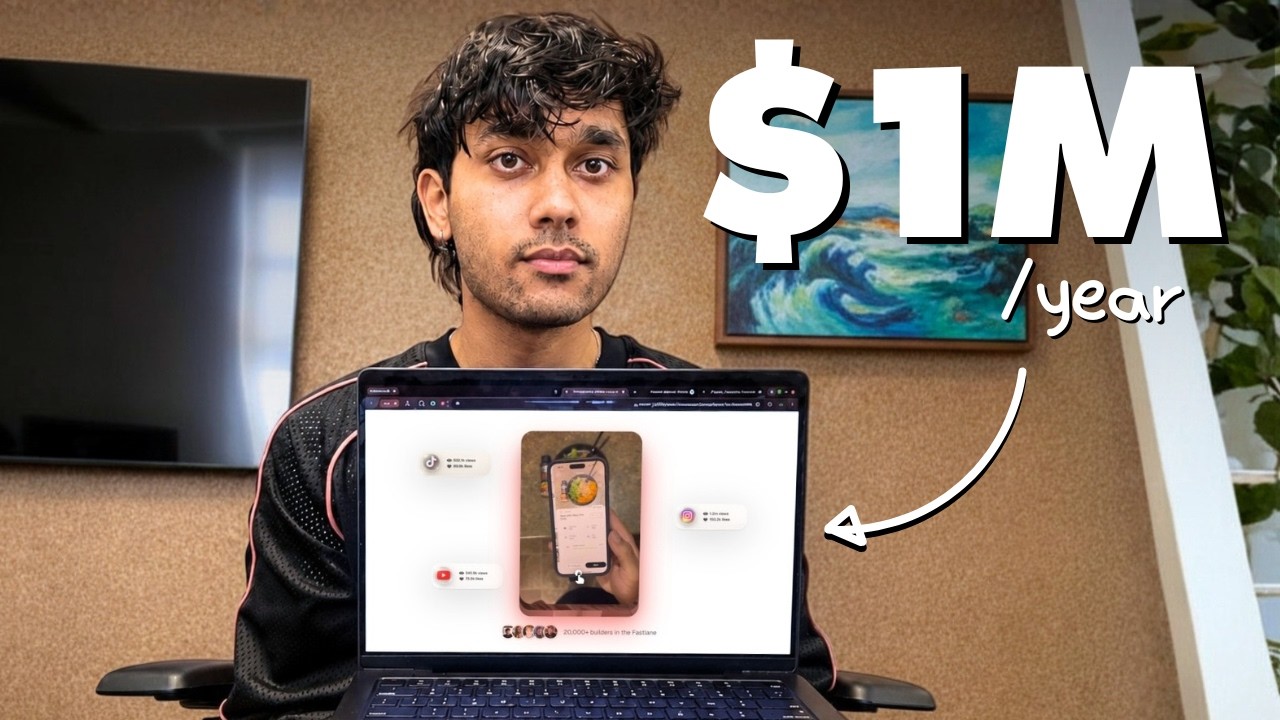
Pat Walls interviews Gaurav, founder of Fastlane, an AI short-form marketing tool that generates viral TikTok, Instagram Reels, and YouTube Shorts for solo builders; launched two months ago, it now does $69K MRR, serves over 1,000 paid users, and has crossed $1M ARR across the business.
Fastlane business model and traction
Fastlane learns what’s trending in a user’s niche from their website, then creates thousands of tailored short-form videos and schedules them directly to TikTok, Instagram, and YouTube.
Primary users are solopreneurs building mobile apps or SaaS products.
Stripe dashboard shows a sharp hockey-stick growth curve starting at public launch on March 23rd; the business went from ~$16K ARR (paid beta) to over $1M ARR in roughly two months.
Origin story: from Starter Story viewer to founder
Gaurav discovered software building around mid-2024 through a Starter Story video about Puff Count (Steven’s app) and immediately started building his own apps.
After building a few apps, he hit the same wall many founders do: building is easy, but marketing is hard and he didn’t want to spend heavily on ads.
He met co-founder Joe (also called Jock in the transcript), who faced the identical problem with his own SaaS project.
They realized the core pain point: founders build products but don’t know what videos to create or how to get distribution on short-form platforms.
Build timeline and the pivot from horizontal to vertical
July 2024: started building “Cast AI,” a horizontal marketing tool attempting to do SEO, LLM SEO, Reddit engagement, and short-form content all in one.
August–September: shipped multiple V1s of the horizontal product.
October: after customer feedback, decided to go all-in on short-form content only.
December: shipped a vertical short-form beta to a ~2,000-person waitlist.
March 23, 2025: publicly launched Fastlane after months of iteration on the beta.
Tech stack (2026 solo-builder friendly)
Backend/database: Convex
Frontend hosting: Vercel
Content-generation microservice hosting: Railway
Authentication: Clerk
Transactional/marketing email: Resend
Logs and observability: Axiom
LLM models: OpenAI and Claude (copy, captions)
Image/video generation: File AI
Development accelerator: Claude Code on the 20x Max plan — credited as essential for shipping speed.
The “insanely obvious” secret: 2,000 customer calls in ~8 months
Since August 2024, Gaurav and his co-founder have run ~20 customer calls per week, every week, totaling ~2,000 calls.
Inspired by Paul Graham/Y Combinator’s emphasis on talking to users.
Simple in-product trigger: a rainbow-bordered “Book a call with the team for 7 days extra access” button linking to Calendly; users booked because they wanted the extra access.
Calls were not sales pitches — they were structured discovery, usability, and success interviews.
Customer intelligence system: turning calls into a queryable knowledge base
Every call recorded with an AI note-taker; notes and transcripts dumped into Notion using a consistent framework.
Built a “Fastlane Customer Intelligence” dashboard (by non-technical co-founder Jock using Claude Code + MCPs) that centralizes all customer data.
Features: segmentation by business type, subscription tenure, company name; “customer love score” algorithm combining usage, retention, and feedback; filters for why users signed up (e.g., “curious” vs. “need marketing now”) revealing retention differences.
Product roadmap indexed on what high-love-score customers request; success metrics tracked (views, conversions, app installs).
Three-phase customer call process
Phase 1 – Customer discovery (pre-MVP): Used The Mom Test principles — never ask “would you use this?” or “do you like my idea?”; instead ask “how are you solving this problem today?”, “walk me through the last time you solved it,” “what did it cost in time/money?”, “what happens if you do nothing?”; sourced calls from personal network, Twitter DMs, even paid participants; stopped when a shared, painful problem emerged repeatedly.
Phase 2 – Usability testing (MVP stage): “Fighting for customers one-to-one” — crawled Reddit, posted lead magnets, emailed waitlist signups to book calls; sent a link to the platform, asked users to share screen, then stayed silent and watched them navigate; resisted the urge to help when users struggled, because friction revealed real UX problems; this phase shaped the MVP into something usable and intuitive.
Phase 3 – Customer success (post-launch): Tracked power users (highest usage, best results), jumped on calls with them, asked Mom Test–style questions about how the platform helped; learned that short-form content driving views, conversions, and app installs was the real value driver; doubled down entirely on that outcome.
Product demo: the Tinder-style UI born from watching users struggle
Core interface mimics Tinder: center shows the generated video; left panel shows a trending reference video in the user’s niche (e.g., a slideshow with ~3M views); Fastlane creates a matching-format video for the user’s product.
User swipes left (no) or right (yes); on “yes,” presses schedule, selects account (TikTok/Instagram/YouTube), AI writes the caption, hits post — live in ~5 minutes.
Multiple formats supported: slideshows, hook demos, etc., all applying the trending format to the user’s product.
Gaurav emphasizes: this UI would never have been conceived without hundreds of usability sessions watching founders get confused by earlier, more complex interfaces.
Final advice for builders
“You need to make something people want and the best way to know this is to actually talk to them.” — overcome the fear of rejection; they already think it’s bad, you just don’t know yet.
Don’t be afraid to go against the norm; Gaurav references Australian “tall poppy syndrome” — back yourself and go all in.
Pat and producer Gus reflect: the “secret” isn’t a marketing tactic — it’s knowing your customer deeply; even at Starter Story (a media company), Pat still gets on calls to understand pain points and desires, which drives every content and product decision.
Before running calls, you must be solving a painful problem; Starter Story offers a free “million-dollar problems database” (90+ problems with revenue potential, startup costs, real businesses solving them) linked in the description.