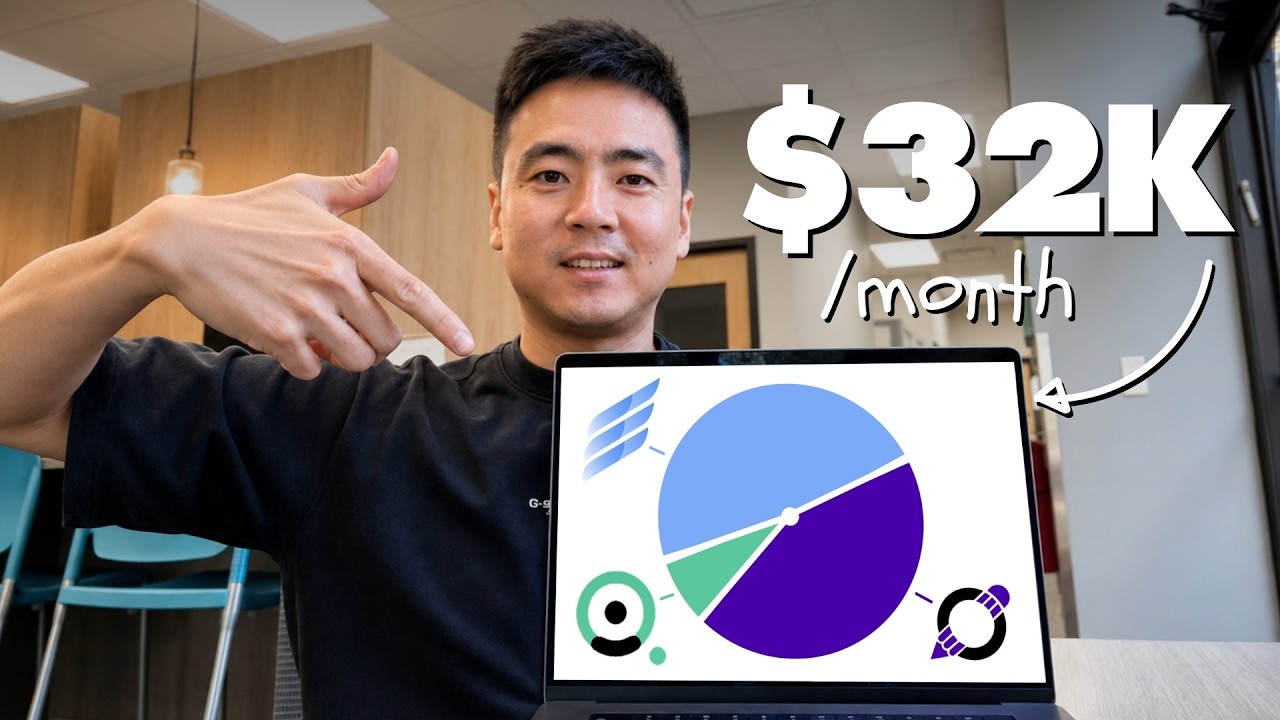
Rashid built a portfolio of three bootstrapped database SaaS products — AngelMatch, InvestorHunt, and JournalistHunt — that collectively generate roughly $32,000 in monthly recurring revenue by helping founders and businesses find investors and journalists through curated, searchable directories.
Business overview and revenue
AngelMatch is an all-in-one platform with a database of ~125,000 angels and VCs that helps early-stage startups raise capital; it generates ~$29,000 MRR from ~360 active subscribers, with a 33% trial-to-paid conversion rate and 800–1,000 daily clicks across organic, referral, direct, and paid Facebook traffic; pricing starts at $59/month and scales up to a few thousand dollars depending on outreach volume.
InvestorHunt is a simpler investor database product making ~$2,800 MRR with no active marketing — purely SEO-driven — and tiered pricing at $57, $97, and $297.
JournalistHunt is a database of ~200,000 journalists for press outreach, currently at ~$260 MRR; users tend to buy the $49–$99/month tiers.
At its peak, the portfolio reached $43,000 MRR.
Founder background and problem discovery
Rashid is a non-technical founder who studied finance; in his final year of college he and a friend raised $100,000 from family and friends to build a fintech investment app, then maxed out credit cards and took personal loans to keep going.
To raise professional capital, they manually compiled a list of angels and VCs, which got them meetings with notable investors — revealing that cold emailing works but finding investors is tedious and time-consuming.
Realizing other founders faced the same pain, they tested the idea by building a 40,000-investor database and launching on Product Hunt, earning $4,000 in the first month and confirming demand.
Growth and marketing strategy
After seeing only ~60 daily clicks in Google Analytics, Rashid hypothesized that 10x traffic could 10x MRR and pivoted to SEO.
Hired six content writers to publish blogs consistently while the tech team built free tools and valuable resources for users.
Over 6–8 months, traffic grew and MRR scaled from ~$3,000 to ~$20,000 through SEO supplemented by Meta ads.
Programmatic SEO now drives roughly half of revenue; Rashid emphasizes doing it consistently.
Secret to successful database products
They work because they solve a painful, specific problem for a well-defined audience — in this case, early-stage founders raising capital, a problem Rashid lived himself.
Positioning as a founder-built tool for founders created trust and relevance.
Niche focus matters: a real estate investor database or stock trader database could work similarly, but the problem must be acute and the audience willing to pay.
Ideas for 2026
Influencer database categorized by location, audience size, and content niche, with a paywall — businesses actively book influencers and struggle to find/reach them.
Newsletter database for sponsored placements — curating newsletters that accept sponsorships saves brands the manual effort of discovery and outreach.
Database product playbook (starting over in 2026)
Step 1: Pick a database/directory idea that solves a concrete, painful problem — not just any directory.
Step 2: Collect the data — manually at first (as Rashid did), or via automated scraping if technically able.
Step 3: Launch, get eyeballs, and look for payment signals — signups and willingness to pay validate the idea.
Step 4: Double down on programmatic SEO for sustainable, compounding traffic; it brings ~50% of revenue for Rashid’s portfolio.
Tech stack and tools
Front end: Next.js
Back end: Nest.js
Database: PostgreSQL
SEO: Ahrefs
Hosting: DigitalOcean
Email outreach infrastructure: Nylas (powers in-app outreach in AngelMatch)
Security/bot prevention: Cloudflare
Email marketing/flows: Klaviyo
Workspace email: Google Workspace
Total tooling cost: ~$62/month across all apps.
Final advice
Be patient, put in the work, and never give up — many founders who started alongside Rashid earned more early on but quit and disappeared; persistence is the differentiator.
The business model is durable: it’s not an AI trend but a B2B directory solving a high-stakes problem (startups need investors or they shut down), which compounds over time rather than spiking and crashing.
Reflections on why this works
The core insight: these products succeed because they solve a painful B2B problem — founders must raise capital or the company dies, so they pay readily.
B2B is critical; B2C directories (e.g., dog trainers) struggle to command $97/month because consumers lack the same urgency and budget.
Influencer databases are a strong parallel: businesses book influencers, discovery is hard, and the pain justifies payment — unlike many B2C directories that fade.