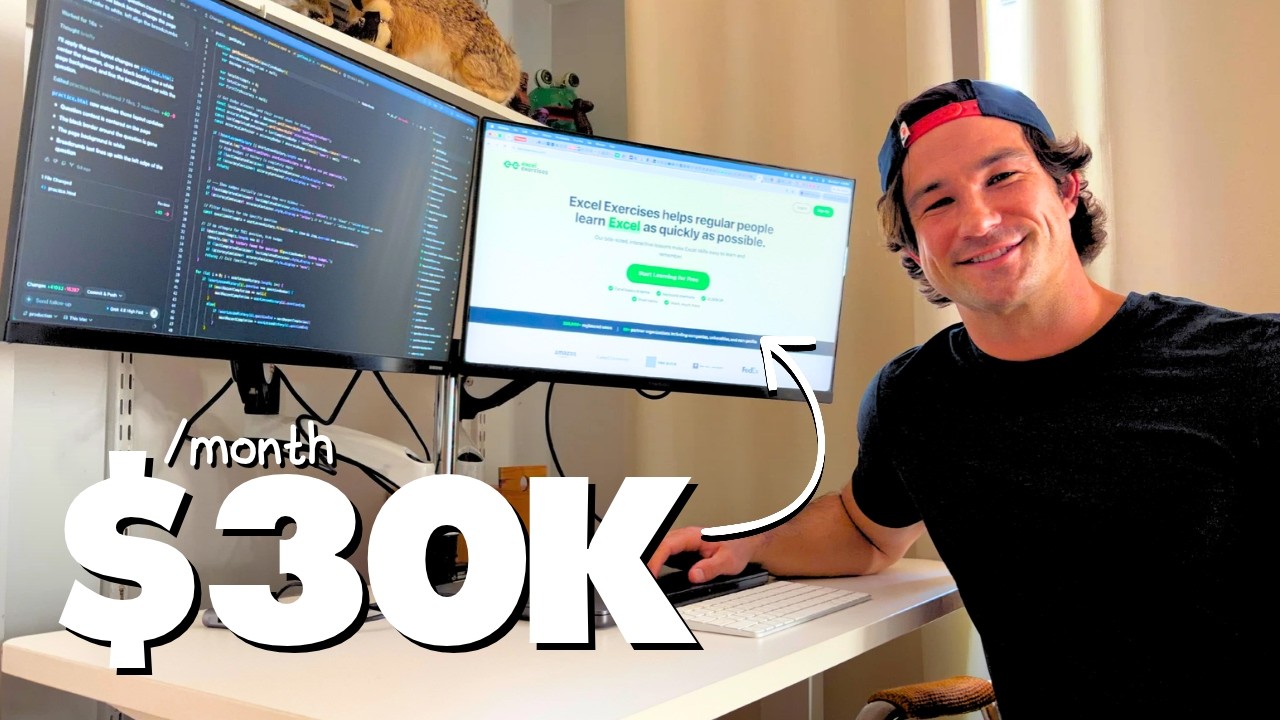
Jake built Excel Exercises (excexercises.com), a web app that teaches Excel functions and keyboard shortcuts through interactive, browser-based simulations instead of videos. It now generates $30–35K/month with ~2,500 active subscribers and runs largely automated.
The product and who it serves
Teaches Excel hands-on: users type formulas directly into spreadsheet-like tables in the browser, get instant feedback, earn points, and progress through lessons.
Core users are people facing career transitions — recent graduates, job switchers, or new hires who overstated their Excel skills and need to close the gap quickly.
Freemium model: a handful of free lessons let visitors experience the interactive format before hitting a hard paywall; this sample is critical because the “learn by doing” approach is unfamiliar to most.
Origin story and early validation
Jake studied finance, worked in corporate finance wearing a suit, and endured mandatory video-based Excel training that put him to sleep.
The idea clicked while doing a Duolingo lesson: “Duolingo but for Excel.”
He taught himself to code via YouTube and Stack Overflow, built the first version over months in his parents’ basement, and deployed it live without a separate dev environment or any promotion.
First validation: woke up to a $50 Stripe notification from a stranger; the site was “really ugly” and “looked like Russian hackers,” but a few more sales trickled in over weeks — proof people would pay for the concept despite poor execution.
Technical build and stack
First working version took months; biggest challenge was building tables that look, feel, and behave like a real spreadsheet (Excel/Google Sheets) so users aren’t frustrated.
Stack kept extremely simple: HTML, CSS, vanilla JavaScript (much copied from Stack Overflow 6 years ago), now supplemented by Claude for new code.
Hosted on Google Cloud Platform (<$100/month), Google Analytics (free), SendGrid for email ($35/month), plus Stripe fees — total recurring costs well under $200/month.
Growth: zero to $10K/month (organic/SEO)
Early traction came from SEO, not Reddit posts (which had minimal impact).
Counterintuitive tactic: wrote 1,500–2,000 words of explanatory content directly on the landing page — “here’s what this is, how you’ll learn, why it’s better than videos” — which got the site indexed and attracted high-intent traffic.
Marketing gurus advised against that much text on a homepage, but Jake kept it because it drove nearly all sales.
Growth: $10K to $30K/month (paid ads + B2B expansion)
Paid advertising became the biggest growth lever, but forced a shift in mindset: with free organic traffic, every subscription was near-pure profit; with paid acquisition, he had to track CAC, LTV, and payback periods rigorously.
Product-led B2B motion emerged organically: individual learners liked the product, recommended it to their bosses, and Jake started closing university and corporate deals (e.g., 50-seat team purchases).
This B2B channel accelerated revenue without proportional ad spend.
Unit economics insight that unlocked faster growth
Stripe’s blended LTV metric masked segment differences. Jake exported all payments, separated monthly vs. annual subscribers, and discovered:
Annual customers were highly profitable.
Monthly customers barely broke even with a 4–5 month payback period.
Action: doubled the monthly price while keeping the annual price unchanged. Growth “took off” immediately after this segmentation-driven pricing change.
Advice for builders looking for simple ideas
Start with a problem you have intimate knowledge of; you won’t understand the user’s mindset, goals, or mental models otherwise (avoid copying trending ideas you don’t personally live).
Get the product into strangers’ hands as fast as possible — even when it’s embarrassing. Jake’s first paying users arrived while the site looked like a phishing scam.
If you’re not embarrassed by v1, you waited too long.
For paid acquisition, know your granular unit economics: segment LTV and CAC by plan, channel, and cohort; blended averages hide the levers that actually move growth.