-
Colin
- Background and origin story
- Was fired twice and laid off once while working full-time jobs and decided to stop working for other people.
- Helped a friend run a Kickstarter for wearable tech, threw a launch party in Seattle, and gained life-changing mentorship in his 20s.
- Bought three mentors lunch weekly, asked questions, and worked for himself for 6.5 years.
- Incorporated Sheets & Giggles in October 2017, shipped the first box in October 2018, and reached about $1.2 million in sales by November 2020 (first million-dollar month at ~25 months).
- Pivotal moments and turning points
- Validated the idea by building a brand identity map, financial model, and business model, then shared them with respected peers for feedback.
- Sold before building by offering a $100 sheet set for $69 to early email signups, captured 11,000 emails with a 45% conversion rate.
- Achieved $45,000 on day one of a campaign, which snowballed into a $284,000 campaign, driven by high email conversion and personal engagement.
- Background and origin story
-
Products and Offerings
- Core product(s) and what each one does
- Direct-to-consumer bed sheets and related bedding sold primarily via sheetsandgiggles.com on Shopify, with additional sales on Amazon.
- Products include sheets, comforters, duvet covers, pillowcases, throw blankets, pillows, crib sheets, mattress protectors, and a mattress launched in late 2022.
- Supporting tools, side projects, or experiments mentioned
- Started with five colors and five sizes; expanded to seven sizes and 17 colors with hundreds of SKUs.
- Core product(s) and what each one does
-
Metrics and Financials
- Revenue figures, user counts, and financial milestones
- Reached about $1.2 million in sales in the first million-dollar month.
- Day-one campaign revenue of $45,000, scaling to $284,000 in the full campaign.
- Sales split roughly 90/10 or 80/20 between Shopify and Amazon.
- Revenue figures, user counts, and financial milestones
-
Strategy and Growth
- Overall vision and positioning
- Build a business model before the product, focusing on founder-market fit and a large, differentiated category.
- Differentiate by not ironing sheets and by creating a brand that polarizes (aiming to piss off at least 20% of people).
- Primary growth engine or method
- Email list building and high-conversion pre-launch signups, followed by social proof and personal engagement.
- Paid and organic channels including Facebook, Instagram, Google, Amazon, podcasts, and YouTube sponsorships that align with the founder’s personality.
- Key tactics, channels, or strategic steps
- Used crowdfunding math to set day-one goals, targeting $30,000 from 300 customers at $100 AOV.
- Answered every social media comment and customer email personally and wrote all website copy for years.
- Relied on referrals and emotional investment by involving customers in product decisions via surveys.
- Overall vision and positioning
-
Tech Stack and Infrastructure
- Tools, platforms, and technical approaches referenced
- Shopify for ecommerce, Google Analytics, Google AdWords, Rebuy for cart upsells, AfterShip for order tracking, Okendo for reviews.
- Showwiz (or similar) apps for tracking, an AI chatbot (SiteGpt) trained on the website to handle customer care and offer discounts.
- Midjourney and Dolly for image creation; ChatGPT to overcome blank-page problems for copy ideation.
- Notable technical decisions, trade-offs, or architecture choices
- Chose tools that integrate directly with Shopify and reduce customer-care load; prioritized AI chat for cost efficiency and sales.
- Tools, platforms, and technical approaches referenced
-
Lessons and Advice
- Direct advice given to other founders
- Build a brand identity map, financial model, and business model before anything else; validate with respected peers, then with customers.
- Sell before you build using wireframes, signups, or promises of launch pricing to prove demand.
- Choose a brand name that is spellable, shareable, memorable, descriptive, SEO-friendly, and has a .com.
- Hard-won insights and key takeaways
- Engage personally and granularly with customers; kindness plus hard work plus intelligence leads to good outcomes.
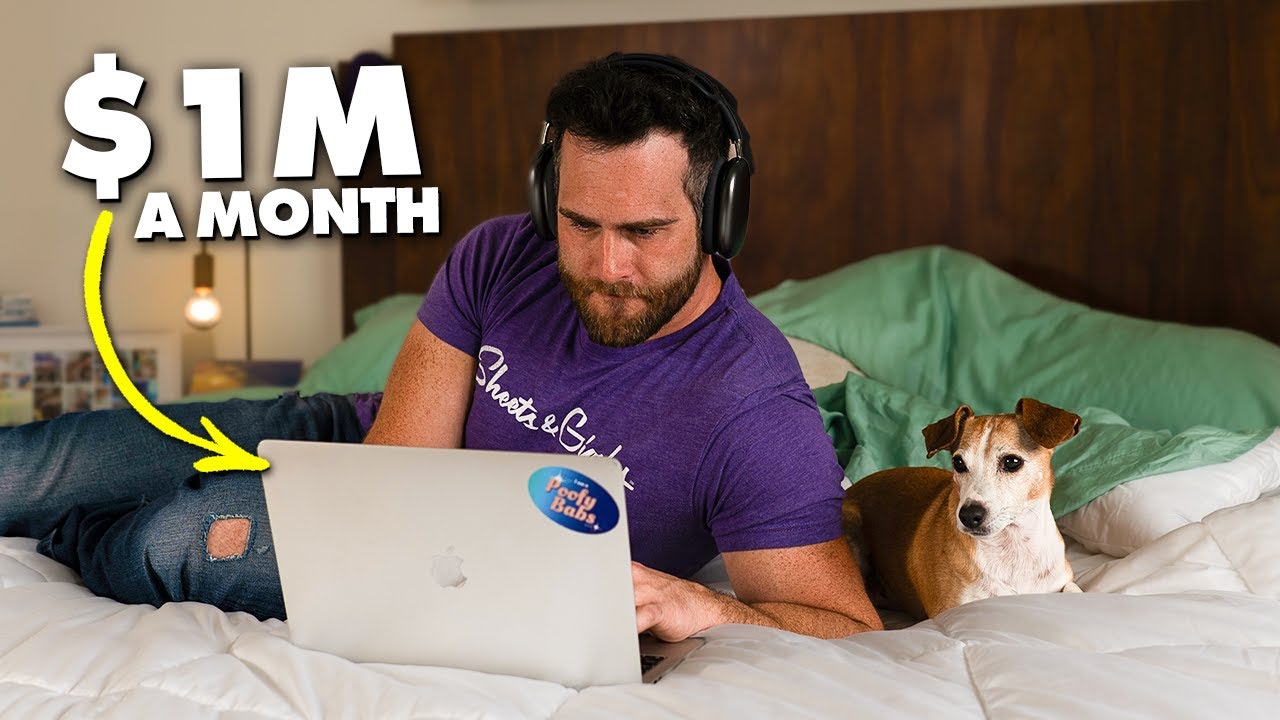
- Work-life integration can include non-traditional spaces (working from bed, a river) to maintain creativity and mental wellness.
- Direct advice given to other founders
I Make $1M/Month From Bed
Starter Story • • 15min • #33