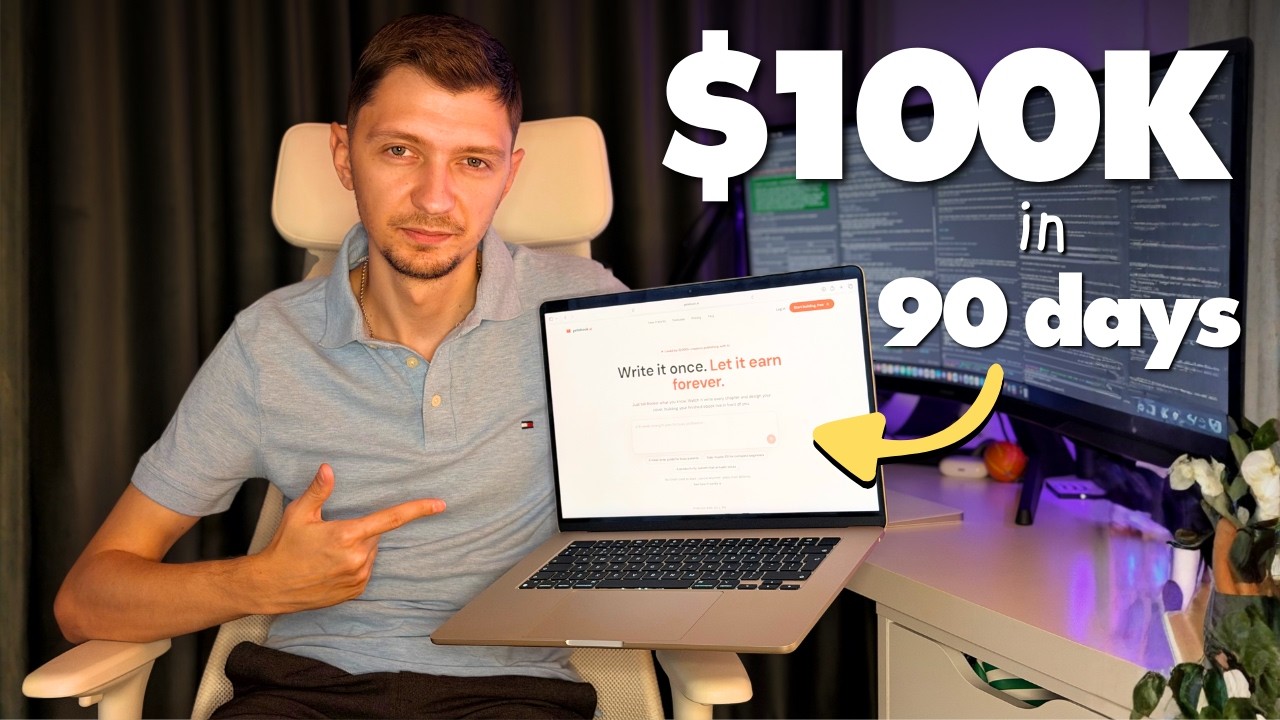
Bogdan, a 28-year-old founder with a computer science degree who never liked coding, built gettbook.ai — an AI wrapper that turns any idea into a complete, formatted ebook — and grew it to $130,000 in revenue in under four months using Meta Ads and a multi-product funnel, all while running a social media marketing agency with his wife.
The Product: gettbook.ai
gettbook.ai helps users turn any idea into a complete ebook — lead magnets, courses, workbooks, coloring books — without needing Canva or other formatting tools.
Target customers: digital product sellers, marketers, creators, affiliates, and business owners who sell ebooks or use them as lead magnets.
Core value: removes repetitive work (research, structure, writing, formatting, packaging) while leaving original thinking and quality control to the user.
Pricing: subscription starting at $29/month, plus credit packs as one-time upsells, plus tutorials and smaller digital tools sold in the funnel.
Revenue & Traction
$130,000+ total revenue in the first four months.
1,700+ paid customers, ~5,000 signups.
~$70,000 MRR (subscription revenue), with total revenue higher due to credit upsells and digital product sales.
40–50% profit margins monthly.
Founder Background
Graduated in computer science for business management but never learned to code or enjoyed it.
Runs a small social media marketing agency with his wife — background in advertising, customer acquisition, and digital products.
Before gettbook.ai, personally sold ebooks online using ChatGPT + Canva and promoted affiliate products.
“Vibe coding” (AI-assisted development) enabled him to build despite not being a traditional developer.
Idea Origin & Validation
Idea came from personal pain: repeatedly creating ebooks manually for his own business and wondering why no single tool handled the full workflow.
Knew demand existed because he was already selling the end product (ebooks) himself.
Real validation: launched Meta Ads and strangers started paying for the software.
Building the Product (Vibe Coding Journey)
First version built with Lovable (no-code AI builder) — fast to start but became unmanageable as complexity grew; Bogdan didn’t understand the codebase.
Rebuilt entirely with Claude Code — more control, but still imperfect; some parts already need another rebuild for maintainability.
Key lesson: AI lets you build incredibly fast, but if you don’t understand what you’re building, it also lets you create a mess incredibly fast.
Now more methodical: sets up basic structure, rules, and architecture upfront to avoid technical debt.
Tech Stack
Coding: Claude Code (primary), ChatGPT (research).
Backend & auth: Supabase.
Hosting: Vercel.
Email: Resend API.
AI generation: OpenAI and Gemini APIs.
Growth Strategy: Meta Ads & Funnel Optimization
Primary channel: Meta Ads (Facebook/Instagram).
Approach: treated it like a direct-response marketing business, not a traditional SaaS.
Tested massive volume of creatives, angles, offers, audiences, landing pages, and funnels — different customers want the tool for different reasons (sell on Amazon KDP, lead magnets, courses, coloring books, etc.).
When a creative works, build variations around it to combat fatigue; learned the hard way that stopping creative production kills performance.
Funnel designed to increase LTV: subscription → credit upsells → tutorials → smaller tools → higher allowable CAC.
Current ad spend: $20–30k/month, scaled from $200/day after proving profitability.
Unit Economics & Profitability
Started at $200/day ad budget, scaled only when profitable.
Now spending $20–30k/month on Meta Ads with 40–50% profit margins.
High LTV from funnel (credits, tutorials, digital products) justifies higher upfront CAC.
Product Demo Example
Live demo: created a Los Angeles–themed coloring book for a 1-year-old in ~minutes.
Selected “kawaii chibi” style (popular on Amazon KDP), 16 pages, custom cast of characters (Luna the Pup, Milo the Cat).
Generated preview with landmarks (Venice Beach, Santa Monica), downloadable as a finished PDF.
Key Lesson / Advice
Don’t quit when it feels like a mess or takes longer than expected — every failure teaches something that improves the next version.
Persistence through the “messy middle” is what separates shipped products from abandoned ideas.