-
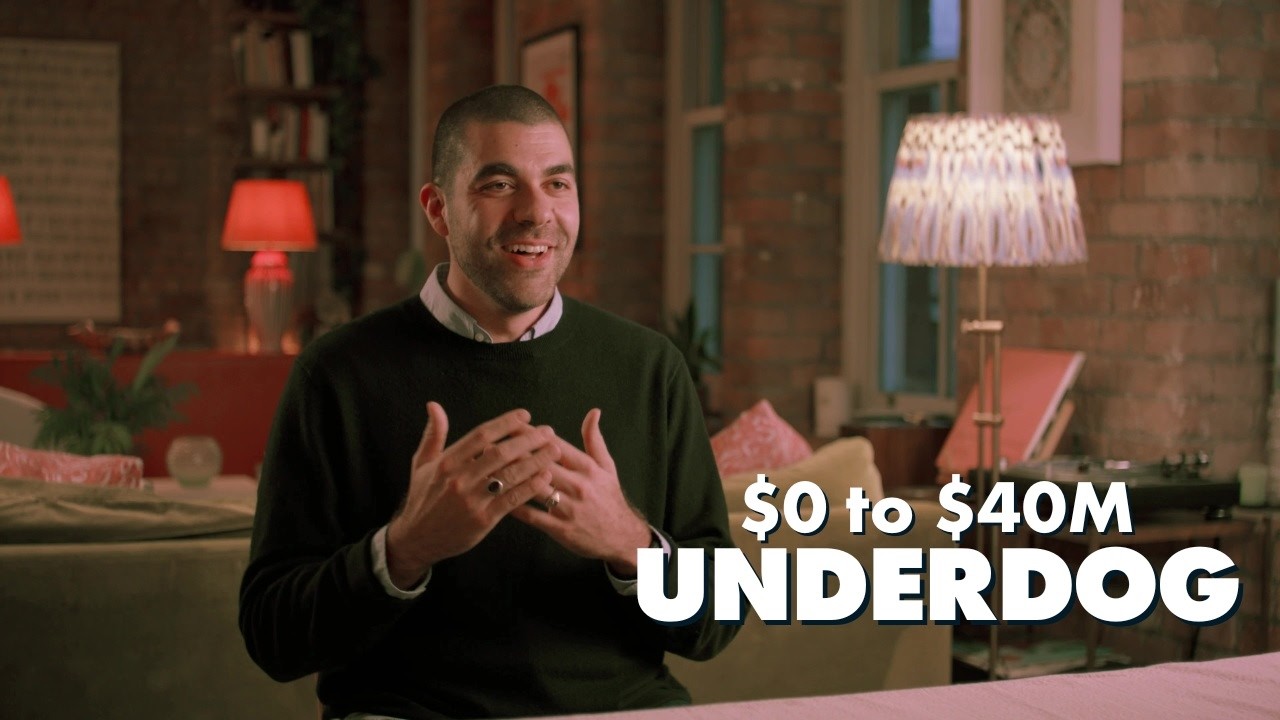
Saba Kenned
- Background and origin story
- Saba grew up in a rural area with no clear entrepreneurial direction, spending free time online and learning graphic design via a cracked version of Photoshop before studying design in college and university.
- Saba left his first post-graduation job after one week, rejecting corporate career progression to own his time and avoid traditional life milestones like suburban homeownership.
- Saba decided to build an app after reading that Candy Crush generated £1 million daily.
- Saba met co-founder Tim one year post-graduation via a global hackathon, connected in person over coffee to start collaborating on projects.
- Saba and Tim tested multiple failed ideas over 2–3 years, focusing first on proving the team could execute end-to-end product builds (buy a domain, build a backend, launch a landing page).
- Pivotal moments and turning points
- Saba and Tim launched video startup V, inspired by Gy’s GIF editor to build basic browser-based video editing tools with features including video upload, text overlay, and trimming.
- The team operated with extreme frugality in early days: Saba and Tim shared a single co-working space access card, negotiated Crisp chat costs from $100 to $20 monthly, biked everywhere to avoid transit costs, ate discounted late-night food and pre-made lunches, and skipped paid social events.
- The team faced major setbacks: eviction from a VC office, both interns quitting on the same day, repeated funding rejections, selling personal crypto holdings to keep the company afloat, and depleted personal bank accounts.
- Both founders took full-time jobs, diverting half their monthly salaries to hire two engineers, and grew to 30,000 monthly users 8–9 months later with no revenue.
- Saba and Tim applied to Y Combinator after reaching 30k users, advanced to the interview round, received an initial rejection, implemented feedback to add paid subscriptions (gaining 20 paid users in one weekend), requested reconsideration, and received a final rejection.
- Saba shifted full focus to growth after the YC rejection, prioritizing week-over-week increases in traffic and revenue.
- Saba drove growth via SEO with no marketing budget: built 500+ landing pages for high-volume search terms (e.g., “trim video”, “crop video”), recorded a dedicated YouTube video for every landing page, and leveraged brute-force execution despite dyslexia.
- Business growth and current status
- Revenue scaled rapidly after monetizing: $1 million in the first year, $2 million 4 months later, $3 million 2 months after that, $6 million 6 months after reaching $3 million, with total revenue reaching $10 million–$40 million.
- No exit, acquisition, or additional current operational details are mentioned.
- Background and origin story
-
Products and Offerings
- Core product: V, a browser-based video editing tool offering basic features including video upload, text overlay, trimming, and cropping.
- No additional products, side projects, or experiments are mentioned in the transcript.
-
Metrics and Financials
- User growth: Reached 30,000 monthly active users 8–9 months after hiring two engineers, with no revenue at that stage.
- Revenue milestones: $0 to $1 million in the first year after monetizing, $2 million 4 months later, $3 million 2 months after that, $6 million 6 months after reaching $3 million, total revenue between $10 million–$40 million.
- Cost efficiency: Negotiated SaaS subscriptions to lowest tiers, shared co-working resources, sold personal crypto to fund operations, diverted half of both founders’ full-time salaries to cover engineering hires.
-
Strategy and Growth
- Vision: Build accessible, basic video editing tools directly in the browser for broad user adoption.
- Primary growth engine: SEO, selected due to a zero marketing budget.
- Key tactics:
- Targeted high-volume, specific search terms with dedicated landing pages (500+ total).
- Created matching YouTube videos for every landing page to drive organic traffic.
- Prioritized consistent week-over-week growth in traffic and revenue after the YC rejection.
- Implemented YC feedback to launch paid subscriptions, gaining 20 paid users in one weekend.
-
Tech Stack and Infrastructure
- Tools: Crisp chat (negotiated down to $20/month from $100/month), browser-based video editing infrastructure (no additional tools specified).
- Notable decisions: Built lightweight, basic video editing tools in-browser to lower the barrier to entry for users.
-
Lessons and Advice
- Direct advice to founders: Persist through rejection and setbacks, keep building even when progress feels slow or impossible.
- Hard-won insights:
- Early-stage validation matters more than perfect ideas: test whether the team can execute a full product build cycle before refining concepts.
- Extreme frugality is critical to extend runway in pre-revenue stages.
- Rejection (e.g., YC denial) can serve as a catalyst to double down on monetization and growth.
- Scaling a business is an endurance marathon, not a short-term sprint, requiring consistent focus on core metrics.
- Founders will face increasing vulnerability and paranoia as the company grows, but the work remains deeply rewarding.
- Near-failure points (eviction, intern resignations, funding rejections, depleted funds) are normal, and persistence through each is the difference between success and failure.
- Adopt a mindset of “if others can do it, we can too” to overcome self-doubt.
I Got Rejected From YC, Then Built a $200M Startup
Starter Story • • 15min • #64