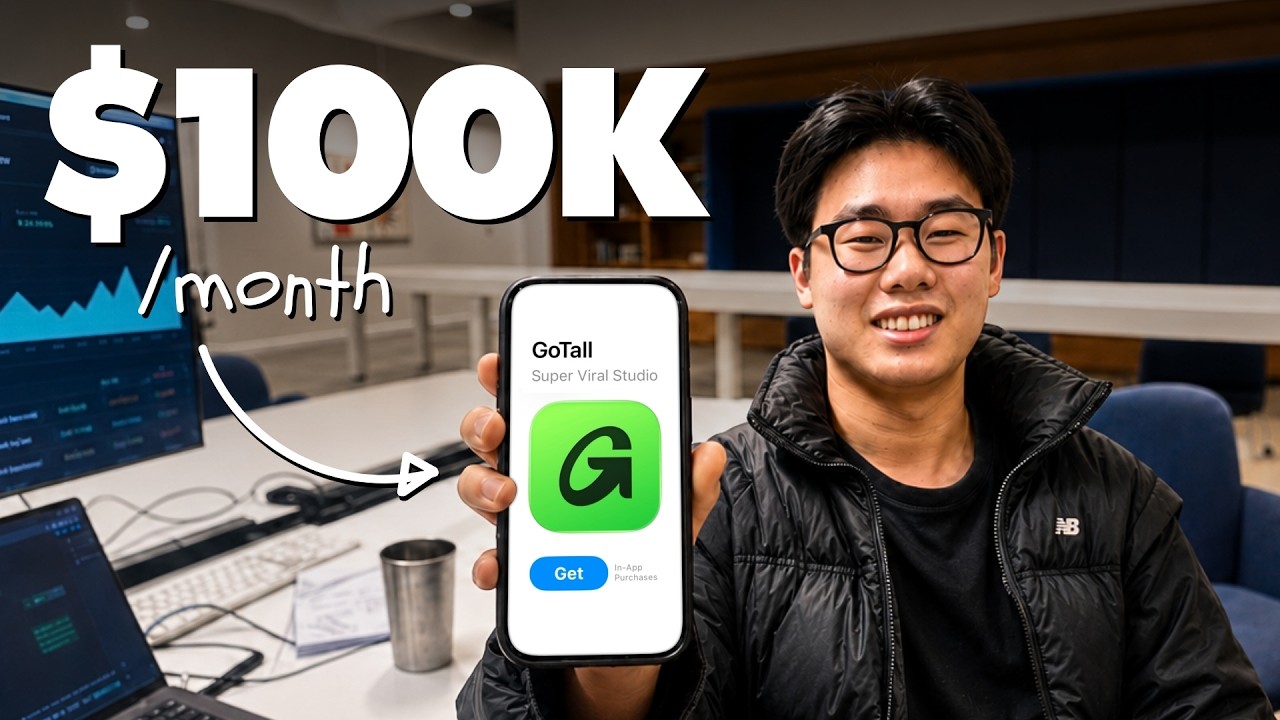
Michael, a 20-year-old NYU finance student rejected from his dream jobs, built a height-prediction app called Go Tall that now averages $100K/month with roughly 1 million total downloads across iOS and Android.
Michael’s background and motivation
Was recruiting for finance roles at NYU and got rejected from every target firm.
Had built apps as a teenager but lacked marketing skills; decided to learn by shipping any viable idea.
Viewed each attempt as marketing practice even if the app failed.
The app: Go Tall — what it is and the numbers
Height-prediction app for teenagers that also coaches habits (sleep, nutrition, stretches) to help them reach their genetic height potential.
Subscription model: $35/year or $5/week; freemium tier lets users log habits and scan meals without the prediction.
~700K iOS downloads, several hundred thousand on Android; ~$100K/month average revenue.
Paywall shows after a long onboarding; 91% paywall view rate despite length.
Finding and validating the idea
Spotted a similar app listed for ~$20K on acquire.com, signaling a validated market.
Personal pain point: at 13 he searched “height calculator” online and found nothing useful.
TikTok comment validation: height videos flooded with teens posting parents’ heights and asking for predictions.
Launched MVP; first sale arrived within two days with minimal views — strong signal of latent demand.
Received 10–20 DMs/day asking for personal height predictions, confirming emotional urgency.
Growth strategy: organic → UGC → paid ads
Month 1: posted 10 TikToks/day experimenting with formats; one format (replying to comments with predictions) went viral.
Replicated format on two more accounts (including girlfriend’s); all blew up, proving format was teachable.
Hired UGC creators via cold DM (50/day); low cost because format was simple.
Attribution was clean: single channel, single format made it easy to map views → downloads → revenue.
Tech stack (kept cheap and cross-platform)
Expo for single codebase across iOS and Android.
Superwall for paywall management and testing.
Adapti to accelerate Apple payout cycles.
Singular MMP for attribution at ~$0.03 per install.
App walkthrough and key product decisions
Onboarding is intentionally long: collects parent heights, current height, age, puberty stage, sleep, nutrition, etc. — each input tied to a research citation.
Prediction engine blends CDC growth charts with peer-reviewed studies (puberty timing, nutrition, sleep) to adjust the baseline estimate.
Prediction updates weekly as users log habits; the dynamic number drives retention and subscription justification.
Freemium features (stretches, meal scanning, sleep logging) give non-payers value while keeping the core prediction gated.
Advice for founders: ego, validation, and idea evaluation
Let go of ego: the idea felt “embarrassing” and conferred zero status; peers reacted with skepticism.
“Climb cringe mountain” — willingness to post silly TikToks and pursue unglamorous ideas unlocks hidden gems.
Validation heuristic: look for unsolicited DMs and comments proving people care enough to ask personally.
Use Maslow’s hierarchy as a filter: Go Tall hits esteem (respect, status) and love/belonging (dating prospects) — two strong drivers.
Competition is not a blocker: calorie trackers still launch and hit $30K/mo alongside giants like MyFitnessPal; execution and marketing matter more than novelty.
Host reflections on the pattern
The idea looked trivial from outside (“height predictor?”) but mapped to a universal, high-emotion pain point.
Founder’s insecurity and uncertainty at the start — zero revenue, social pressure — is the norm; pushing through when nobody believes is the defining founder trait.
Health/self-improvement/relationships categories consistently produce high-willingness-to-pay problems.