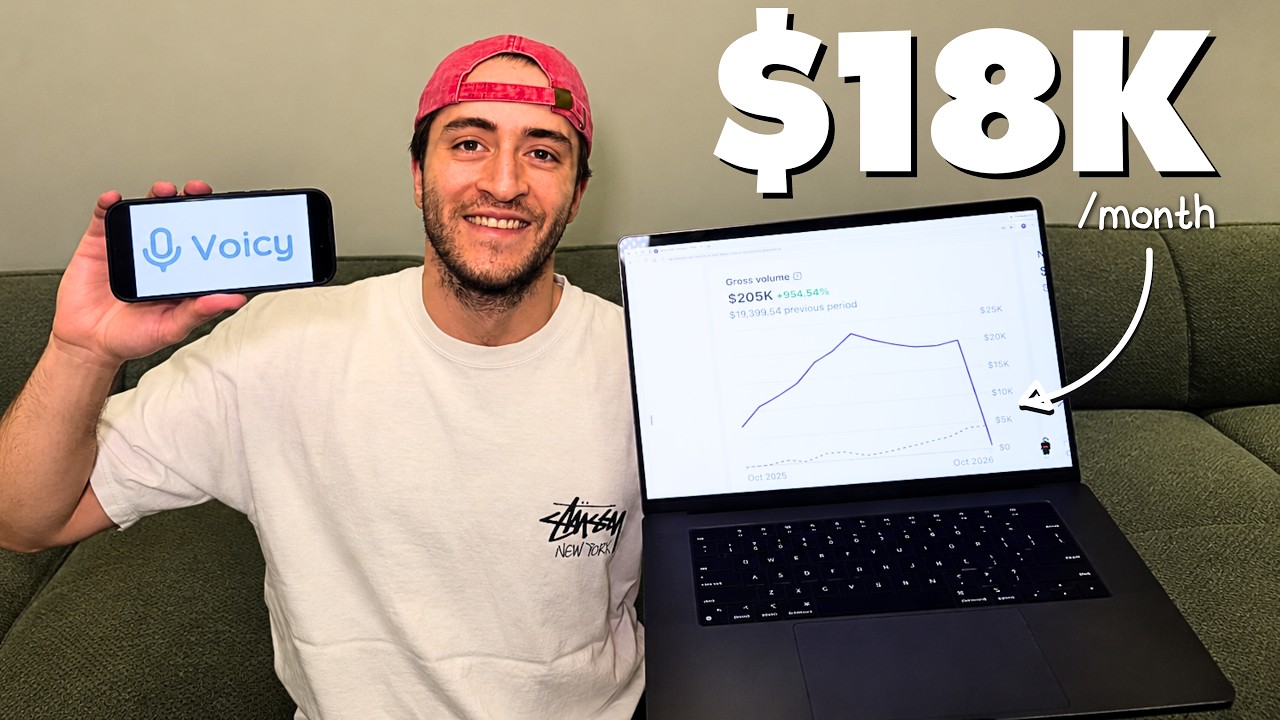
Koresh built Voicy, a speech-to-text app powered by OpenAI’s Whisper API, as a side project while working full-time as a product manager; it now generates $16–20K/month with 2,500 daily active users by serving older adults and people with disabilities — a segment overlooked by better-funded competitors in a seemingly saturated market.
Origin and initial build
The idea came when Koresh’s father visited him in London and typed painfully slowly; Koresh, bedridden from illness, wished he could give his dad dictation everywhere on the computer.
He built the MVP as a Chrome extension in two weeks using ChatGPT 3.5/4 to generate code, then copy-pasting into an IDE.
The Chrome Web Store provided immediate organic traffic; after asking five friends for reviews, he got 10–20 page views on day one and reached ~100 users quickly.
He later discovered Cursor, which 10x’d his coding productivity, and expanded to Windows (Electron, 3 months), Mac (1 month), Linux (2 weeks), iOS (6 months ago), and Android (one-shotted with Claude Opus 4).
Product and business model
Voicy works anywhere on desktop and mobile, letting users dictate instead of type.
Pricing: $8.49/month subscription or $260 lifetime deal; lifetime deals drive revenue to $16–20K/month despite $11K MRR.
1,400 active subscriptions; 20% of users receive a 20% disability discount (requested via email).
Tech stack: Framer for website ($200/mo), Cursor and Codex for coding, PostHog (free tier) for analytics, Loops for email, Tella for video creation, Ionos VPS ($40/mo), and RomeoSEO (his own SEO tool) for growth.
Target customer and market positioning
Early user calls revealed 60–70% were fast typists wanting 10% productivity gains (“vitamins”), while 20–30% were seniors or people with physical disabilities who depended on the product (“painkillers”).
Competitors like WhisperFlow target power users and ignore the senior/disability market because it’s “not as sexy.”
Koresh realized he couldn’t win on product quality against funded rivals, but he could win on visibility: “It’s not the best product that wins. It’s the product that your customer sees first.”
The senior market doesn’t compare modern tools; they compare against 15-year-old dictation software, making Voicy a massive upgrade.
His newer product, RomeoSEO, applies the same logic: local tradespeople need local SEO more than indie hackers do, and that market is less crowded.
Growth strategy
Chrome Web Store: Free initial distribution channel for the extension.
Reddit: Posted a viral content angle daily across subreddits until blocked; reached 200–300 users.
SEO (primary engine): 200+ blog posts, 30+ landing pages, website localized in 4–5 languages; uses his own tool RomeoSEO.
YouTube: Launched “AI for Seniors” series; grew from 1,000 to 12,000 subscribers in a month with standard how-to videos on speech-to-text.
Philosophy: “Your ideal customer profile picks you.” Post everywhere early; go after the easiest market with lowest barrier to entry, not the biggest.
Founder background
Grew up in Tehran, moved to London at 18 to study business.
Non-technical; started with no-code tools, built a community analytics app (Meet Waves) that reached $5K MRR but stalled without marketing.
Became a full-time PM in fintech for 2–3 years; learned to code during COVID from a physical book.
Voicy was his first fully coded product shipped end-to-end.
Key insights and advice
In crowded markets, distribution beats product perfection: one article ranking above a competitor captures most users regardless of product quality.
Serve a segment where the product is a painkiller, not a vitamin; those users tolerate MVP roughness and stay loyal.
“Turn off your brain. It’s really not that serious and just do things.” Execute in volume: write 10 blog posts, make 5 videos; quantity leads to quality and faster learning.
Perfectionism is a waste of time; “an idiot in motion goes farther than a genius at rest.”
Talk to users constantly — Koresh would do user calls 24/7 if he could; that’s how he discovered his true customer.