-
Benji
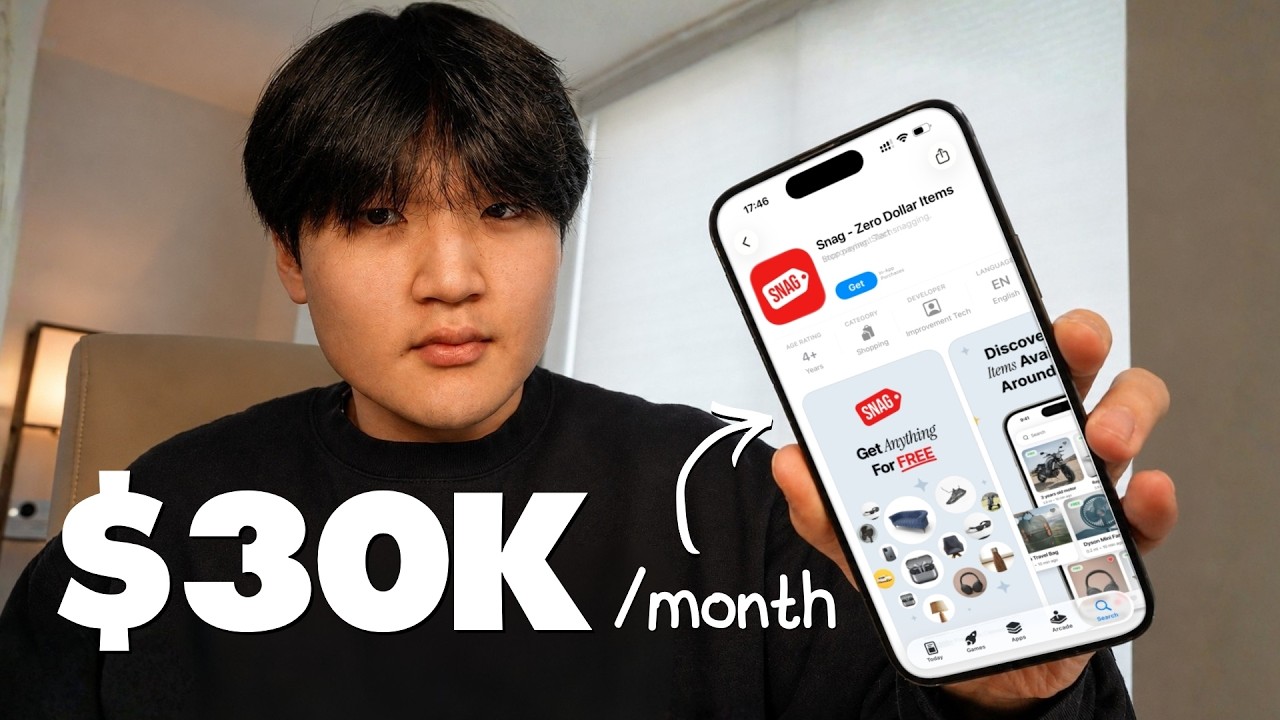
- Built over 45 apps in the past year, with his latest app Snag reaching $30,000 in monthly recurring revenue within four months
- Grew up in Asia, followed a traditional academic path with a 4.0 GPA, then sold his first media company for six figures
- Worked in Congress investment firms, did quant research, and worked in media companies before pivoting to software products
- Experienced shiny object syndrome early on, launching apps like Pillar and HighGBT but not focusing long enough to scale them
- Decided to lock in on one product (Snag) and build it with a dedicated team at 10X Studio
-
Products and Offerings
- Snag is an app that helps people find free items near them
- Users can search or filter for free items in their area
- Includes a favorites section to save items
- Offers weekly, monthly, yearly, and one-time subscription plans
- Has over 100,000 authenticated users, 9,000 conversions, and over $80,000 in total proceeds
- Has around 3,300 ratings on the App Store, providing strong social proof
- Snag is an app that helps people find free items near them
-
Metrics and Financials
- Snag generates approximately $30,000 USD in monthly recurring revenue
- For every 100,000 views on a UGC video, the team makes around $1,000 to $2,000 in direct subscription profit
- One specific UGC video garnered 240,000 views
- A single paid ad campaign had $3,000 spent before ROAS turned negative
- UGC creator conversion rate is about 10% (9 to 10 good creators out of every 100 interviewed)
-
Strategy and Growth
- Overall vision is to build a scalable product with a clear value proposition so that marketing becomes almost secondary
- Primary growth engine is UGC (user-generated content) campaigns at scale, then converting top-performing creatives into paid ads on Meta
- Reach out to many creators, interview and filter them, then put the best on a monthly retainer plus CPM structure
- Test creators and only scale those whose videos get over 50,000 views
- Run test campaigns on Meta ads at $50 per day to validate creatives before scaling
- Gradually scale ad spend (e.g., $50 to $100 to $200 to $300 per day) if ROAS is greater than 1
- Monitor for ad fatigue and continuously pump out new creatives to maintain performance
- Key insight is that Meta ads have diminishing marginal returns, so scaling is not linear
- Distribution strategy emphasizes that content creation and knowing how to get algorithmic views on TikTok is the most valuable skill right now
- If budget is limited, founders should film content themselves and hire an editor to scale
-
Tech Stack and Infrastructure
- Uses Cursor as the IDE and Claude Code Max to code the entire app
- Uses GoDaddy for domain hosting
- Uses Loops to send emails to churned users to convert them back
- Uses Superwall to A/B test paywalls
- Uses Mixpanel to evaluate onboarding effectiveness
- Has an Apple Developer account and Figma subscription
- Hosts everything on Supabase as the backend
-
Build Process
- The entire build process takes around four to five hours for a working app (without backend)
- Step one is finding a scalable, implementable idea by reverse engineering the value proposition from the marketing side first
- Step two is wireframing and designing in Figma, then feeding designs to Claude Code in the IDE
- Step three is distribution through UGC or self-filmed content
- Step four is iterating on the product to increase LTV and lower CAC by delivering real value to users
- Ideas are sourced from YouTube, Twitter, and Sensor Tower, where successful apps are identified and improved by 10%
- Believes ideas are worthless unless you can deliver the product to the end user in a better way
-
Lessons and Advice
- Create your own luck by consistently iterating, learning from mistakes, and putting yourself in a position to meet great people
- Surround yourself with ambitious, high-performing people because you become the average of the five people you spend the most time with
- A good product with a strong value proposition converts at a higher rate and retains users naturally, reducing the need for heavy marketing
- Do not overcomplicate the process; focus on building fast, testing, and iterating
- Shiny object syndrome is common but the key is to lock in on one product and commit to scaling it
I Built A $30K/Month App: Here's My Exact Process
Starter Story • • 14min → 3 min • #158