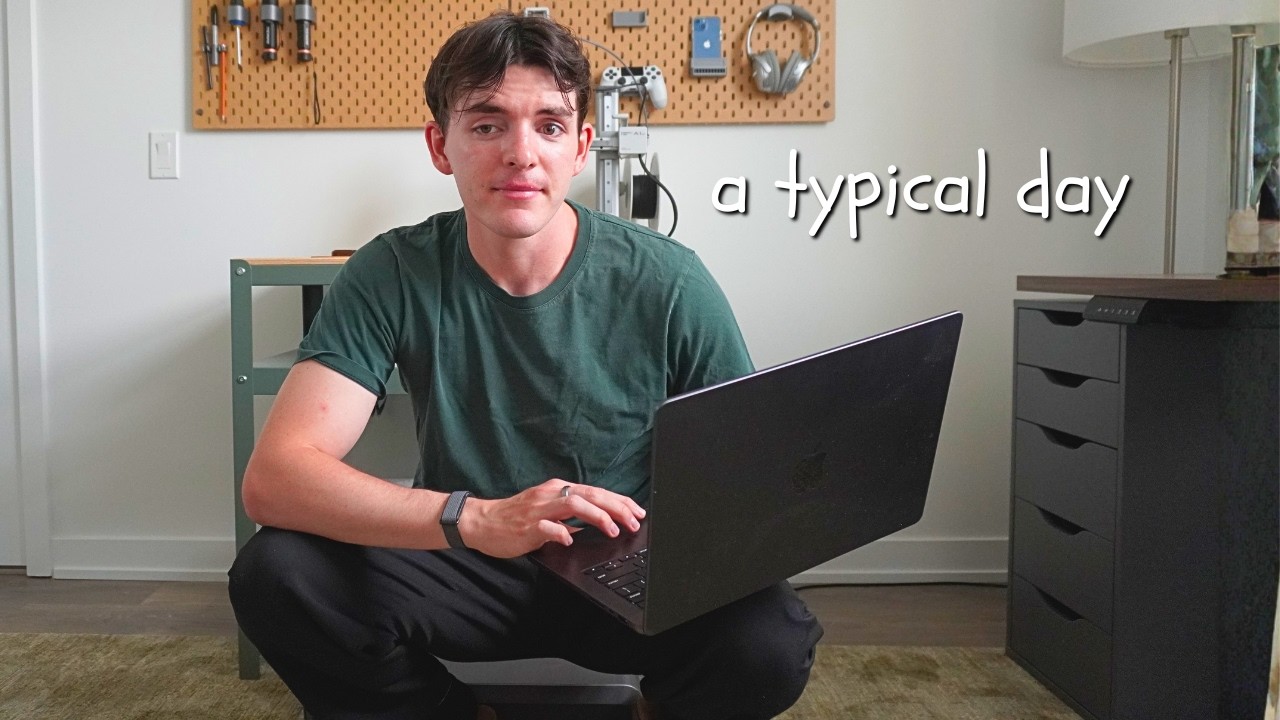
Jack Butcher is a solopreneur earning roughly $40,000 per month who structures his work around flexibility, curiosity, and sustainable energy rather than fixed hours or hustle culture.
Morning routine
Jack wakes naturally between 7:00 and 8:00 a.m., brushes teeth, works out, showers, makes coffee, then opens his laptop to handle customer support first.
He tackles support immediately because it is his least favorite task and because fast replies keep paying customers happy, which drove product improvements and retention.
Work environment
He works exclusively from a dedicated desk with a good chair, clean surfaces, and minimal clutter; he cannot focus in cafés or while moving locations.
A consistent, controlled environment lets him sit down and execute without friction from unfamiliar surroundings.
Working in sprints
His weeks vary wildly: some weeks he works 1–2 hours a day, others 8–10 hours a day, depending on what phase a product is in.
Launch weeks are intense and energizing (he sometimes forgets lunch); maintenance weeks are light, leaving space for sports, walks, or time with his fiancée.
This variability is intentional — he became a founder precisely to choose his own rhythm day to day.
Daily work routine
After support, he picks one main project for the day based on what feels most important or exciting — a critical bug, a compelling feature, a clear vision of something coming to life.
He deliberately avoids multitasking: one focused project per day plus support, because splitting attention degrades output.
Enjoyment and curiosity are his filters; if he isn’t having fun, he questions why he’s doing it at all.
Stress, anxiety, and the turning point
Early on he suffered headaches and constant anxiety for two years, doubting he could make it; a low point came 2.5 years ago when he broke down on a walk with his fiancée, stuck at $3,000/month from a mobile app.
Two months later that app hit a peak of $15,000/month; recurring revenue crossing a survivable threshold, then a year of savings accumulation, let him relax and trust the trajectory.
Financial security reduced the pressure to overwork; he now works hard when inspired, not from fear.
Finding ideas
Every product starts from his own need: he built his first app because he wanted it to exist; 100,000 others agreed.
To grow that app he built a scheduling tool (Post Ridge) for himself, which became 10–100× larger than the original app.
Each new product solves the next bottleneck he personally faces — growth, distribution, case studies — so the portfolio compounds organically.
Lessons learned
Copying someone else’s niche or model fails because the builder lacks intrinsic curiosity; without fun, persistence evaporates and quality suffers.
He validates ideas by shipping a landing page or TikTok and watching real behavior: if 1,000 visitors don’t click “buy,” the framing or value proposition is wrong, not necessarily the core idea.
He asks “how can I frame this so it’s valuable?” and “would I use this? would it save someone time or money?” rather than “is this a good idea?”
Evening routine
He typically stops work around 5:00 p.m., closes the laptop, and spends the evening cooking, walking, biking, playing sports, or watching shows with his fiancée.
This boundary took two years to establish; early in the relationship work bled into shared time and damaged connection.
He aims for 7–8 hours of sleep (usually 11:00 p.m. to 7:00 a.m.), treating sleep as non-negotiable for cognitive performance, especially before heavy work days.
Number one piece of advice for builders
Find your own path by staying curious and optimistic; he kept a folder of inspirational images to remind himself to keep going when experiments failed.
There is no single blueprint — the right path is discovered only through testing, experimenting, and noticing what energizes you.
Keep going
Countless viable paths exist; the one that fits you is unknown until you try things.
Hard days are normal, but if you stay curious, keep learning, and look for something worth anticipating, things tend to work out.