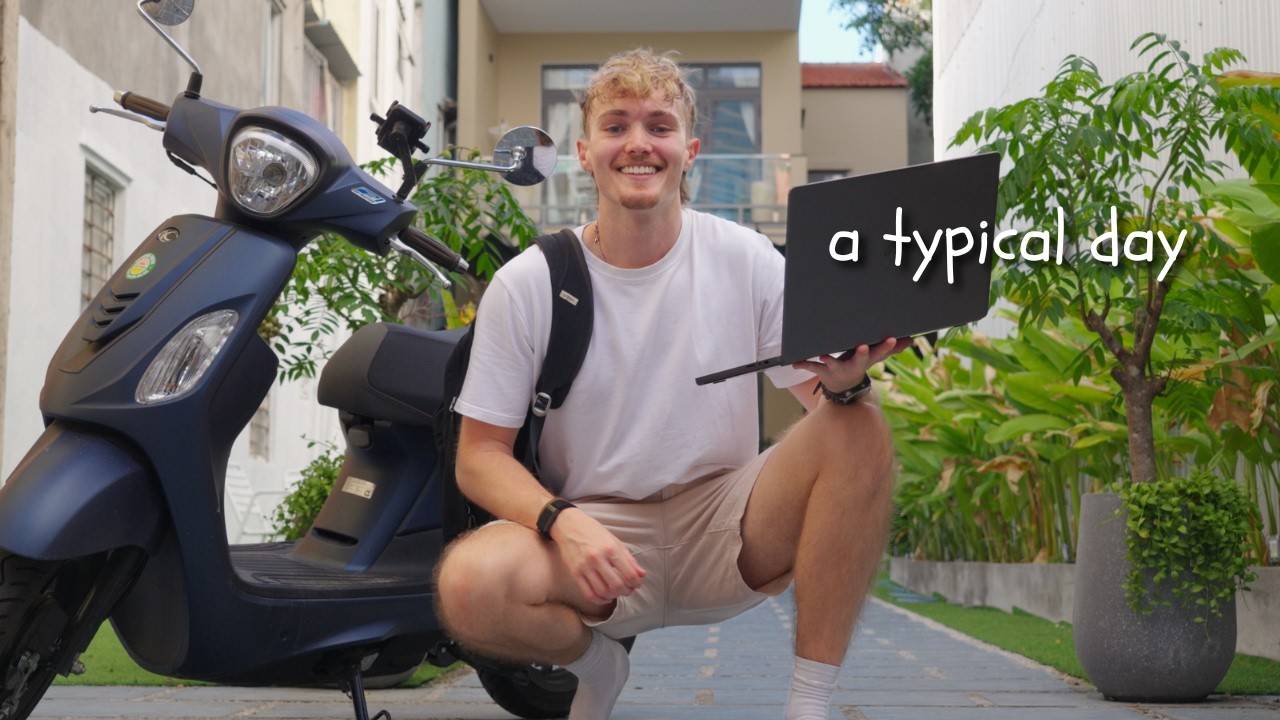
Rob Hallam is a solopreneur earning $22,000 per month running SuperX, a Twitter/X analytics tool, entirely on his own while traveling the world; he rejects conventional “guru” productivity advice in favor of a night-owl schedule, extended stays in each location, and the principle that productivity follows happiness.
Philosophy and lifestyle
Rob lives a “reverse typical guru advice lifestyle” — he wakes at 11:00 a.m. to 12:00 p.m., goes to bed very late, and does his deepest work in long uninterrupted blocks at night when no one is messaging him.
He spent years feeling guilt about not being a morning person, but realized his natural rhythm works; he protects 9.5 hours in bed (9 hours asleep) as the single most important input for creative thinking, motivation, and gym consistency.
Core belief: productivity follows happiness — the places where he shipped the most were always the places he was happiest; discipline was never the variable, environment and mood were.
He cultivates a “state of play” (e.g., fidgeting with a Rubik’s Cube between tasks) to approach work with the same curiosity he had as a kid; when work feels like play, output quality and life satisfaction both rise.
Travel and work rhythm
Started as a backpacker trying to build startups while moving every few days; made no money for about a year and struggled to focus.
Cadence gradually slowed: every few days → every week → every two weeks → every month.
Breakthrough came in July 2025 when he settled in Colombia for three straight months and finally made real progress on SuperX.
Current model: set up a base for 2–3 months (ideally 3), then move on; this balances the routine needed for deep work with the novelty and perspective he values from travel.
Sees travel as “living life on full” — observing how others live, how money moves, and where opportunities exist in different environments.
Daily routine
Morning (11:00 a.m.–2:00 p.m.): wake up in a blur, slowly pull himself together, breakfast, sunlight, light admin (customer support emails, small chores).
Afternoon (2:00–3:00 p.m.): gym on training days (weights + cardio), shower, second coffee.
Evening (roughly 3:00 p.m. onward): front-loads all chores and obligations so that when he sits at his laptop, nothing else competes for attention.
Deep work block: 8+ solid hours at night with zero distractions; this is his flow state — “there’s nobody talking to me. That’s all I’m doing.”
Pre-sleep wind-down (~1 hour before bed): phone off, read or watch YouTube, sometimes doom-scroll briefly, then 30 minutes phone-free before sleep.
Work prioritization system
Maintains a rolling monthly or bi-monthly list: top 3–4 features to build, improvements, and bugs.
When starting a session, either continues yesterday’s task or picks from the list based on how he feels — privileged to work on what he wants, but aims for what moves the business forward most.
Learned that 99% of the time the highest-leverage work is “boring stuff,” not flashy visual features.
Note-taking system: when a list gets too long, copies only the important items to a fresh note; if a customer doesn’t raise an issue again or he forgets it, it wasn’t important enough.
Critical bugs self-evident (five emails = fix immediately); nice-to-have requests with no follow-through get dropped.
Core lessons and mental models
Surfing analogy: building a business = spending time in the water learning to read waves before they break; you only develop this intuition by getting in the water repeatedly.
The hardest part is the first entry — everything is new, overstimulating, the “surfboard” is unfamiliar — but once you’ve been in long enough, you keep catching waves.
Winning once teaches you to read waves, which is why winners tend to win again; switching waves is a choice, but you must first get in the water.
Sleep is the foundation: everything (creativity, motivation, gym, mood) is downstream of sleep; he tried 8 hours and failed, 9 hours is non-negotiable.
Advice for builders
Stop chasing discipline hacks (wake earlier, plan harder, lock in); the gap between where you are and where you want to be isn’t discipline — it’s environment and happiness.
Find the environment, routine, and activities that put you in your best state; for Rob, that meant reclaiming childhood joys (travel, play, Rubik’s Cube).
In 13+ countries over recent years, his output varied wildly — not from discipline changes, but from how he felt in each place.
“Productivity follows happiness” — the best work comes from being in a good place; optimize for that first, and output follows.