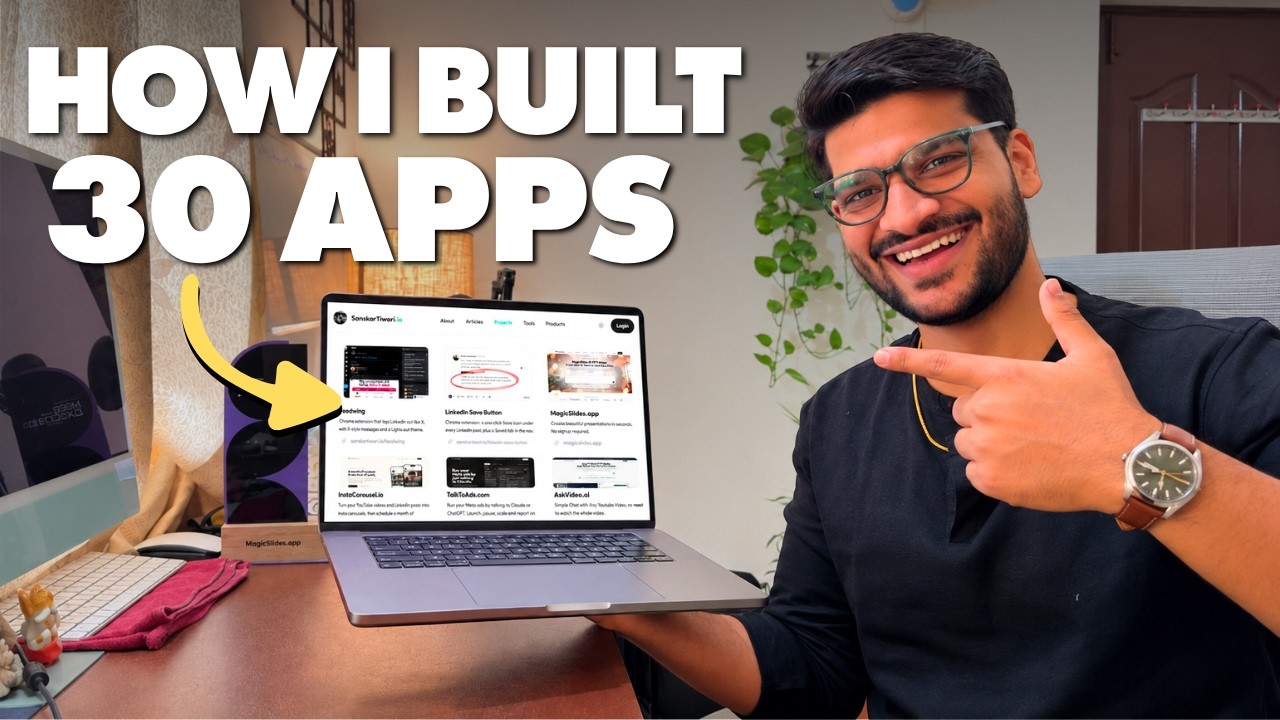
Sanskar Tiwari, a solo founder from Bangalore, India, has built over 30 micro-products in six years, with eight generating revenue and combined lifetime revenue crossing $1 million — all while running zero-person teams and distributing exclusively through Chrome extensions and Google Workspace add-ons.
Origin story: from call-center night shift to $1M portfolio
Sanskar worked a call-center night shift, then an eight-month sales job, while teaching himself to code in the evenings.
After two years of no traction, he launched two small lifetime-deal products that each matched his monthly salary within days, giving him the confidence to quit and build full-time.
He credits the turning point to sharing sign-up-screen designs on GitHub (“the Indian app guy”), which created a public-building habit and early audience.
Core philosophy: many tiny bets, single-feature apps, platform leverage
Every product is either a Chrome extension or a Google Workspace Marketplace add-on — no standalone web apps — so distribution and auth are handled by the platform.
Each app does exactly one thing (e.g., “turn a PDF into a PPTX,” “blur sensitive data on a page,” “chat with a YouTube video”); he avoids feature creep because users “come for one thing.”
He treats every launch as an experiment: build fast, put a buy button up immediately, and double down only when revenue signal appears.
The eight revenue-generating products (high level)
MagicSlides.app — converts documents, PDFs, and YouTube videos into editable PPTX presentations (largest product).
Ask Video — chat interface for any YouTube URL.
Blur Web App — Chrome extension to hide sensitive info in one click.
Magic Form — AI-powered Google Forms add-on (born after an investor asked for a pitch deck and he realized he’d covered Sheets and Slides but not Forms).
SheetAI — use AI inside Google Sheets (first product to hit ~$2K MRR).
Talking PDF — chat-with-PDF tool similar to Ask Video.
Two additional smaller apps round out the eight; all are listed at sanskartiwari.io/projects.
Revenue breakdown
~$856K via Stripe (direct subscriptions/one-time sales).
~$85K+ via AppSumo lifetime deals.
First two years: $0 revenue; growth was slow and non-linear after that.
Idea generation system
Platform scouting: watches Trust Matter (shows revenue/traffic of marketplace apps) and Twitter/X (curates feed of builders and problem posts).
Scratch your own itch — but only if the problem is paid for by people with budgets (warns against student problems with no willingness to pay).
Buy-button-first validation: spin up a landing page with a pre-order button and a 10–30 day delivery promise; start building only after first sale.
Iterate in public: first year he launched one product that failed; subsequent years he launched many, learning what users would actually pay for.
Build process & tech stack (solo, AI-accelerated)
Frontend: Next.js (React).
Backend/database: Supabase + Cloudflare Workers.
Email: Resend (primary) or Google Apps Script (lightweight).
Coding agent: Cursor (AI pair programmer) writes the bulk of the code; he reviews and ships.
Typical MVP timeline: days to a couple of weeks per micro-app.
Customer acquisition: content + marketplace SEO, one channel per product
Facebook groups: first sales came from posting in niche groups matching the product’s audience.
AppSumo: early lifetime-deal launches provided cash flow and user base.
YouTube: creates a separate channel for each product (MagicSlides channel, SheetAI channel, etc.) to avoid audience confusion; evergreen tutorial/demo videos drive organic traffic years later (e.g., 145K views on a Magic Form video).
Instagram Reels: posts 10+ raw phone-recorded demos per day across products; treats it as a high-volume experiment lab — no polish, just volume to find what resonates.
Marketplace SEO: listing on Chrome Web Store and Google Workspace Marketplace captures intent-based search traffic.
Key lessons & advice for beginners
Biggest mistake: kept polishing a single product nobody wanted instead of putting buy buttons on the internet.
One-word summary: “Put more buy buttons on the internet.” If you have zero ways for people to pay you, you have your answer for why revenue is zero.
Experiments over perfection: launch ugly, learn fast, iterate — both for products and content (record on phone, post immediately, see what sticks).
Platform risk is real but manageable: he accepts dependence on Chrome/Google marketplaces because distribution leverage outweighs risk for micro-apps.
Solo scale is viable: 1,000+ monthly paying customers, $1M+ lifetime revenue, zero employees — achieved by keeping scope ruthlessly narrow and automating with AI tooling.