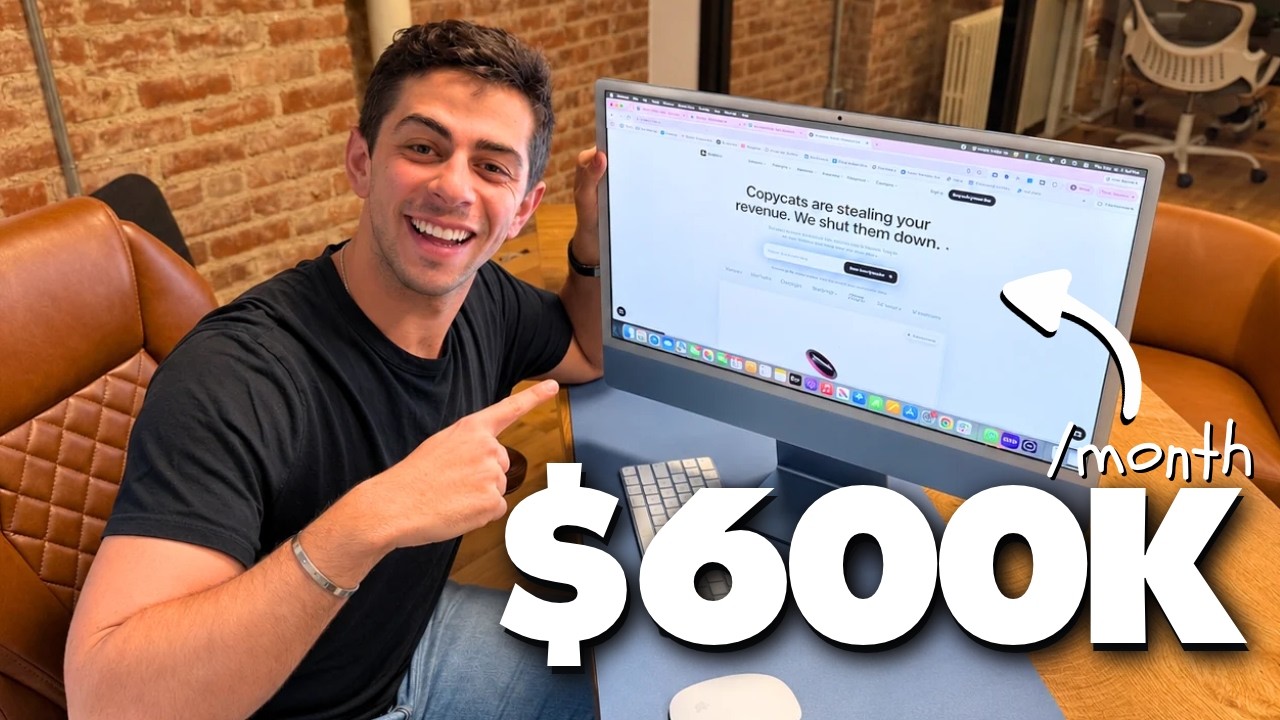
Oliver Bracato, founder of Pasta, built and sold Tabs Chocolate (an e-commerce brand) for millions at age 19, then launched Pasta — a hybrid software-and-agency business that helps e-commerce brands detect and take down copycats, counterfeits, and unauthorized resellers; Pasta has scaled to $600,000/month in revenue, is fully bootstrapped and profitable, employs 50+ people globally, and services 180+ brands from an office on Madison Avenue in New York City.
The problem Pasta solves
E-commerce brands that succeed online inevitably get ripped off: bad actors clone product images, copy entire websites, and steal Meta ads to run as their own.
This is a massive, widespread issue that Oliver experienced firsthand with Tabs Chocolate.
Existing solutions were either pure software tools that required brands to do the manual enforcement work themselves, or traditional agencies that lacked automation and scale.
The pivot from SaaS to hybrid agency model
Oliver initially built a SaaS tool (beta tested with ~30 brands) that scanned the internet for infringers and gave brands step-by-step instructions to report them.
Critical failure: none of the beta testers actually used the tool — the reporting process was too time-consuming, boring, and menial.
Key lesson: giving the tool away for free masked the lack of real demand; if people won’t pay, the product isn’t solving the problem in a usable way.
Oliver pivoted to a “done-for-you” agency model: instead of selling a tool, sell the desired outcome — finding and taking down the bad actors.
The model combines AI agents and automation (scanning billions of pages) with a human team (identification analysts, enforcement agents, team leads, client success managers).
Counterintuitive insight: leaning into the human-in-the-loop nature increases perceived value; clients are willing to pay more when they know real people are handling enforcement, not just “AI magic.”
Business model and pricing
Productized service hybrid: standardized, repeatable service packages powered by proprietary software and automation.
Pricing: $1,500–$5,000/month per client (average ~$3,000/month).
High revenue per customer vs. traditional B2B SaaS (which often charges tens of dollars).
Fully bootstrapped, profitable, no outside investors.
As AI models improve monthly, the operation becomes more efficient, margins expand, and customer acquisition costs drop — a compounding advantage.
Customer acquisition
Initial rocket fuel: Oliver’s Twitter following.
Diversified into 18+ channels: SEO, AI-driven outreach, cold LinkedIn, cold email, SDRs, AEs, paid Meta ads, paid Google ads.
Onboarding: brand connects website, social media, Amazon storefront, Meta Ads account.
Asset ingestion: Pasta scrapes all images, breaks videos into frames, captures keywords, brand terms, product titles.
Detection: runs tens of thousands of search combinations across the “underworlds of the internet” to find infringers.
Review workflow: matches presented in a dashboard — brand’s asset on left, potential copycat on right; brand approves or declines with reason.
Enforcement: instead of contacting the bad actor directly, Pasta goes to the infrastructure providers — Shopify, Amazon, Google, payment processors, domain registrars, hosting providers — asserting liability for supporting infringement.
Resolution: cases move to “takedown confirmed” or “takedown rejected”; high takedown success rate.
Client experience and communication
Many clients don’t want to log into a platform; Pasta meets them where they are.
Every client gets a dedicated Slack channel with a team lead, client success manager, and head of brand protection overseeing.
Weekly automated summaries in Slack: takedowns completed, pending approvals, new infringers found, actions taken, revenue the bad actors were generating, time saved for the brand’s team.
High-touch service model wrapped around the automation.
Advice for founders: niche focus and model selection
Singular sniper strategy: the more narrowly focused on one specific problem, the better. Example: Aelia built only the best email-capture pop-up for e-commerce brands, reached $10B+ ARR, sold for ~$60M — they didn’t try to compete with Klaviyo on all features.
All niches are ripe for disruption with the productized-service + AI model (e.g., legal services shifting from hourly billing to project-based, productized offerings).
Lean into human-in-the-loop: don’t hide the human element; it justifies higher prices and builds trust.
Charge for outcomes, not tools: if the tool requires customer labor to deliver value, the business model is misaligned.
Oliver’s personal lessons for second-act founders
After exiting Tabs Chocolate, Oliver was burnt out: e-commerce lacks recurring revenue (no repeat customers), creating relentless monthly pressure.
He deliberately chose a subscription-based model for predictable revenue.
E-commerce was lonely; he wanted to build a real office and a real team — optimizing for daily experience, not just financial outcome.
Core advice: learn from past experiences, do what excites you, build something great.
Co-host Gus’s take: why this model is the future
Software is now trivial to build; the scarce, valuable layer is the service that gets the job done for the customer.
Founders in private chats are spinning up similar businesses and hitting $500K ARR in weeks.
The “secret sauce”: every month AI models improve → operational efficiency rises → margins expand → CAC drops → flywheel accelerates.
Huge untapped opportunity in applying this to non-tech audiences (e.g., elderly users who can’t navigate Facebook Marketplace) — AI assists, but the experience feels human.