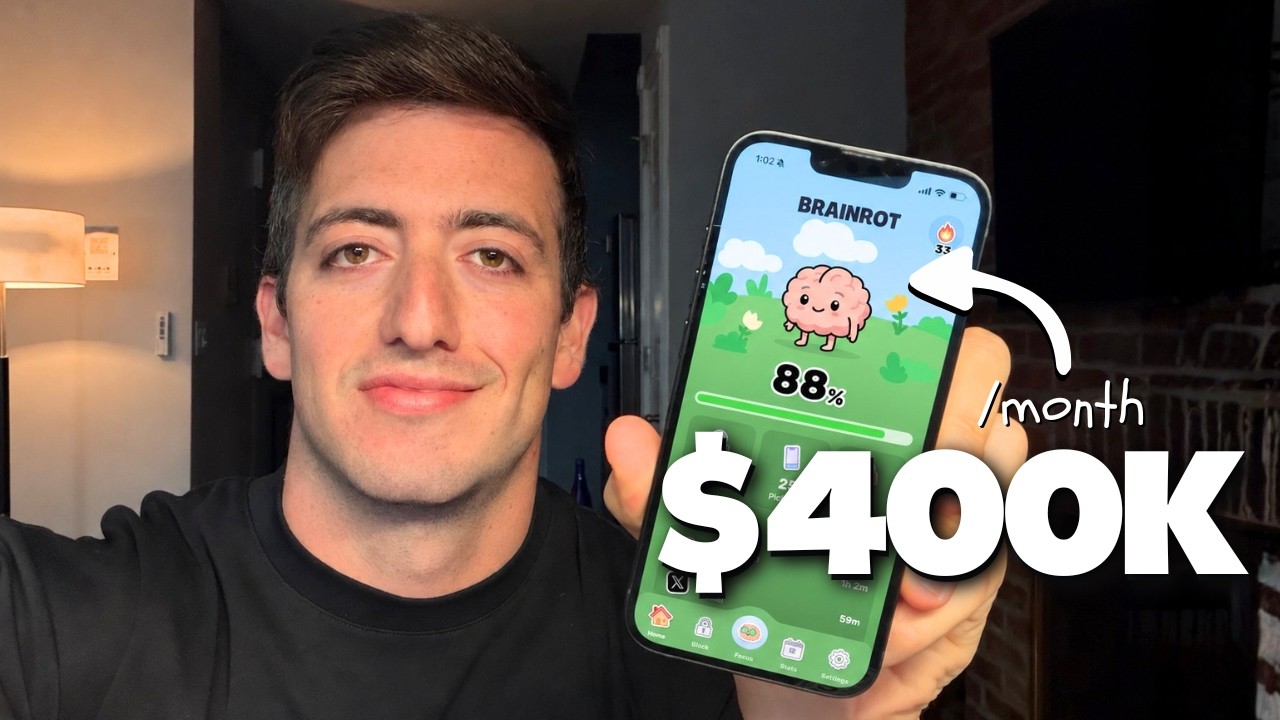
Yoni Smolyar, a former corporate software engineer turned content creator, built Brainrot — a gamified screen-time app with a digital pet brain that “rots” as you use blocked apps — and scaled it from $10K to $400K/month in under a year by leveraging a pre-launch audience, influencer content, paid ads, rigorous analytics, and a co-founder partnership.
Who Yoni Is and What He Built
Yoni Smolyar worked as a corporate software engineer while running side hustles that never took off, then started documenting his journey online and built a following of roughly 100K–150K on Instagram.
He co-founded Brainrot with Brock Anderson, who handles complementary responsibilities and acted as a force multiplier for the business.
Brainrot is a subscription-based mobile productivity app (mostly annual plans) with a couple million downloads, ~150K users, and ~$400K/month in revenue as of the interview.
The Brainrot App
Core concept: a “gamified screen time app” where a cute digital pet brain loses health the more time you spend on designated “brain rot” apps (Instagram, YouTube, TikTok, etc.).
When you try to open a blocked app, Brainrot interjects a playful friction flow — e.g., a “FaceTime from your brain” — that adds just enough pause to shift behavior.
Features include per-app blocking rules by time of day, screen-time statistics, and a persistent pet-brain dashboard showing current health percentage.
Origin Story: From Phone Addiction to App Idea
Yoni was personally addicted to Instagram, YouTube, and Twitter; he knew app blockers existed but wanted a more engaging, personality-driven approach.
The “brain rot” metaphor clicked: a digital pet brain that visibly deteriorates with usage — nobody had built that exact angle, and the idea excited him enough to go heads-down for a month.
He built the first version in a couple of weeks during summer 2025, treating it initially as a personal tool.
Launch and Early Growth
Pre-launch: Yoni teased the app to his existing Instagram audience (“I’m building an app, join the waitlist”) to build suspense.
Launch day: ~$10K in revenue on day one from the waitlist conversion.
Early insight: the team immediately studied analytics to identify power users — who they were, how they behaved, and what distinguished them from casual users.
Growth levers that worked: influencer content and paid ads; they doubled down on those channels rather than chasing unproven tactics.
Co-founder Brock joined early and became a “huge force multiplier,” enabling faster iteration and execution.
Scaling to $400K/Month
Continuous analytics: sampled event data sent to Mixpanel/PostHog, then analyzed with AI (Claude, Codex) to understand activation moments, cohort behavior, and power-user patterns.
Relentless small experiments: onboarding slide order, timing of paywall exposure, feature placement — 9/10 don’t move the needle, but 1/10 can be trajectory-changing.
Channel economics: tracked which acquisition channels delivered users with higher LTV relative to CAC, then allocated spend accordingly.
Input–output lag: recognized that results lag inputs by months; avoided complacency when metrics looked good because today’s work determines future results.
Quitting the Day Job
Yoni wrestled with the timing: no single number or date makes the leap safe; staying in an unfulfilling job and letting dreams fade are also risks.
Practical floor: have enough runway to survive a downturn, but accept that you can always get another job if needed.
Decision framework: tolerate the discomfort of uncertainty rather than the certainty of regret.
Yoni’s 2026 Playbook for Building Apps
Step 1: pick a problem space that genuinely excites you — something you want to work on first thing in the morning and last at night — because difficulty is inevitable and excitement sustains you.
Step 2: build a team; if you’ve failed solo before, don’t go alone again — bring a complementary co-founder or use equity (currently worthless) to hire contractors/freelancers (e.g., via Upwork).
Step 3: instrument analytics from day one (Mixpanel, PostHog, Firebase) and use AI to dissect user behavior — find the activation moment, identify obsessed cohorts, and replicate those behaviors broadly.
Step 4: run small, measurable experiments constantly; accept that most fail but the winners compound.
Step 5: understand channel-level unit economics — not all users are equal; acquire the ones who pay more and churn less.
Step 6: respect the delay between inputs and outcomes; don’t get complacent when lagging indicators look good.
How to Find an App Idea
Match the idea to your experience level and goals: first-time founders should avoid hyper-competitive “super app” categories.
Build a simple utility app with one core function solving one core problem for one core user — ideally a problem you have yourself.
Be a daily power user of your own app; be brutally honest about whether it actually helps.
Don’t chase trends or clone apps for a quick buck; aim for either high LTV (subscription willingness) or genuine daily utility (opens every day).
The best filter: build something actually valuable for users.
Tech Stack
Analytics & experimentation: Mixpanel, Firebase
Internal tools & tracking: Supabase
Paywall management: Superwall
Paid ads attribution: AppStack
AI-assisted coding & business logic: Claude, Code, Codex
Contractor/freelancer sourcing: Upwork
Final Advice: High-Leverage Decisions Over Busywork
Many founder activities yield ~1% impact; a few decisions yield 20–100% system-level changes.
The job is to find those high-leverage decisions, execute them, and delegate or ignore the low-leverage busywork.
Goal isn’t to grind like a rat — it’s to identify and act on the few things that disproportionately move the needle.