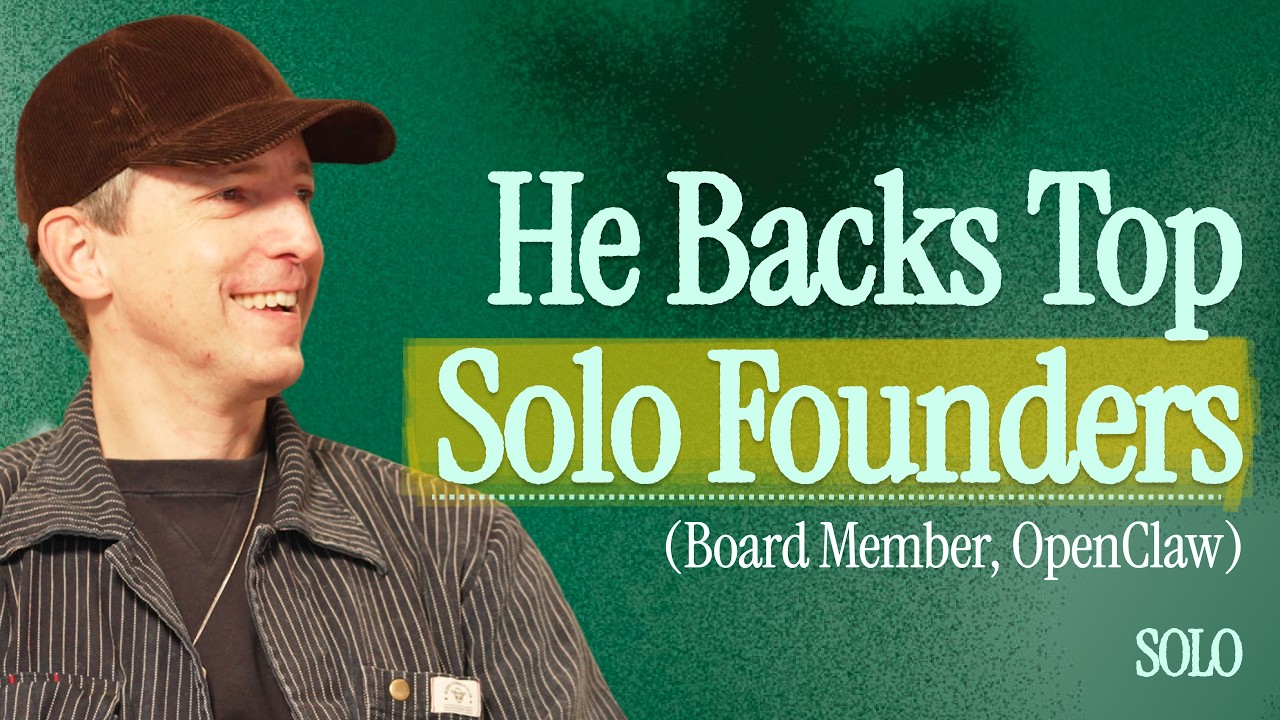
Dave Morin — former Apple and Facebook Platform lead, Path founder, Slow Ventures co-founder, now running Offline Ventures — argues that solo founding is becoming the default (40% of new companies, up from 25% five years ago per Carta) but the worst way solo founders fail is believing “solo” means being alone; the real job is finding great creative relationships, not working in isolation.
The core thesis: solo founding is a relational act, not a solitary one
Morin frames entrepreneurship as production, not investing: like a music producer, he helps artists (founders) bring their work to life, and the “design of the team is as important as the design of the product” (a lesson from Jony Ive after Steve Jobs died).
Most startups fail because relationships break down, not because the product or market was wrong — bands split up, and the music changes.
Even “auteur” creators like Hitchcock depended on collaborators like Edith Head; great founders actively search for creative partnerships that fit their working style.
No one grows up alone: Morin uses parenting as a metaphor — children are constantly guided by adults — and the best founders stay open to finding the next great collaborator rather than closing off.
Why solo founding is rising: tools and community have changed
In the early 2000s, startup knowledge was a “dark art” passed through mentorship; today YouTube, ChatGPT, Claude, and open-source communities act as always-available co-founders.
AI agents now handle roles like CMO, VP of Engineering, even therapist — Ben Cera built a “Company OS” of agents while traveling solo through Asia.
Social media and online communities mean founders are never truly alone; they can find thought partners, investors, and early users without a formal co-founder.
The barrier to prototyping, accessing capital, and distributing a product has never been lower.
Three singular solo-founder stories
Peter Steinberger / OpenClaw: after a decade of deep PDF/engineering work at PSPDFKit, Peter channeled his craft into an open-source AI coding agent; within weeks it had thousands of contributors — more than most AI labs have employees. Morin fell in love with the product instantly (like seeing the Macintosh or Facebook for the first time) and partnered to protect and scale it as a foundation.
Ben Cera / Pulsia: backed by Morin 15 years ago, Ben worked with Travis Kalanick at Cloud Kitchens, then tried a merch startup (Gift Shop) with a co-founder; they split amicably. Ben went on a literal journey (Kyoto, Hong Kong, Shanghai, Thailand), built an agent system to combat loneliness, and three months before launch told Morin “Am I crazy?” — Morin said “You’re halfway through an album, keep going.” Pulsia launched and took off.
Matt Oesterle / Ramble: a Denali-level mountaineer who previously used data science to publish bestselling books (80%+ of Amazon’s top 50 at peak). He applied the same logic to camping: buy land near national parks where demand exceeds supply, elevate the experience. Complex real-estate/zoning/operations — “entrepreneurship on PhD mode” — but the vision is singular and deeply personal.
What makes a company singular vs. derivative
Founders must start from “inner knowing” and love: you’ll talk about this for 10,000 hours (10,000 dinners), so if you don’t love it, someone else will beat you and you’ll quit.
Ramble expresses Matt’s love for deep nature; OpenClaw expresses Peter’s mastery of engineering craft; Pulsia expresses Ben’s need for a creative operating system while wandering.
Derivative startups pattern-match to safe ideas; singular ones come from a founder’s unique obsession and lived experience.
Fear of stepping outside the norm keeps people in the “ordinary” lane; the best founders trust their intuition like Santiago in The Alchemist — the world conspires to help once you set the intention.
The bare case against solo founding (the trap)
Believing “solo” means literally alone — just you and AI — leads to failure.
Founding is a relational act: you need creative collaborators (investors, studio musicians, engineers, designers, customers) who challenge you, hold accountability, and complement your neurotype.
If you convince yourself you don’t need people, you cut off the oxygen supply.
The case for solo founding today
First-time founders: the internet is your co-founder — YouTube, ChatGPT, communities, accessible capital, instant prototyping.
Repeat founders: every prior version of you is a co-founder — faster decisions, pattern recognition, accumulated relationships.
In both cases, the tooling and network make it easier than ever to find the right relationships if you activate them.
Don’t wait for a co-founder of convenience; just start, express the idea, and go find the people who help you pull it into the world.
Morin’s own journey: from operator to producer
Investing began as a way to give back what he learned at Apple (Jobs) and Facebook (Zuckerberg) — small-town Montana instinct to help others figure it out.
He loves the creative arc: the dark nights, the warp-speed moments, the psychology and sociology of building.
Slow Ventures started while he was still at Facebook; Offline Ventures launched with a studio attached to signal “we are creatives first, investing comes with it.”
The joy is being in the process himself and alongside founders — practicing the craft across decades and multiple firms.