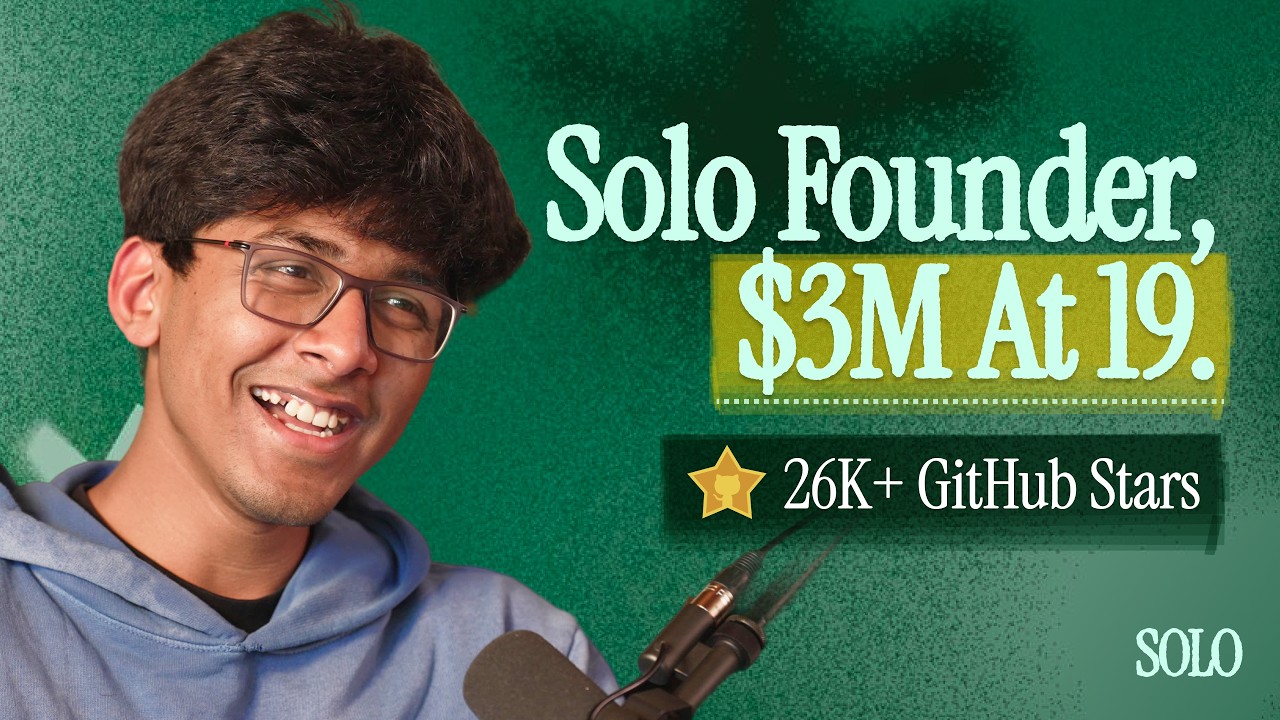
Dhravya Shah sold his first company at 16, raised $3M at 19 as a solo founder for Supermemory — an open-source memory and context layer for AI agents with 26K+ GitHub stars and 1M+ SDK downloads — but never set out to start a company. He said no to VCs for nine months while broke and borrowing from friends, only raising once the thing he’d been building in public became undeniable. His story is a case study in fundraise as a result, not a goal.
How a side project became a company
While working on open-source AI inference at Cloudflare and studying at Arizona State University, Dhravya started a side project called Any Context to collect personal context — bookmarks, notes, things saved — so AI agents could reason through it and understand him better.
He open-sourced it and posted an architecture diagram tweet that got 500,000 views. Within two weeks, 100,000 people tried the app.
He had no money — was literally borrowing from friends to survive — but optimized the infrastructure to run 100,000 users for $5/month, which went viral again.
This made him a micro-influencer in context infrastructure. Startups flew him to New York and SF to help them build for free, planting the seed that agent context infrastructure would be as important as inference.
He wasn’t embedded in the startup ecosystem. When VCs started reaching out asking if he was raising, his reaction was: “You’re telling me I can raise $2M right now? I don’t think that is the case.”
His goal was never to raise money. It was to build the version of the world he believed must be true.
India → ASU → Cloudflare: two teenage acquisitions
Before coming to the US, Dhravya built two companies in India as a teenager: a social media automation tool and a Discord bot hosting platform (sandbox-style infrastructure). Both were acquired, which opened the door to come to the US.
At ASU he didn’t tell peers he coded. He’d sit in the library building things for fun — a database, a meme platform, a note-taking app — never approaching them as startup ideas, just as art.
Everything was open source, nothing behind a paywall. This built an audience of people who saw him as someone genuinely in it for the love of building, which gave him credibility when he launched Any Context.
The advice that reframed everything: “make something that makes too much sense”
During his first summer interning at Cloudflare, a VC offered him a residency program with money and a place to live if he could fly out the next day. He asked Dane (Cloudflare’s CTO, whom he worked directly with) what to do.
Dane told him: either raise from a tier-one VC or bootstrap, but ideally make something that makes so much sense you don’t even have to ask the question.
Dhravya’s framework for whether to raise: will money actually change how I solve this problem? Do I have distribution? Do I have the technical capability? If he’d raised before his inflection point, it would have put him in a worse position — he wouldn’t have known who to raise from, and he’d have raised for the wrong thing.
Saying no to VCs for nine months
From summer 2024 to summer 2025, Dhravya took hundreds of VC calls and said no to all of them. He didn’t realize he was wasting his time — he just wanted cool names like a16z to see the exciting work he was doing.
During this period he was still building a consumer app. Had he raised then, he’d have raised for consumer, and pivoting to B2B later would have been much harder.
Only after crystallizing exactly what Supermemory should be did he raise — from the best angels and VCs for what he was actually building.
Escaping the inventor’s dilemma: from consumer app to context cloud
Supermemory started as a B2C personal knowledge management tool. Dhravya was initially delusional — comparing himself to Perplexity and Google and thinking he should be bigger.
He realized competing on product alone wasn’t enough; distribution and positioning mattered, and he was one person. He couldn’t figure out why someone would use Supermemory over Notion for personal context.
The pivot happened in small iterations. He moved from consumer to B2B, from a router product to an SDK, from just retrieval to memory (graph-based), then to retrieval + memory, then added file systems, profiles, and more — eventually arriving at what he now calls the context cloud: a horizontal, unopinionated stack for agent context.
He references the IBM System/360 story: IBM was the greatest company in the world building custom machines for each enterprise, and the founder’s son killed the company for two years to build the IBM 360, which made IBM dominant again. The lesson: if something is blowing up now but isn’t the future, end it.
Launching Supermemory Local: run the whole stack on your machine
The day he moved into the Solo Founders Program house, he launched a router that auto-edited LLM requests to be more personalized. It got 500K impressions in one day — but he killed it because no one wanted another router on top of their existing routers, and companies didn’t want to send API keys through an untrusted player.
The research from that failed router proved people wanted better context management, just not in that format. This led to the SDK, then the memory system, then the full context cloud.
Supermemory Local launched alongside this podcast: a fully self-hosted version running embedding models, graph databases, vector databases — everything — locally with a single npx supermemory local command. No API key, no setup, runs on any OS.
The philosophy: inference is running everywhere (local devices, on-prem, thousands of providers). Context should be too. Supermemory covers third-party (cloud), and now Supermemory Local covers first-party (fully owned).
It also serves as an easy ramp into enterprises — they can try it locally, then reach out when they need to scale.
Hiring “true builders” out of open source
Dhravya’s hiring philosophy: find true builders, even if non-technical, who are invested in the craft, fun to work with, and have extreme autonomy.
He found early employees (Mahesh, Shange, and others) through the open source community — people who were already contributing for free. That’s a magnet for the right kind of person.
He gives new hires the tools to feel like owners of their area. But he also learned to move fast when someone isn’t working out — it brings the whole team dynamic down.
Over Supermemory’s history, 30 people have worked with the company. The current core team is seven, almost all of whom have been there for a year.
The fundraise: being honest online, a16z, and the narrative
Dhravya’s superpower in fundraising was being very online and honest. People who’d followed his journey for years messaged saying “when you’re raising, let me know” — he never replied at the time, but those messages became his seed capital when he was ready.
The trigger to actually raise: Claude was becoming big, it was obvious ChatGPT wasn’t the only way to use AI, and a VC flew to Vegas to meet him at a conference. He also had an a16z meeting online at the same time. Both went incredibly well — not in terms of “we’ll invest” but in terms of “this is obviously the future.”
Being in the Solo Founders Program helped him crystallize the narrative. In college he was doing whatever made sense moment to moment; SFP forced him to think of it as a company with a story.
He raised a $2.6M seed led by Susa Ventures, with angel backing from Google’s chief scientist Jeff Dean, Cloudflare’s CTO, and executives at OpenAI and Meta.
Not anti-college: dropping out before the visa
Dhravya was top of his class at ASU, had tons of fun, lived with Americans his first year — it was probably the best time of his life. He’s not anti-college.
He dropped out before he even got his visa because it was that obvious. He’d already dropped out of the traditional IIT path in high school as a leap of faith, and that turned out well.
His parents and brother told him not to drop out. All the VCs giving him millions seemed like money laundering to them. But he had so much belief he’d figure it out that he did it anyway.
By the time he dropped out, he’d been working on the idea (from Any Context through Supermemory) for 2–3 years. He’d dived deep into the tech and the problem space.
The honest version of AI memory: Goodhart’s Law and Memory Bench
The AI memory space has enormous FUD because the barrier to entry is low and measurement is nondeterministic. Unlike inference or databases, memory performance isn’t deterministic to measure.
Companies run their own benchmarks with their own code, optimize for specific wording, then tweet about being the best. This is Goodhart’s Law: when you optimize for one goal, the goal is no longer relevant.
The evaluation setup varies wildly: how you store, how you retrieve, how many tokens you ingest back, whether it’s a tool call or hook, what model answers, what judge evaluates — all change the result.
Supermemory built Memory Bench to run deterministic tests across multiple benchmarks (Beam, LongMemEval, etc.) showing latency, quality, speed, tokens used, recall@5, recall@15 — and they’re honest about all numbers.
ChatGPT and Claude perform badly on memory benchmarks on purpose — they’re built for the user, not for showing numbers on Twitter. Real systems optimize for the user, not the benchmark.
Lego blocks with no instructions: developer autonomy
Most memory systems are hardcoded with little flexibility for developers. Supermemory is designed as configurable Lego blocks — developers choose which pieces to use and how to arrange them.
Example: for a business agent, you might want knowledge of Slack conversations (retrieval), documents (retrieval), and learned preferences (memory). Supermemory’s hybrid mode means if memory doesn’t have an answer, documents fill the gap.
File systems let agents figure out semi-organized data on their own. Profiles enable deep personalization. Every configuration is possible in the cheapest, best format for any use case.
What excites customers on sales calls: when they ask “can I do this?” the next slide already covers it. The internal model that determines what’s important is configurable per use case — something companies couldn’t build themselves because they lack the data to fine-tune such a model.
Why he’s solo: a co-founder breakup that killed a company
Dhravya had co-founders for his first two companies. One company died because a co-founder went rogue over money or power and tried to destroy the business — they had to sell minutes before everything was destroyed.
For Supermemory and other projects, he tried with various people but there was always lack of compatibility, mismatched excitement, different working styles, or different visions of the future.
He doesn’t want to wake up every day arguing about what to do next. He wants to go for the hard thing that might take years and might kill the company — it’s hard to find someone equally excited about that, especially when you’re constantly changing direction.
Teammates provide accountability without the co-founder alignment problem. He can convince a teammate differently than a co-founder, and he doesn’t get stuck at local optima where a co-founder wants to keep going with something that got viral traction.
The Solo Founders house: learning from Chai, Ryan, and Philip
Living in the Solo Founders Program house was probably Dhravya’s best decision. The osmosis of learning from other solo founders was invaluable.
Chai (roommate, working on formal verification): their walks to Dandelions coffee exposed Dhravya to formal verification and reliable architecture design, which directly improved Supermemory’s infrastructure reliability.
Ryan (world record for most pull-ups): his extreme discipline — recording daily progress updates at 5:30am — taught Dhravya discipline. Ryan treats building a company like an astronaut mission.
Philip (founder of Docmost, on-prem wiki software for governments/enterprises): a true builder who default does everything well. He started with hosting for open-source wiki software, saw the software was bad, built the best open-source wiki, then charged for the on-prem enterprise version. His deep values — everything must be open source, fine if he doesn’t make money — are what got him to selling to public companies and government agencies.
The house enables 2am conversations about startups, the world, and mutual help. Dhravya can walk up to any of them and ask directional questions about his life and company.
Investors as people on the journey
Dhravya assembled an unusually strong angel bench for his round: Jeff Dean (Google chief scientist), Cloudflare’s CTO, OpenAI and Meta executives, plus Susa Ventures leading the seed.
Joshua Browder (DoNotPay founder): Dhravya crashed at his place before moving to SF. Joshua was extremely direct, asking questions until Dhravya had a clear answer, then immediately offering more money — signing a SAFE at 1am on the spot.
Shahir at Susa Ventures: knew nothing about memory/context, dove extremely deep, now knows as much about the market as Dhravya. Calls weekly asking if he needs help with sales. Sat on a sales call and gave feedback afterward.
Sudaran: helps with sales strategy, made a chess board of who to hire (2 sales reps, 3 AEs, 3 BDRs).
Dhravya’s lesson: think of investors not as people in suits putting in money, but as people in jackets and shorts on the journey with you. Put stuff out publicly — that’s how you get connections when you’re an outsider to Silicon Valley.
Post to show your real self, not for the likes
Dhravya’s advice for people posting online and getting depressed about no engagement: your goal should never be getting likes or attention. It should be showing your real self on the internet.
The network effect starts at some point, but you shouldn’t expect it for the first few years. If you play to an empty room and quit because you’re disappointed, you’ll never get there.
He’s posted many things that got zero engagement. That’s normal. Do it because it’s your art.
The bear case for solo founding
As a solo founder, all the darts are coming at you and you have to catch all of them — sales, engineering, distribution, recruiting, accountability. If you’re not good at multitasking or can’t recruit a good team, it’s really hard.
No one is there to keep you accountable. If you don’t do it, no one scolds you. You have to train yourself mentally for this.
Dhravya was terrible at self-accountability for the longest time. He didn’t track calls, didn’t have a CRM. Other solo founders in the cohort (like Chai) now shout at him when he drops the ball — and that external accountability from non-co-founders is essential.
The case for solo founding
Solo founding is the best way to build something true to yourself. That only happens when you have extreme conviction — when you’re okay doing it in your darkest, deepest times with no one by your side.
With a co-founder, it’s a shared vision or someone else’s vision you’re inside of. It’s typically a standard business that works out, but if you want to build something big, it must be deeply personal.
All great solo companies are literally representations of the founder: Philip/Docmost, Ryan/his company, Chai/his company, Vercel — the founder’s identity and the company’s identity are inseparable. That’s what makes solo-built companies special.