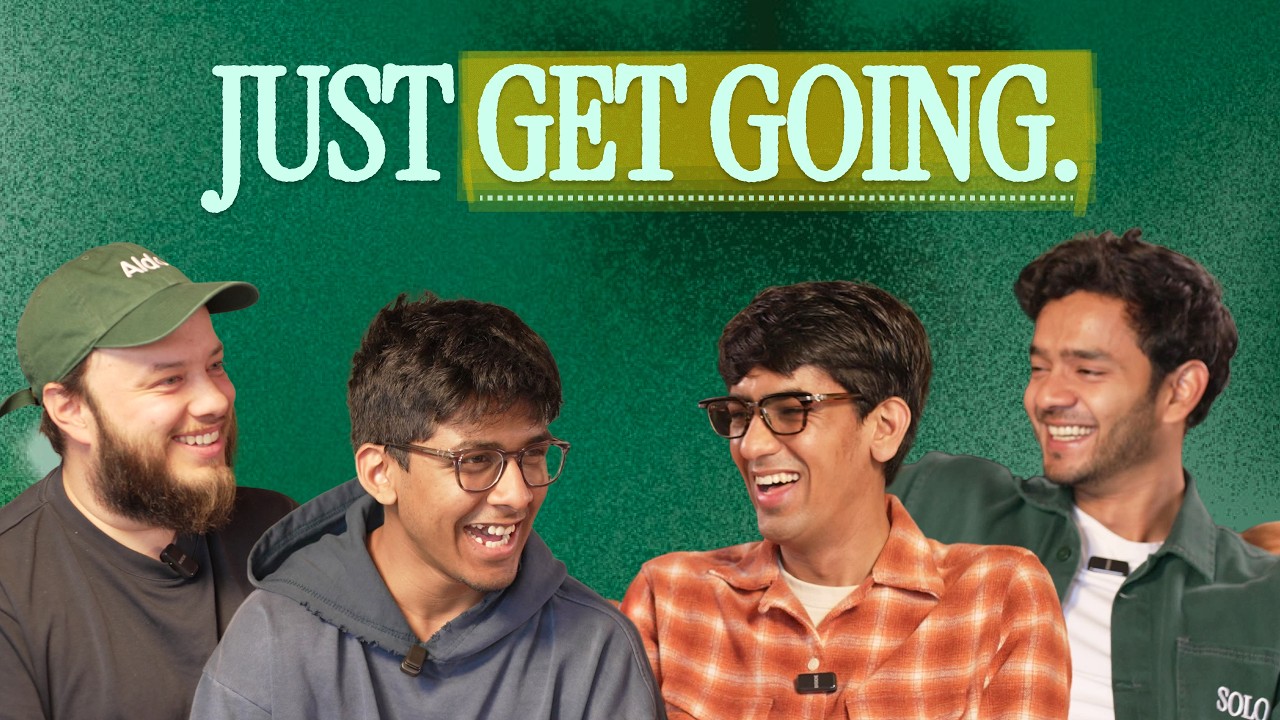
This episode celebrates the one-year anniversary of the Solo Founders Program (SFP), a three-month San Francisco residency where solo founders build “solo together” instead of alone. Host Julian speaks with four members of the first cohort — Aldo, Chai, Namanyay (Nam), and Dravia (Draia) — about their early founder journeys, the lessons they exchanged, why they reject the idea that a co-founder is a prerequisite to start, and what “solo together” means in practice.
The Solo Founders Program premise
SFP was created because the hosts believe solo founding will become the default way great companies start, and that searching for a co-founder before starting often leads to a “co-founder of convenience” — a bad match that kills the company.
The program selects about a dozen founders per cohort, invests $100k in each, and runs for three months in San Francisco with close mentorship from Julian.
Demand has grown sharply: Cohort 1 had ~1,000 applications for 6 spots; Cohort 4 had 4,500 for 10; Cohort 5 applications opened the day of this recording.
Early alumni results include a formal partnership with a major US government institution within 5 months of incorporation, 20k+ GitHub stars and 3M downloads for an open-source tool, and $2M ARR before a single hire.
Aldo: four ideas, then a co-founder found by building
Aldo cycled through four ideas during SFP before landing on his current venture: turning any computer into a data center.
He started on an AI product-manager / self-healing product, kept pulling the thread on a specific privacy-and-context problem, and a previous investor (who had advised his last company for five years) reached out to join as founding engineer.
After a technical breakthrough, Aldo asked him to become co-founder; they frame their partnership as “artist–producer” rather than CEO/CTO, swapping roles as the company needs.
Aldo’s takeaway: you don’t have to wait to start; the right people appear when you’re in motion, and elevating a trusted first hire to co-founder can work when incentives and complementarity are explicit.
Chai: pulling the thread through three ideas
Chai explored two broad areas — travel and software reliability — and tried three concrete ideas before settling on the current one.
Idea 1: AI email client for travel advisors. Had distribution (hundreds of thousands of social views) but realized scaling would be painfully hard.
Idea 2: Session-recording / user-struggle detection (similar to what Aldo explored). Built it, saw the same scaling pain, and watched later entrants hit the same wall and pivot.
Idea 3 (current): Flip software reliability from a top-down mental exercise (imagining all failure modes) to a bottom-up compute problem: give the software, simulate all customer behaviors and production scenarios, surface every problem, and tune compute to reach a desired reliability standard.
Chai’s lesson: keep pulling the thread; many founders stop at a suboptimal local maximum when the real opportunity is a few iterations further.
Nam: from India to SF, learning to distinguish signal from noise
Nam had been programming since his teens, ran a startup in India, and came to SF when he saw the AI wave concentrating there. He joined ODF’s one-week program, then SFP with ~40–50 paying customers for a developer tool (prosumer/hobbyist).
Biggest push during SFP: learning to separate valuable feedback from hype signals. “Even if my Twitter posts get hundreds or thousands of likes, that’s not something I should be focusing on.”
Free users ≠ a business: unless free traction converts to paying customers, you’ve created a free trend, not a company.
Aldo drilled the “10x question” into him: “What is something people will pay you 10x more for? How do you make it 10x more valuable for a large business?” That focus on the biggest, most valuable, payable problem got the startup off the ground.
Draia: the youngest in the room, learning by osmosis
Draia joined the first group office hours late (May 15) and felt like an imposter surrounded by top talent; his first impression of Chai was “top 0.1% IQ in San Francisco.”
He absorbed life and startup habits from the older founders — cooking, coffee, daily rhythms — describing it as “like having a dad” and observing what he used to be but lost.
The intergenerational dynamic worked both ways: older founders saw their younger selves and were re-energized.
Core lessons the group exchanged
Retention is growth. Aldo taught the cohort to watch the leaky bucket: smile curves, retention benchmarks, and why ignoring retention during hypergrowth creates a fragile business that tanks when luck turns.
Free users vs. real business. Nam internalized that free traction without paid conversion is a trend, not a business; the focus must stay on problems people pay 10x for.
Grounded over hype. Aldo consistently pulled conversations back to fundamentals (unit economics, retention, payable value) rather than narrative-driven excitement.
Speed and rhythm. Aldo noted he moved slower in his previous company; SFP’s daily cadence of new problems, insights, and challenges from Chai, Nam, and Draia re-taught him that momentum compounds.
Co-founder experiences: why they’re wary of “prerequisite” co-founders
Nam: Had a great school-friend co-founder (aligned values, worked well), but also watched a well-funded, high-traction company with tier-one investors collapse solely because of a bad co-founder dynamic — conversations they should have had pre-founding came too late.
Chai: First co-founder was his dad (he was 17). Family power dynamics made hard conversations impossible; the company survived but the relationship eroded. Second co-founder was a close college friend/roommate; dominance/passivity patterns eroded that friendship too, leading to a painful split after two companies together.
Aldo: Elevating a five-year advisor/first-hire to co-founder worked because they had already stress-tested trust, complementarity, and shared vision through years of collaboration — not because they needed a co-founder to start.
Shared view: Co-founders can be amazing, but treating one as a prerequisite forces bad matches. Better to start solo, make progress, and let the right partner emerge from the work.
What “solo together” means to each founder
Nam: “Geniuses always behind my back” — technical help, negotiation counsel, emotional grounding from people who’ve done the same things and empathize with the panic.
Chai: “Like having five other co-founders” — collective journey coverage across stages, problems you’ll eventually hit, and the energy of passionate builders replacing the burnout of searching for a co-founder.
Aldo: A family fighting the same battle (the market, the customer) instead of competing with each other; instant access to domain expertise (Draia on memory/context, Chai on technical depth, Nam for levity), all bound by a higher purpose.
Draia: (Echoed the above) The combination of smart people who care, are passionate about their own companies, and create an environment where you can go further than you could alone.