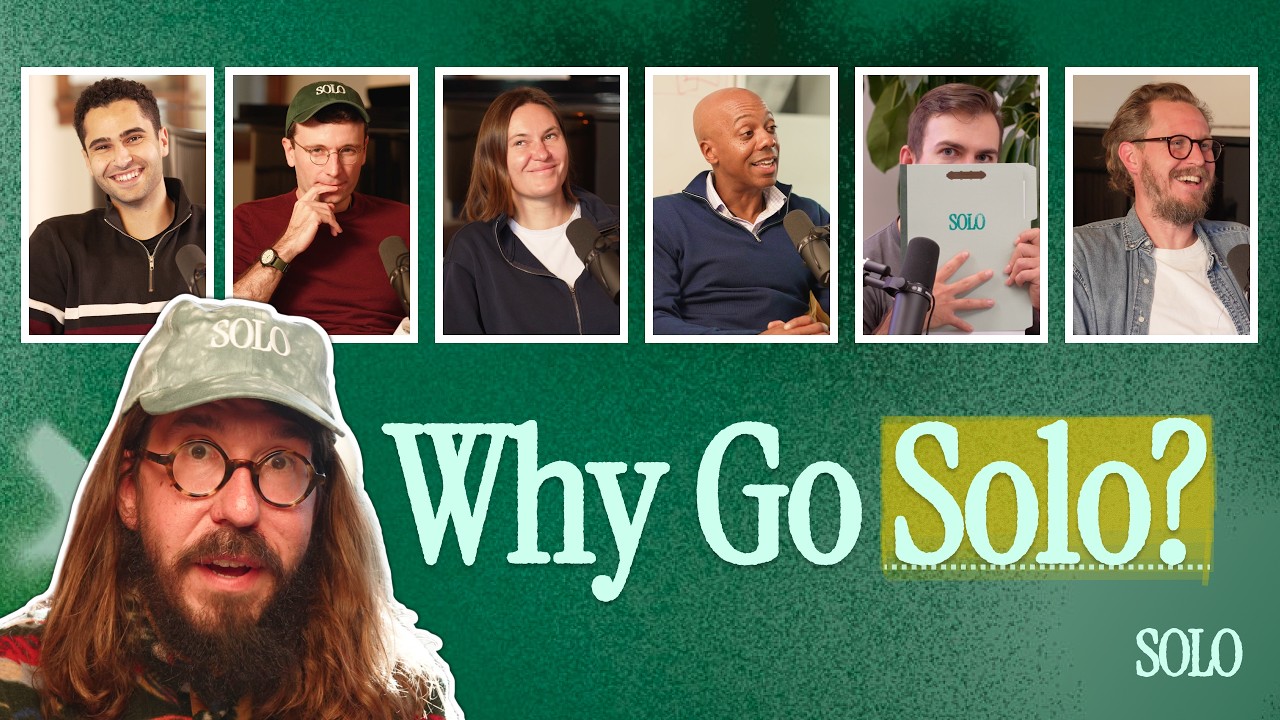
This episode is a curated retrospective of the Solo Founders podcast, where host Arya pulls together key clips from previous conversations with solo founders and one investor to surface deeper themes about building companies alone in 2026. Rather than a standard interview, it’s a thematic synthesis exploring why solo founding is becoming more viable, more powerful, and in some ways more beautiful than the traditional co-founded model.
The 80/20 rule for AI-era companies
Ben Cera, founder of Pulsia (a $30M raise at $250M valuation, $10M annualized revenue, built as a true solo founder with no human teammates), argues that in 2026 a new company must be 80% autonomous — meaning AI handles the bulk of operations, engineering, and marketing — or it will be outcompeted by someone who does it faster and cheaper.
The remaining 20% is what he calls “taste”: human judgment, creativity, direction, and the ability to guide AI toward something meaningful to other people.
This is really about judgment and opinion — even if someone had the exact same AI scaffolding as Ben, their output would differ because the human input shapes the result.
The host frames this as a Pareto principle for the AI era, but notes that the tools amplify both the 80% and the 20%, so the total output is far greater than before.
Solo founding as a clarity advantage
Paul Klein IV, founder of Browserbase, describes solo founding as “beautiful” because of its directness: there is only one layer of alignment between founder and company, compared to the complexity of aligning co-founders with each other and then with the company.
When there are co-founders, it’s unclear whose insecurity or hesitation is driving company decisions; as a solo founder, Paul knows exactly where the company’s emotional state comes from because it comes from him.
The host connects this to Eugenia Kuyda (founder of Wabby and Replica), who also used the word “beautiful” — noting that this language is unusual in startup discourse, which typically reserves “beauty” for product design, not organizational structure.
The simplicity of one voice eliminates ambiguity about who makes decisions, which is especially valuable for early team members trying to understand direction.
A talented solo founder beats a mismatched team
Charles Hudson, an investor at Precursor Ventures and the only investor featured on the podcast, shares his hierarchy of founding teams:
First choice: two deeply connected, tightly coupled co-founders with trust and shared history — though even those teams can break up.
Second choice, and the third “isn’t even close”: a really talented solo founder over a mismatched team.
The host emphasizes that most people don’t have a perfect co-founder match; they bring on a co-founder out of convenience, to appease investors, or because they fear loneliness — not because the person is the ideal partner.
Roughly two-thirds of early-stage startup failures are attributed to co-founder conflict, making a co-founder of convenience one of the biggest risks a company can take.
The host’s advice: don’t take a co-founder unless it’s a truly great fit; if you’re solo, build a support system (like the Solo Founders program) instead.
The personal is the universal
Eugenia Kuyda’s story of building Replika grew from deep personal loneliness — growing up as an only child with young, absent parents, losing a close friend in her twenties, and wanting to recreate that sense of connection for herself and others.
She articulates a principle the host finds powerful: “the most personal is the most universal” — her individual story resonated with millions.
The host extends this into a broader philosophy: startups at their best are a form of art, like an album, painting, or novel. The best fiction tells a personal story that resonates with people who haven’t lived it.
Practical implication: solo founders should start by building for the people who will actually use the product, creating resonance first, rather than trying to convince investors or co-founders before there’s something real. Once the personal-to-universal resonance is demonstrated, fundraising and hiring become much easier.
Mission as a forcing function
Daniel Francis, founder of Abel (software for police officers), shares that his company’s impact can be quantified: every 115 officers on the platform saves one life per year through time saved on report writing.
This creates a visceral accountability: if the software underperforms or someone on the team isn’t measuring up, real people could die. He frames this as “aligning” — the mission clarifies every decision, including hiring and firing.
The host notes that not every company needs a life-or-death mission, but having a tangible connection to the people you serve is extremely motivating and clarifying. It raises the stakes of performance in a way that builds serious teams.
Solo founding is very hard to lose
Yasser Elsaid, founder of Chatbase, recently announced $10M ARR bootstrapped from a college dorm room in Canada — a venture-scale business built without venture funding.
His core argument: “solo founding is very hard to lose” because the number one reason startups fail is co-founder breakup. Without that risk, a solo founder can pivot, raise more money, or find other paths forward.
He echoes Charles Hudson’s investor perspective from the founder’s side: an amazing co-founder is worth considering, but a below-average co-founder is far worse than being solo.
The host distinguishes between Ben Cera’s “true solo” (no human teammates, just AI and contractors) and Yasser’s “free solo” (no venture funding but a sizable human team) — showing there are multiple viable paths to building alone.
Two models of solo building
The episode implicitly contrasts two archetypes of solo founding:
True solo (Ben Cera): one human, AI agents, and contractors — pushing the boundary of what a single person can operate.
Free solo (Yasser Elsaid): bootstrapped, venture-scale revenue, real team — proving you can build a large business without outside funding or a co-founder.
Both models reject the assumption that you need a co-founder or venture capital to build something significant.