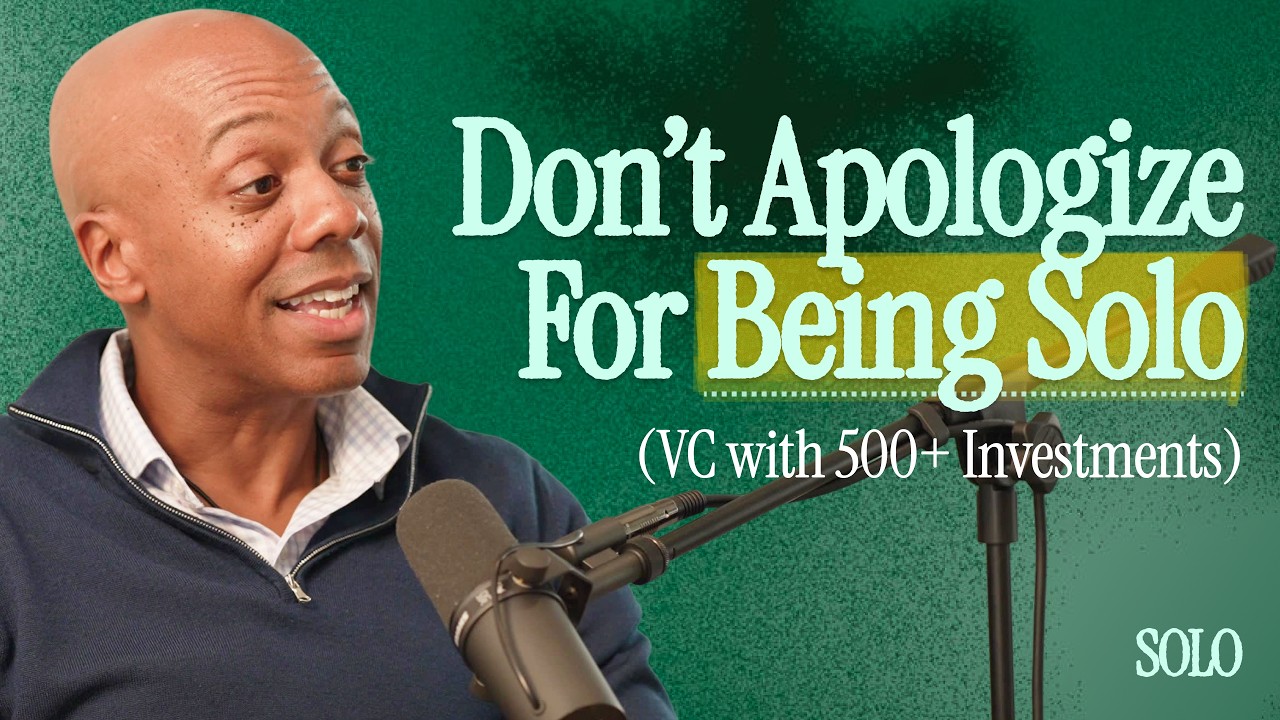
Charles Hudson, a solo GP at Precursor Ventures who has invested in over 500 companies, makes a detailed case for why solo founding is underrated and why the conventional wisdom that startups require co-founders is often wrong.
He argues that the ideal — two deeply trusted, well-matched co-founders — is rare, and that mismatched co-founder teams cause enormous damage, with 25–30% of his portfolio companies losing a co-founder before Series A.
He would consistently choose a talented solo founder over a mismatched co-founder team, and his preference for solo founders has grown over time.
Why the co-founder consensus is wrong
The “team sport” analogy is misleading
People say startups are a team sport, but Charles points out that tennis and golf are also “team sports” — in singles, no one serves or putts for you. You make your own shots.
Soccer, where you’re only as good as your weakest player, is a fundamentally different model. Startups are more like singles tennis.
Denominator delusion
Investors pattern-match on successful companies with co-founders but ignore the denominator: huge numbers of co-founded companies fail specifically because the team didn’t get along.
Co-founder breakups create dead equity, cap table damage, and massive distraction — often worse than starting solo.
Myth: “It’s too much work for one person”
Charles distinguishes between being a solo founder and being a company with only one employee. They are not the same thing.
A solo founder can and should build a team around them — they just don’t give away co-founder titles and equity to do it.
What actually goes wrong with co-founders
Dead equity and cap table damage
Charles has seen co-founders leave with 20–25% equity, making it nearly impossible to attract new investors.
Fixing these situations requires convincing departed co-founders to stay on the cap table until a buyout can be arranged — work that creates zero value for the company.
Technical co-founders are more likely to depart
Charles’s observation: technical co-founders who can’t manage people and aren’t senior enough to be architect/CTO-level often find their long-term role at risk.
Some are individual contributors who’d rather start their own thing than be a small piece of someone else’s puzzle.
Rivalry and resentment
Rivalry: a non-CEO co-founder decides they should be CEO. This is extremely hard to resolve and often ends in succession-style conflict.
Resentment: the more pernicious problem. Small perceived slights accumulate into a narrative that the resented party often doesn’t even know is building. Once resentment takes hold, Charles has almost never seen teams recover.
Directional misalignment
Companies evolve and pivot. One co-founder may be attached to the original product or mission while the other sees the need for change.
Charles is actively dealing with a case where a CEO wants to pivot within the same category and the technical co-founder is vehemently opposed — the CEO may need to part ways with him.
Late-joining co-founders create weird dynamics
Some companies add “co-founders” years in or after a pivot. The title signals something specific to employees, but the equity and power don’t match, creating a hard-to-navigate dynamic.
Charles has seen cases where investors required a co-founder as a condition of investing, and it went poorly — in one case, the title itself was so stressful the person would have stayed on as CTO but left because of the co-founder title.
Early co-founder breakups are common and should be destigmatized
Somewhere between a quarter and a third of founders Charles has spoken with had a co-founder for only a few weeks or months.
He’s far less concerned about early breakups than late ones — parting ways early is less expensive and less traumatic.
Advantages of solo founding
Authorship
Charles considers this the most underrated advantage. A solo founder is the sole author of the company’s story, with a specific vision in mind and the drive to pursue it relentlessly.
This mirrors how most great creative works are structured: one director, one principal, one author — not co-authors.
He experienced this himself as a solo GP: he had a specific vision for the kind of firm he wanted to build and knew it had to be his to create.
Single decision-maker
When hard decisions arise — pivots, principle adherence, strategic direction — having one unquestioned decision-maker is faster and clearer.
Charles believes people overestimate the value of deliberation in some contexts; sometimes a strong point of view and the empowerment to act on it matters more.
Equity as a superpower
A solo founder who owns 90% of the company can make dramatically more compelling equity offers to early hires.
The first hire at a solo-founded company has outsized impact on culture and outcomes, and the founder can compensate them accordingly.
Culture reflects one person’s values
Without another co-founder shaping the cultural ethos, the company’s values and beliefs are a pure embodiment of the founder’s vision.
This can produce companies with unusually strong, coherent cultures.
Trying all jobs
Because there’s no division of labor, solo founders get to try every role — recruiting, sales, operations — and often discover hidden talents.
Sales is a common one: founders realize they have a natural aptitude they never would have discovered if a co-founder handled it.
Speed
Solo founders aren’t encumbered by needing to find a co-founder before starting. They can move immediately.
Decision-making is faster without consultation or negotiation with a partner.
Full empowerment to fix problems
If something about the company isn’t working, the solo founder is fully empowered to fix it — they either created it or allowed it to happen, and no one else is responsible for changing it.
Who tends to be a solo founder
Non-tech founders
Founders from outside tech — digital health, CPG, education — often don’t have the “co-founder” mental model at all. A former high school principal pointed out there are no co-principals.
These founders think bottoms-up and make unconventional decisions not out of contrarianism but because they haven’t been exposed to Silicon Valley conventional wisdom.
Tech founders who go against the grain
Tech founders who choose solo founding despite knowing the consensus tend to question convention in other areas of how they build their company as well.
Fundraising advice for solo founders
Don’t apologize for being solo
Charles used to meet solo founders who were defensive before anyone raised the issue. If it was an intentional decision, don’t qualify or explain it until asked.
When asked, frame it as a superpower: explain how you’ll use the extra equity to build a world-class team.
Don’t give wishy-washy answers about adding a co-founder later
If you’re never going to add a co-founder, say so clearly. Don’t say “maybe someday.”
Screen your investors
Before pitching, check whether the investor has ever backed a solo founder. Some have a hard block on it — don’t take it personally.
Understand that “no co-founder” is often a polite rejection
When investors pass, they sometimes give the least offensive reason. “No co-founder” is a convenient, inoffensive excuse when the real reason is they don’t believe in the company.
Most investors will pass on most companies regardless — don’t internalize it.
The emotional reality of solo founding
The bear case: isolation and overwhelm
The amplitude of emotional ups and downs is greater without a co-founder to balance you. Good co-founders ensure you never both have your worst day on the same day.
Many solo founders underestimate the loneliness by a factor of 10. Some come to Charles saying they weren’t prepared for the emotional roller coaster.
Solo founders are doubly isolated: no co-founder to partner with, and CEO burdens you can’t share with your team.
The company can become single-threaded through one person. If the founder is fundraising, the company isn’t talking to customers. Misallocating time has no corrective feedback mechanism.
The bull case: pride, energy, and deep investor relationships
Charles finds that many of his closest, deepest founder relationships are with solo founders — they lean on him not as a co-founder but as a trusted partner, creating a natural bond.
Solo founders in his portfolio use group chats as journals, venting with “no response needed” — a practice that reflects the unique need for connection.
There’s a special pride and energy in authorship: the ability to fix anything about the company you don’t like, because it’s entirely yours.
Charles sees a kinship between solo GPs and solo founders — both are atomic units making decisions independently, which creates a natural foundation for honest conversations about leadership challenges.
Practical advice for co-founder situations
If you’re a few weeks in and it’s not working: end it early
Charles is far more comfortable with early breakups than late ones. The cost of parting ways at 3 months is far less than at 3 years.
Common legitimate reasons: directional disagreement, someone wants stability for family, someone’s heart isn’t in startups anymore.
If a co-founder is checked out: have the real talk
Don’t threaten or remind them of consequences. Explore why they’re disengaged. If they’re meant to build something else, release them to do it — and be happy about it.
The hardest part is having the courage to start a conversation when you know the answer might not be what you want to hear.