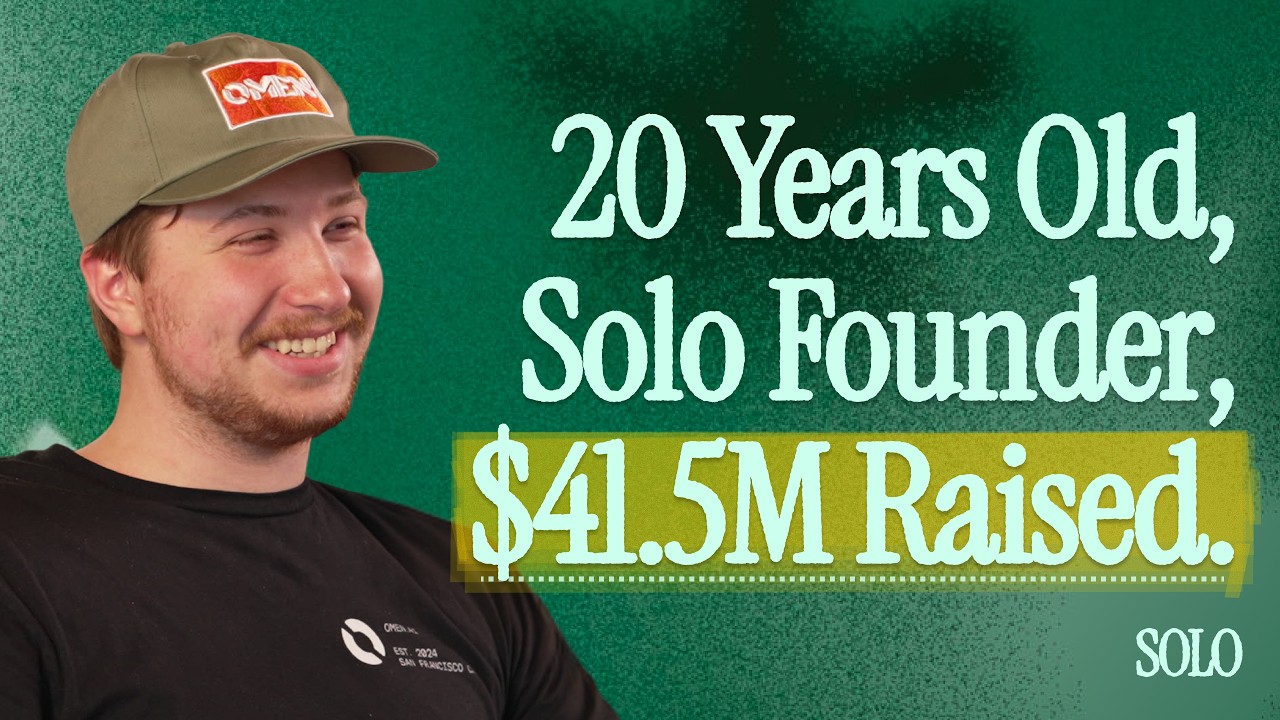
Zach Laberge, a high-school dropout from Nova Scotia, built his first venture-scale company (Frenter) at 15, shut it down at 18, then founded Omen — a predictive-maintenance startup for heavy-equipment hydraulics that pivoted into AI data-center liquid-cooling monitoring — raising $3M in three days and scaling to a Series A with strategic investors while remaining a solo founder with a tight founding team.
Early entrepreneurship: Alibaba flips, dog cookies, and six ventures before 14
Zach’s entrepreneurial start was money-motivated: at 10 he borrowed $100 from his parents, bought 10 fake Apple Watches on Alibaba for $10 each, and flipped them to classmates for $40.
He and his twin brother ran six to eight projects between ages 10–14: a dog-cookie brand (Kickstarter did $6–7K, ~$10K total sales), jewelry, a fashion line, and an NFT collection for their dog’s 20K-follower Instagram.
Kickstarter taught him that distribution requires real work — posting once doesn’t bring floods of buyers; you must promote, tell a concise story, and execute a launch strategy.
Shark Tank and online startup content (Collison brothers, Airbnb) shaped his view that young people could move to SF and build real companies.
Discovering no-code and the Frenter idea (January 28, 2020)
At 14, Zach learned Bubble (a no-code platform) to build the dog-cookie site, then spent eight months writing a business plan for “Airbnb for stuff” — a peer-to-peer tool-rental marketplace called Frenter.
He admits he put blinders on: deep research but zero customer conversations, assuming “if I build it they will come.” A few Google searches would have revealed a graveyard of failed P2P rental marketplaces.
Dropping out at 15: the pitch to his parents
At 15 (grade 10), Zach told his parents — both lawyers, mom a former Ontario education minister — he wanted to work on Frenter full-time. He prepared a multi-page essay arguing that serious entrepreneurs can’t do school and a startup simultaneously, framing the downside as only six months behind in school versus unlimited upside.
His parents agreed after 1–2 conversations; the deal was one to two hours of online school each Friday. He attended the first day of grade 11 and never returned.
Raising $3M for Frenter and the shutdown at 18
Zach cold-emailed investors for a month, met the 1517 Fund (first VCs he ever spoke with), and raised ~$3M over 4.5 years. Frenter pivoted to GPS tracking and software for heavy-equipment owners, reaching six-figure revenue.
At 17–18, facing a month or two of runway, Canadian severance laws (personal liability for a year’s pay), and a co-founder breakup, he chose to sell assets and wind down rather than raise a bridge round.
His shutdown test: “What fundamentally changes with $3M more?” He couldn’t convince himself the structure, team, and dilution would yield a different outcome, and he felt uncomfortable raising more capital.
He transitioned all customers to another company, secured months of severance for team members (many with kids), and sent a transparent wind-down email. Valley founders praised the move; traditional Canadian contacts asked why he didn’t keep grinding.
Omen: $3M in three days, then engines → hydraulics → fluid monitoring
Immediately after Frenter, Zach leveraged his network: he emailed every major construction/rental CEO (CAT, United Rentals) asking what they’d buy. United Rentals’ innovation director said they’d buy a sensor predicting hydraulic failures.
He recruited a senior CTO (ex-Nest founding team), worked out of a spare bedroom, and deployed vibration sensors on excavators. Customers said engines rarely break, but hydraulics represent 30–40% of machine value and fail often.
They discovered the current workflow: technicians pull fluid samples, ship to a lab, wait weeks for results. Zach asked: “What if we do this on-machine, in real time?”
Six months in, a customer said: “Focus only on the hydraulic fluid sensor.” Next day, the team “full-sent” on fluid monitoring for hydraulic systems.
From Cat dealerships to AI data centers
By early 2025, Omen had traction with large dealerships and fleet owners, raised a seed round, and began scanning adjacent markets (shipping, manufacturing/Bridgestone, data-center liquid cooling).
Data-center liquid cooling was ~6 months early: a Bitcoin-mining veteran laughed at Zach (“you’re an idiot, never heard of this problem”). But rumors of Nvidia’s next-gen chips running at 34–43°C (ideal bacterial growth temps) signaled the problem was coming.
Zach’s pitch to data-center execs: “19-year-old, backed by Caterpillar and Fortune 500s, $13M raised, interested in your space — can I pick your brain?” Cold emails to CEOs (CoreWeave, TensorWave) got meetings; Peter Tamasic (TensorWave co-founder) became an investor/advisor after meeting at a bar where Zach, then 20, couldn’t sit at the counter.
Solo by default: founding teams vs. co-founders
Zach never had a co-founder for either venture-scale company. At Frenter, a COO (32 at the time) stayed the full 4.5-year journey. At Omen, a CTO joined as a founding team member with equity but not co-founder status.
He views solo founding as: “I know what I want to build; I have capital; I’ll hire exceptional people who are bought in, but the final accountability sits with me.”
After the seed round, he reset the team: frank conversation with his CRV investor (Caitlyn) that scaling required a different caliber. He went back to just himself, then recruited a CTO, head of research, and 4–5 founding-team members — all network-driven, many from “not now, maybe later” relationships maintained over months.
He agrees with Replika/Wobby founder Eugenia: solo founder + founding team creates a tighter, two-layer org (CEO → founding team) vs. three layers (CEO → co-founders → founding team), reducing ego friction and hiring barriers.
Fundraising: “greatest fundraising market in history” but concentrated
First half of 2026 saw more capital deployed than all of 2025, but ~50% went to 10–20 companies. The best (or perceived best) get all the money; fewer startups get funded.
Zach’s rounds have been preempted and aggressive. His strategy: build a kick-ass company in a hot market, pick investors you want, and raise when you’re not desperate. The best round happens when you’re not raising.
He mixes generalist VCs (CRV) with strategic operators (ex-CEO of Lambda, CBO of CoreWeave, Johnson Controls) who open customer doors.
Early Frenter advisors: some forgotten, some regretted. Now he’s “exceptionally generous with exceptional people” — C-suite execs from every major Neocloud, plus investors, on a formal advisory board.
Bar for entry: “If I’m not excited — ‘holy shit, how do I get this person?’ — it’s not worth giving equity.”
Cadence: weekly 30-min 1:1s (biweekly for the busiest), auto-scheduled so it doesn’t fall off. No group dinners/board meetings — they create performance, not candor.
Compensation: uses a template (from advisor Peter Tamasic) with tiers (expert/intermediate), defined deliverables (meetings, intros), suggested equity by stage (e.g., 0.1% vested over 2 years with 6-month cliff), rarely cash.
The bear case for solo founding
Loneliness of ultimate accountability: investors, customers, payroll, personal guarantees on loans/credit cards. Even with a bought-in founding team, the founder’s name is on the line.
Misaligned incentives: contractors, wrong hires, and others see the bank account as a piggy bank; the founder must filter all interests against “how do we build a kick-ass business?”
Personal sustainability: buying the Maple Leafs and fixing yourself early
Long-term north star since childhood: buy the Toronto Maple Leafs. Motivation fluctuates with company traction (Frenter up → on track; Frenter down → off track; Omen up → back on track).
Realization: core pillars (fitness, health, relationships, mental health) never get easier to fix — more success = more busy = harder to repair. “You just got to fix yourself now.”
Office strategy: started in house, then separate room, then dedicated office a block from home. Space decisions tied to team trajectory, not funding rounds. Commute >1 hour kills energy; he encourages team to live close (stipends if needed).
The case for solo founding: the force multiplier
You are your own greatest advocate and motivator; everything good is also on you.
Forced to learn everything early: hiring, technical domains (plasma physics, spectroscopy) because no technical co-founder existed. “You get 10× smarter than the guy who says ‘I won’t learn technical stuff because I have a co-founder.’”
If you don’t have the perfect co-founder, you’re only 50% as good as you could be. Solo founding removes that ceiling.