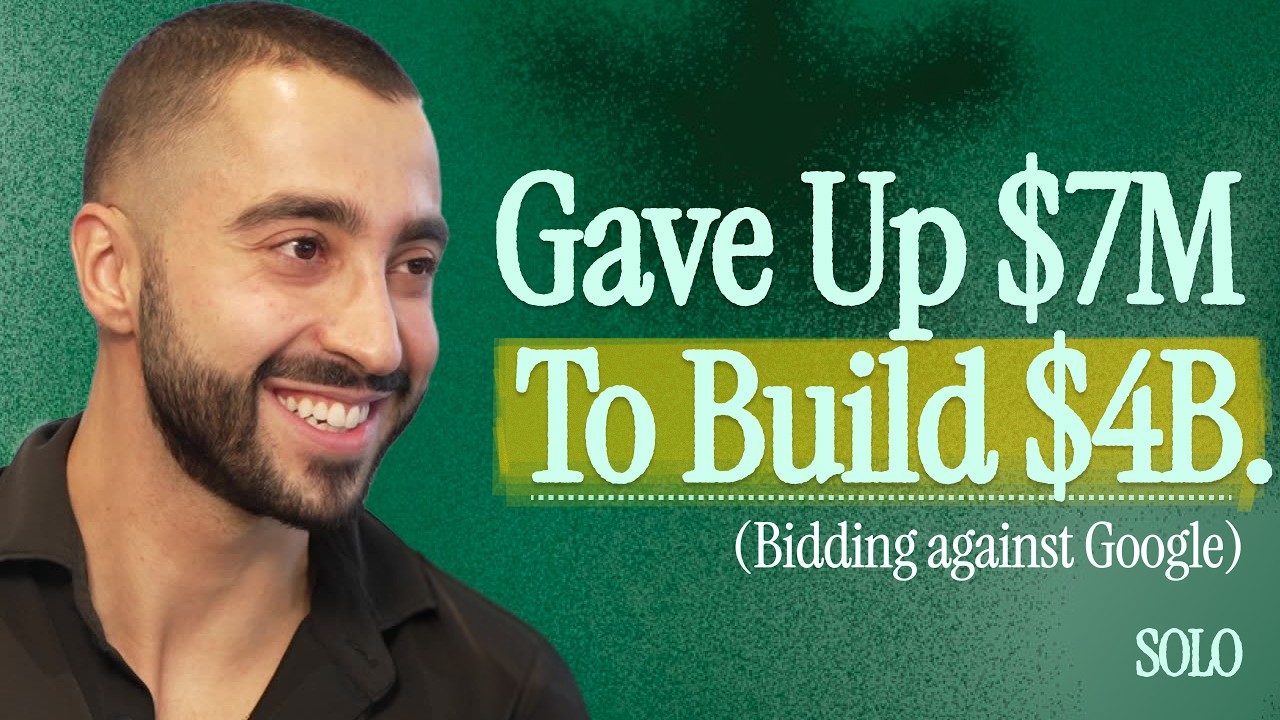
Ali Ansari founded Micro1, a company building data environments for AI labs to train models, after a decade of entrepreneurial experiments starting with selling his dad’s shoes on eBay at age 12; the episode traces his path from garage-sale textbook flipping through a tutoring business and a software agency to the pivotal pivot from an AI recruiter tool to a full-stack data platform, the near-death experience of losing 60% of revenue overnight, and his philosophy on solo founding, high-velocity culture, and refusing to sell American intelligence to adversarial nations.
Early entrepreneurial roots
At 12, Ansari listed his father’s branded shoes on eBay without permission, sold them for ~$70, and realized he could make money online; he quickly exhausted household inventory and began biking to garage sales to buy and flip textbooks, fitting them in his backpack.
He built CashBooksNow, a website that used Amazon’s API to give instant quotes for used textbooks based on ISBN, sales rank, and price; he stored inventory in his room, marked walls with Sharpie to track listed vs. unlisted books, sold a few thousand copies over a couple of years, then sold the remaining inventory in bulk and moved on.
In high school, he launched Pure Link, a peer-to-peer math tutoring center (later virtual) staffed by older students; it reached six-figure run rate but flatlined for over a year until a mentor, Hamid Cohen (LegalZoom), bluntly told him it was not an interesting business, prompting a small acquisition and exit.
At Berkeley, he started Moonch, a software development agency; the bottleneck of constantly interviewing and vetting engineers led him to build an internal AI screener (later named Zara) that became the seed of Micro1.
Three signals it’s time to move on
CashBooksNow: Google Ads CAC stopped scaling; after exhausting alternative channels, he sold inventory and exited after a couple of years.
Pure Link: Revenue flatlined for over a year; a trusted mentor’s direct feedback that the market was too small and uninteresting broke his attachment and led to acquisition.
Moonch: The internal AI recruiter tool solved a painful, recurring problem for a services business and showed potential to be a standalone product in a massive market; he spun it out quickly once the signal was clear.
Core lesson: market matters enormously; early founders ignore it, but at some point you must deliberately choose a market with tailwinds — Micro1’s growth owes as much to the AI data market explosion as to execution.
From AI recruiter to data infrastructure: the all-in pivot
About 18 months in, a single customer (a frontier lab) hired 500–600 engineers in a week via Micro1’s AI recruiter, revealing the shift from generalist talent to expert data labor for model training.
Micro1 initially served other data providers as a tool; then realized it could build the full stack — data platform, research team, pipeline performance management — and serve labs directly.
The transition took nearly a year of iteration; Ansari finally recorded a Loom titled “Micro1 is going all in on data,” shut down the AI recruiter product (≈$7–8M run rate), and reoriented the entire company.
Two months before the Loom, the would-be competitor terminated the contract, cutting 60% of revenue overnight and nearly killing the company; the crisis made the all-in decision personal and urgent.
Ansari argues outlier outcomes require outlier decisions that the team initially thinks are crazy; only the founding team can inject that level of risk, and doing so repeatedly builds confidence for more such bets.
Solo founding vs. founding team
Ansari never knew “co-founder” was a concept; he just started companies alone in LA, outside Silicon Valley norms.
When applying to YC, he couldn’t find a logical reason to need a co-founder beyond investor de-risking; he views co-founder matchmaking as procrastination — just start, get someone to pay you, then attract a founding team.
For Micro1, he doesn’t consider himself a solo founder: early members like CRO Will (joined months in) and investor Joshua Browder function as co-founders; the distinction is founding team closeness and shared ownership without a middle co-founder hierarchy.
Almost all early agency hires transitioned to Micro1 and remain; they were involved in every pivot debate, making changes feel like collective evolution rather than top-down mandates.
Hardcore-but-kind, async, action-oriented culture
Remote-by-default, async-by-default despite “hardcore” intensity; no arbitrary 996 office mandates — people work weekends from couches at 2 a.m. because problems are interesting.
Decision-making via “open threads”: proposer states problem and candidate solutions, only necessary people join, minimize messages to reach “final actions,” thread owner executes; long discussions converge to same actions, so converge earlier.
No meetings by default; “circle back next week” is a banned phrase; new hires get rapid feedback loops to adapt.
Culture is simultaneously high-pressure and deeply supportive: new members feel pressure immediately but also immediate kindness and support; both must be true from day one.
Surprises for new joiners: caliber of clients (frontier labs, enterprises), redefinition of “fast-paced,” and unexpected depth of team support amid chaos.
Micro1’s business: environments, data partnerships, and units of intelligence improvement
Core product: environments for labs to train models — seeding data, tooling, tasks, and verifiers; realism of environment is a scaling law.
Company Data Partnerships (CDP) function licenses operational data from ~150 new companies/day, anonymizes it, and uses it to seed environments and build verifiers.
Spirit Airlines bid (hearing Sept 30) is one high-profile CDP deal; the strategy is buying real-world operational data to make training environments realistic across domains.
Abstract mission: provide “units of intelligence improvement” (datasets, environments, eventually reward-model-as-a-service, post-training-as-a-service, rollouts-as-a-service) for any intelligence system — LLMs, enterprise agents, humanoid robots, other hardware embodiments.
Expansion criteria: anything under the umbrella of a data engine producing predictable, abundant intelligence-improvement units.
Malibu robotics office
“Why not Malibu?” — unique recruiting angle for scarce robotics researchers (train robots at the beach), key robotics team members already in LA, LA’s broader hardware ecosystem matters for non-humanoid embodiments, and it’s simply fun.
HQ remains SF; team stays distributed; Malibu is an extension, not a relocation.
Values: refusing to export American intelligence
Principled, long-term outlook: only work with US and allies, even if it sacrifices nine-figure near-term revenue.
Ansari’s family won the green-card lottery from Iran; he feels profound gratitude and sees winning the AI race as the single most important national objective; data is the decisive factor.
Selling structured, large-scale environments (especially with US company operational data) to adversaries is exporting American intelligence — effectively distilling US models for them — and should be shameful; he hopes for government regulation to stop it.
Case against solo founding
Bear case: lonelier initially (but founding team fixes this fast); potentially justified for extremely hard deep-tech requiring multiple deeply committed domain experts from day one (though many El Segundo hard-tech companies are solo-founded because early hires prefer equity/ownership over co-founder title).
Case for solo founding
Faster decisions: single clear leader, no co-founder matching delays, tighter board control — critical because outlier decisions must be made by those deepest in the weeds.
Can build MVP alone in months, then attract a stronger founding team faster than co-founder search.