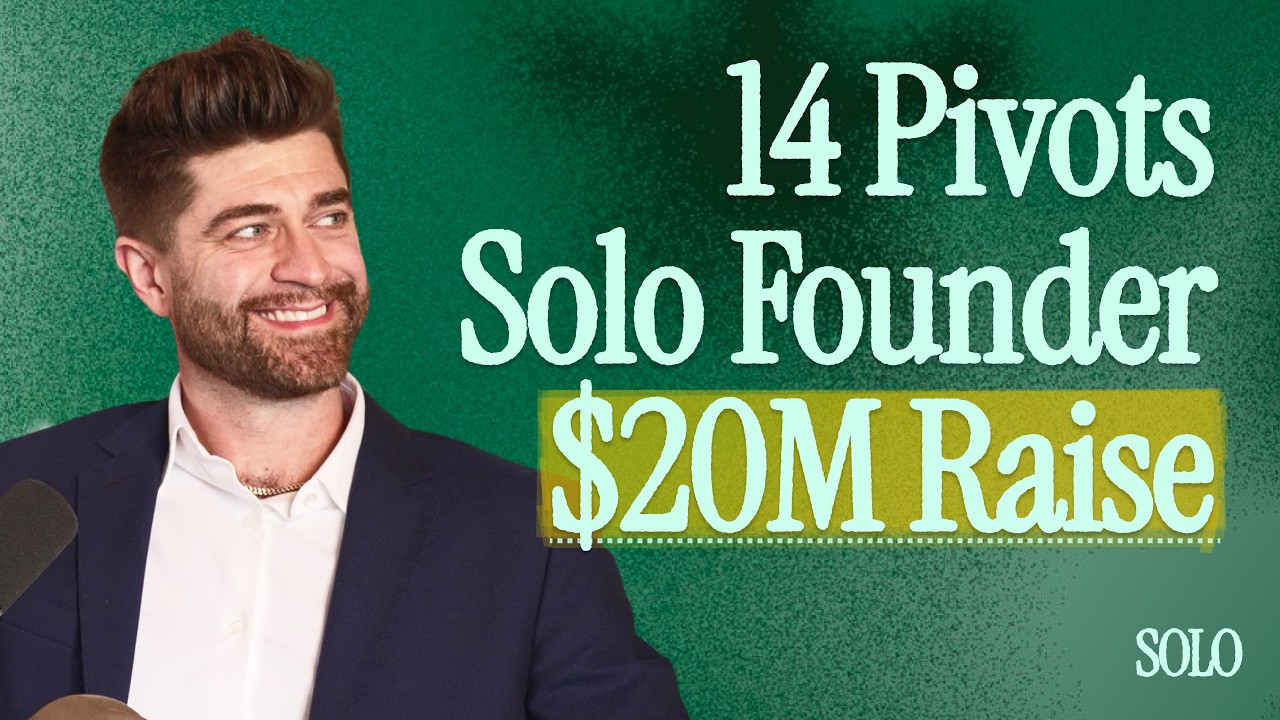
Jimmy Douglas left Tesla after five years to build Plug, a marketplace for used electric vehicles, as a solo founder — and the company has since grown to hundreds of millions in revenue after 14 go-to-market pivots. He ran Tesla’s used car business (the largest used EV operation in the world) and saw that the secondary EV market was deeply inefficient, with dealerships largely unprepared for software-defined vehicles. When the Inflation Reduction Act triggered a surge in EV leasing, he realized a massive wave of off-lease EVs would flood the market within three years — and nobody was building the right infrastructure to handle it. He left Tesla not out of frustration but out of conviction that this needed to exist, and that he was uniquely positioned to build it.
Leaving Tesla and the personal calculus
Douglas spent five years at Tesla, joining during one of its most precarious periods and leaving when it was one of the most valuable companies in the world. He led sales operations, delivery, internal fleet, internal comms, and the used car division. By the end, he was running one of the best operational teams he’d ever seen, and the financial rewards were significant.
The decision to leave was not about escaping corporate life — it was about conviction that the used EV market needed a new kind of marketplace and that he was the person to build it. He emphasizes that he was not running away from anything.
Becoming a father was the inflection point. His son’s birth changed his relationship with time: he realized he’d be working intensely regardless of whether he stayed at Tesla or started a company, but the energy he’d bring home would be fundamentally different. He wanted his son to witness “builder energy” rather than “corporate executive energy.” He raised the seed round over Zoom with his son in his lap.
The earned insight: why the used EV market was broken
Teslas were fundamentally different assets than traditional used cars — computers on wheels with self-driving hardware, high-voltage batteries, over-the-air updates, and software-enabled features — but the used car ecosystem treated them like any other vehicle. Normal dealerships would sit on a used Honda Accord for 45-60 days to maximize margin; sitting on a used Tesla Model S for 60 days during that era could mean losing $10,000 due to rapid price volatility.
The secondary market outside Tesla’s walls was characterized by information asymmetry, confusion, and processes not designed for EVs. Most dealerships opted out entirely; a small number captured arbitrage from the information gap. Douglas believed this was an existential threat to new EV adoption — if the secondary market was dysfunctional, it would undermine confidence in EVs overall.
The Inflation Reduction Act (2023) caused EV leasing to skyrocket, meaning a massive wave of off-lease vehicles would hit the secondary market starting around 2026. Douglas realized he had roughly three years to build the right platform and be in position when that inventory tsunami arrived.
Disproving hypotheses before building
Douglas spent significant time pressure-testing business models before committing, trying to disprove rather than validate his ideas. He built Excel models testing market size, achievable market share, unit economics, and speed to $100M in revenue. He killed many ideas before landing on the one he couldn’t disprove.
This “disprove, don’t validate” muscle was built at Tesla, where every proposal was stress-tested by teams of analysts whose job was to find flaws. At Tesla scale, the only mistakes you could make were measured in millions or billions, so the rigor was extraordinary. Douglas applied this to himself and his own team routinely.
Mike Maples Jr.’s essay “Reality Doesn’t Negotiate” was a key intellectual framework — the idea that founders fool themselves trying to prove their hypothesis right, but reality eventually catches up. It’s better to aggressively try to disprove your own ideas early.
14 go-to-market pivots before finding product-market fit
The business model was right from the start, but the go-to-market motion required 14 different pivots before finding one that grew like a hockey stick. Douglas asked Claude to analyze his emails, board decks, and investor updates to count the pivots — the answer was 14.
Roughly 10 of the 14 pivots bore some fruit and showed growth, but the team was honest that none were growing fast enough to be the primary motion. They kept experimenting rather than negotiating with reality.
The pivotal moment came during a “fake board meeting” where investor Ann Miura-Ko asked: if you had the balance sheet and could start over, what would you build? Douglas realized he’d go all in on consumer vehicles — the one quadrant they had completely ruled out due to concerns about balance sheet risk in a marketplace model.
Investor Vic Ramakrishnan (AAR) reframed the risk: “What’s worse than business structure risk is not growing. If you’re growing really fast, someone’s going to be interested.” Douglas went back to the office, formed an LLC subsidiary, got a wholesale dealer license, and bought their first consumer car.
The result was immediate: unique sellers per quarter went from ~16 to 429 — the first real hockey stick. Consumer supply started coming in organically, without any marketing or beacon on the website. People were finding Plug and asking for cash offers on their vehicles. “That is what market pull actually feels like,” Douglas said. Before that, every vehicle had been sourced through brute-force sales calls.
Solo founding: the case for and against
The bear case for solo founding: you may not have enough credibility, network, or skill set to recruit world-class talent. Douglas felt comfortable going solo because he was the most qualified person in the world to build this specific business, had backing from extraordinary partners (Floodgate, Mike Maples Jr.), and had decent social reach. Not everyone has that trifecta.
The bull case for solo founding: it’s the agency-maximizing play. If you’re a high-agency person entering entrepreneurship, total accountability and decision-making authority reside with you. In a big company, you might know the right thing to do but can’t do it for political reasons or because you can’t win alignment. In a co-founder partnership, the same dynamic can exist. Solo founding eliminates that.
“You must have a co-founder” is, in Douglas’s view, the worst factory setting in startups. He points out that YC won’t invest in solo founders, and many investors have a co-founder requirement. His view: you should have a co-founder only if there’s an obvious person to build that company with — not for any other reason. Rushing through a “dating process” to find a co-founder within a market window is, in his words, “insanity.”
Douglas was open to a co-founder presenting itself but never found one. Between working at Tesla, having a newborn, and ideating on the business, he wasn’t meeting many people. He knew from early on that solo was likely the path.
Floodgate as a pre-founding cohort
Before starting the company, Douglas spent 6-9 months in a facilitated cohort with Floodgate — about six to seven aspiring founders meeting monthly to pressure-test ideas. It functioned like an “On Deck” experience: a forcing function to invest calories in ideation while still employed, and a bidirectional “try before you buy” for both Douglas and Floodgate.
By the time Floodgate offered a term sheet, they already knew Douglas’s work style, strengths, and gaps. The offer came casually during a conversation — “we’re ready if you are.”
Early execution: founding engineer, first customer, first sale
Douglas took 90 days off after the term sheet to have his baby, then started recruiting a founding engineer. He interviewed 55 people over ~60 days through Twitter, LinkedIn, friends-of-friends, and investor networks, narrowing to two finalists. He selected Saul, and they immediately started building a prototype of what became Plug’s pricing engine.
Simultaneously, Douglas was doing stealth business development with dealerships — door-nocking, showing up unannounced, and leveraging connections including Yosi Levi (Car Dealership Guy) to get introductions. This led to Alex Lawrence of EV Auto, Plug’s first paying customer.
The first auction was one Tesla Model 3 sourced from fleet operator Finn, with 10 dealers bidding and over 100 bids total. Plug lost $3,000 on the sale. Douglas’s reflection: they should have done it much faster. If they hadn’t ruled out owning consumer vehicles due to “conventional wisdom” about balance sheet risk, they could have transacted a vehicle within a month of starting.
The first three people — Douglas, Saul, and TN (a Tesla colleague) — worked out of a WeWork shoebox and laid the foundation for the company’s culture. Douglas describes it as “manifesting this idea into reality, riding on a whole lot of hope.”
Hiring high-agency people from big companies
The most critical attribute for early teammates is high agency. High-agency people are typically unhappy at big companies because those environments don’t give them agency over their outcomes.
Douglas hired TN (who thrives on building structures that operate in alignment with his own vision) by presenting a sandbox that was highly attractive to the right person. “If you have to convince them, then they’re probably not the right person.” The person who needs convincing is someone holding onto the sanctity of not having agency.
Combined with conviction about the mission, the opportunity to build something reflecting your own vision is “highly attractive to the right people and super unattractive to the wrong people.”
Marketplace principles
Always be supply-constrained, never demand-constrained. Plug’s demand was never the problem — they sell virtually every vehicle that enters their rails. The challenge was supply, which was solved when they opened to consumer sourcing and supply started coming in organically.
Don’t underestimate emotional decision-making. Plug took a data-driven approach, but car dealers sometimes bid more simply because they don’t like the other bidder. Bringing transparency into the marketplace (showing current bids, who’s bidding) activates competition and market-clearing price acceleration that can’t be fully quantified.
Go where your customers are and watch them interact with your product. What customers say to you isn’t always reflective of what’s actually going on. Few people are fully self-aware about why they do what they do. Watch what excites them and pisses them off.
Raising a Series A during an EV downturn
Plug raised its Series A during what Douglas calls an “EV hellhole cycle” — the administration was hostile to electrification, IRA incentives had just ended (pulling demand forward), and ~$20B in EV investment had been cancelled. The narrative was “EVs are dead in the US.”
The core VC skepticism was whether there was a venture-scale opportunity in EVs at that moment. Douglas’s counter: EV adoption won’t be driven by US government incentives but by China. Chinese manufacturers (BYD, Xiaomi, Zeekr) are permeating global markets, and US automakers will have to compete or get annihilated. That requires years of investment and volume ramp production.
Some investors who passed remained positive relationships. Douglas notes that belief changes over time — investors who passed at Series A have followed the company closely and may invest later. He also observes that “you can tell a lot about a person by the way that they pass.” Some were thoughtful and communicative; others went into the data room and disappeared. He remembers both.
Investors who did participate included Lightseed (who had independently developed a thesis on the space before discovering Plug) and Galvanize.
Culture: self-manufactured constraints
Douglas’s biggest cultural takeaway from Tesla is what he calls “self-manufactured constraints” — Elon Musk’s ability to spot and eliminate them. Multiple times, Douglas was certain a Musk mandate would lead to catastrophic failure, and he was wrong every time. His certainty was based on conventional wisdom, not on having actually tried.
The lesson: don’t assume anything is impossible until you’ve exhausted reasonable options to prove it cannot be done. At Tesla, every quarter involved herculean efforts that seemed physically impossible — and they kept doing them, or getting 95% of the way there. Former Tesla CFO Zack Perkorn reminded Douglas: “Remember how often we actually missed our targets barely, but they were so astonishingly high — we basically failed our way to where we got.”
At Plug, the team operates under the same mindset: burn the boats, act as if there’s no choice but to figure it out.
The new venture playbook in the age of AI
Douglas believes something fundamental has changed in venture capital since Plug was founded: the “SaaS apocalypse” has made investors hungry for business models that were previously uninvestable. One top-10 global VC firm that passed on Plug specifically because of balance sheet risk is now suddenly open to balance sheet-heavy models because AI has eroded the defensibility of pure software/marketplace plays.
This opens the door for Plug to pursue “heavy capex physical infrastructure” — augmenting the atoms flowing through the marketplace — that would have been unthinkable as a venture-scale startup before AI. These are potential force multipliers and moats that previously would have required non-venture funding sources.
Douglas’s advice to other founders: be very careful about what inhibitions you allow conventional wisdom to place on you, because the conventions are different now. The era where “you must be an AI company to get venture funding” is overstated — but every venture-backed company should be leveraging AI for 100x leverage per team member. The bigger opportunity is identifying components of your business that cannot be replicated with AI, which naturally points toward the physical world.