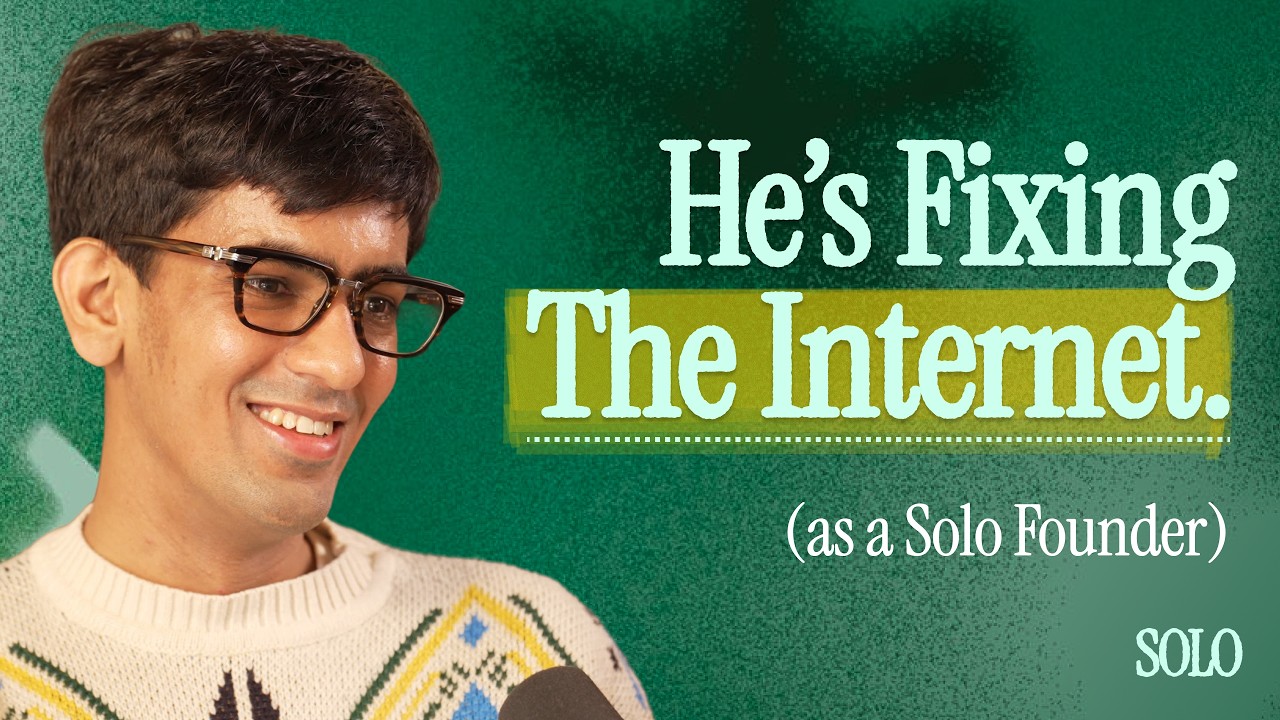
Chai Choudhary, founder of Workers.io, grew up in a tiny Rajasthani village (53 LNP) with no internet until college, learned to code on paper at 16, built and sold a media startup too early, then spent years building financial runway before launching Workers.io — a deterministic simulation platform that gives companies mathematical confidence their mission-critical software (databases, financial infrastructure, healthcare systems) will never lose data or fail under load, even when AI agents write most of the code.
Early life and first startup
Grew up in 53 LNP, a settlement in Rajasthan named after a canal intersection; first touched a computer at 16 in school, writing code on paper with one lab hour per week
Uncle bought him a computer but no internet until college; met a co-founder on Facebook, launched a regional-content media company that hit 200k views in a week and made national news
False lesson: thought every startup works that fast; pivoted to interactive video platform, struggled, sold the business right before Jio made internet free in India — the same IP later became one of India’s most valuable media properties
Key takeaway: founders often treat current conditions as permanent; they sold assuming the market would stay small, ignoring clear signals of coming distribution explosion
Building financial runway and choosing the next problem
After the sale, joined a Harvard Law research project, then worked at several companies including On Deck; wanted enough personal savings to sustain a decade of building without fundraising pressure
Identified two deep-interest areas: travel and verification; tried an AI travel agent first (commodity pricing game against Booking/Expedia), then an email client for travel advisors (not painful enough)
Doubled down on verification after seeing firsthand at a code-generation startup that teams lose confidence in their own systems after large AI-driven refactors
Workers.io: the problem — AI-generated code, lost understanding, rising reliability floor
Core insight: agents now write most code, write the tests, review the PRs; engineers don’t know what’s in the test suite, only see green checks
Simultaneously, usage intensity has spiked: 100 users with 10k agents generate workloads that previously required millions of human users; GitHub outages exemplify this new scale
Customers (database builders, financial infra, healthcare) need guarantees — not code — that systems handle all failure modes, survive 20-year workloads, and compose safely
Traditional testing samples scenarios; formal verification proves properties for all possible states, but requires maintaining a separate formal spec that drifts from code
Product evolution: from formal verification to deterministic simulation testing (DST)
Started with formal verification (model checking specs); too hard to adopt — specs look like math, engineers won’t touch them
Pivoted to DST: systematically explores the state space of the actual running code (written by humans or agents), checks user-defined promises, gives guarantees proportional to compute spent
Key design choices: extreme ease of use (not just for the smartest engineer), pricing below competitors to drive frequency of use, building tooling internally so customers just connect code, define promises, get guarantees
Result: strongest customer pull in 7–8 years of Solo Founders program history; teams migrating from well-funded incumbents mid-contract
Solo founder journey and the Solo Founders Program (SFP)
Joined SFP cohort 1; felt impostor syndrome surrounded by six exceptionally driven solo founders (Dave, Drava, Naman, Aldo, Ryan, etc.)
Learned from peers: Ryan forced outcome-focused framing over tech novelty; Drava modeled developer education and visibility; Naman modeled shameless optimism and distribution
“Solo together” = density of solo founders sharing diverse stages and skills, acting like six co-founders for the early journey; course-correction via blunt peer feedback
Hired exceptional engineer Veswa with meaningful equity (harder with multiple co-founders); building is easy now — the hard part is deciding what not to build
Content strategy and distribution
Delayed content too long; now posts every other day on X about problems and solutions for ICP (infrastructure engineers)
Specificity wins: niche community on formal methods self-organizes with hundreds of active members; general content drowns in noise
Quality + frequency + specificity = trust signal; customers come inbound because they see you consistently, assume success, want to associate
KPI: incidents and support tickets drop dramatically after adoption; if not, product must change
Solo vs. co-founder: reflections
Never felt a co-founder would make things easier; equity flexibility lets you hire senior talent as “early co-founders” who rise over 10 years
Loneliness and sole blame are real; if you can’t tolerate them, solo founding will break you — but those same traits make you a bad co-founder anyway
Default should be solo; add partners later from early team who earn it
Vision: “Fixing the internet”
Industry has normalized flaky software (restart and pray); physical constraints don’t exist, so correctness is a choice
Cost of rigorous verification has flipped: same spend now yields higher reliability than best-tested legacy systems
Workers.io provides the “proof of work” buyers need when sellers can’t explain their own AI-generated codebase
Long-term: verified software becomes the only software people buy; compliance-style trust marks (e.g., “Workers.io verified”) will emerge
Bare case against solo founding / Case for Solo Founders Program
Bare case: if you can’t handle isolation, no one to celebrate with, and being the only person to blame when things break — you’ll quit
Case for SFP: unmatched density of talented solo founders at varied stages; peer course-correction, shared distribution tactics, emotional sustainment — “six co-founders for your early journey”