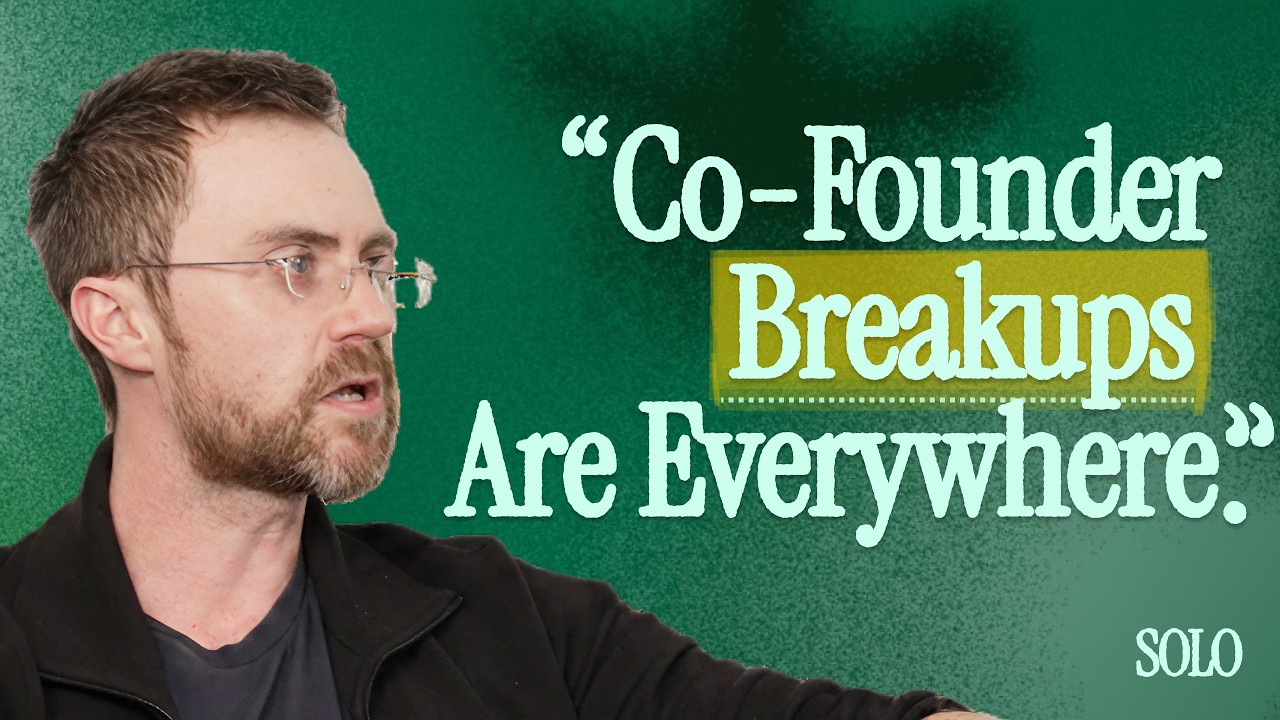
- Flo Crivello is the solo founder of Lindy, an AI executive assistant that manages email, meetings, and inbox chaos for busy professionals. He previously co-founded Teamflow, a virtual office tool, and argues that solo founding should be the default rather than the exception — a position he laid out in a 2022 essay called “Co-Founding Considered Harmful” that resonated widely because it named something many founders experience but rarely discuss publicly: co-founder breakups are a leading cause of startup death, yet the conventional advice is always to find a co-founder.
The case against co-founders as the default
- Flo’s bar for a co-founder is extreme: “If there’s a doubt, there’s no doubt.” You should be over the moon — “I hope he doesn’t fire me, I love him so much” — because you’re giving away half your company and making a massive bet on someone’s integrity.
- He believes you should never co-found with someone you haven’t worked with before, and ideally you’ve been through high-stakes conflict with them. A car that drives beautifully for 500,000 miles but will eventually explode is not a good car — you judge co-founders by how they behave in tail events, not in easy times.
- He thinks standard vesting schedules (four years, one-year cliff) are broken because after twelve months the company is barely alive, yet the co-founder already owns 25%. He advocates for exponential vesting and at least six-year vesting.
- His own co-founder breakup came from a mismatch in working intensity — he and his friend had very different urgency levels — and it led to legal conflict despite a decade-long friendship. He notes that the public discourse understates how common and destructive co-founder breakups are, because people don’t talk about them honestly.
From Teamflow to Lindy: the pivot
- Teamflow started as a side project during COVID — a spatial video conferencing tool with virtual offices. A friend called with $2 million to invest in three days, and Flo incorporated the company (called “COP”) in six hours.
- After strong initial growth during remote work, the market shifted back to offices and growth collapsed. Flo persisted for about 12 months, which he now considers a mistake — “the hardest quadrant to be in is a persistent founder when things are hard.”
- The pivot to Lindy began when the GPT-3 API launched. The team started with meeting summaries, then CRM field extraction, then realized the LLM could make entire API calls — an early agent. Around October 2022, it clicked that agents, not generative text, were the real opportunity.
- When pivoting, the team was about 45 people and Flo let go of roughly two-thirds. He now believes he should have cut even deeper — the ideal 0-to-1 team is three to five people. He uses Naval Ravikant’s analogy: surveying an infinite jungle from a helicopter, and only so many people fit in the helicopter when you need to move to a new spot.
The gold rush analogy and when to neglect the mine
- Flo distinguishes between two phases of startups: prospecting for gold (finding product-market fit) and operating a mine (running the business). Prospecting is fundamentally a one-person job. If you’re busy operating a mine that’s digging in the wrong ground, you must neglect the mine — even though people will think you’re incompetent — and go prospect.
- He points to examples like Segment (analytics.js blew up immediately), Hugging Face (a weekend project that became the company), and Slack (worked quickly) as evidence that when you find gold, it shows fast. If it doesn’t, you’re probably digging wrong ground.
The burnout insight and the leader’s real job
- After two years of grinding on Teamflow with no progress, Flo was deeply burnt out. But when the Lindy pivot created momentum, his energy returned almost immediately. His conclusion: “The cure to burnout is not rest, it’s momentum.”
- He believes a founder’s most important job is to win, not to be a cheerleader. That means being willing to say plainly, “We’re going to die if we don’t solve this.” Some people will leave, but those who stay are galvanized and treated as owners. Problems that are hard to solve become impossible if you don’t talk about them honestly.
The brain trust and structured thinking
- To combat loneliness without a co-founder, Flo relies on a small circle of lieutenants — two to four people he can be completely open with in long, vulnerable brainstorming sessions. He points to the South Park “Six Days to Air” documentary and Pixar’s “brain trust” concept as models: a group with no ego where bad ideas are discarded instantly and good ones are recognized immediately.
- He uses the Double Diamond framework: first diverge on the problem (open up understanding), then converge (narrow to the real problem), then diverge on solutions, then converge on the answer. He protects Wednesdays as a no-meeting day for thinking and writing, and keeps strategic jams loose and unstructured — even when the topic is still murky.
Bear and bull case for solo founding
- Bear case: if you genuinely lack a critical skill the company needs, find someone. Loneliness is real and painful, even with lieutenant relationships. The weight is entirely on you.
- Bull case: you move dramatically faster, and you never have to align with anyone to make a decision. Flo was grateful to be solo during the Teamflow-to-Lindy pivot — he could walk out of the room and execute immediately, and he watched many co-founder teams break up at exactly that kind of inflection point.