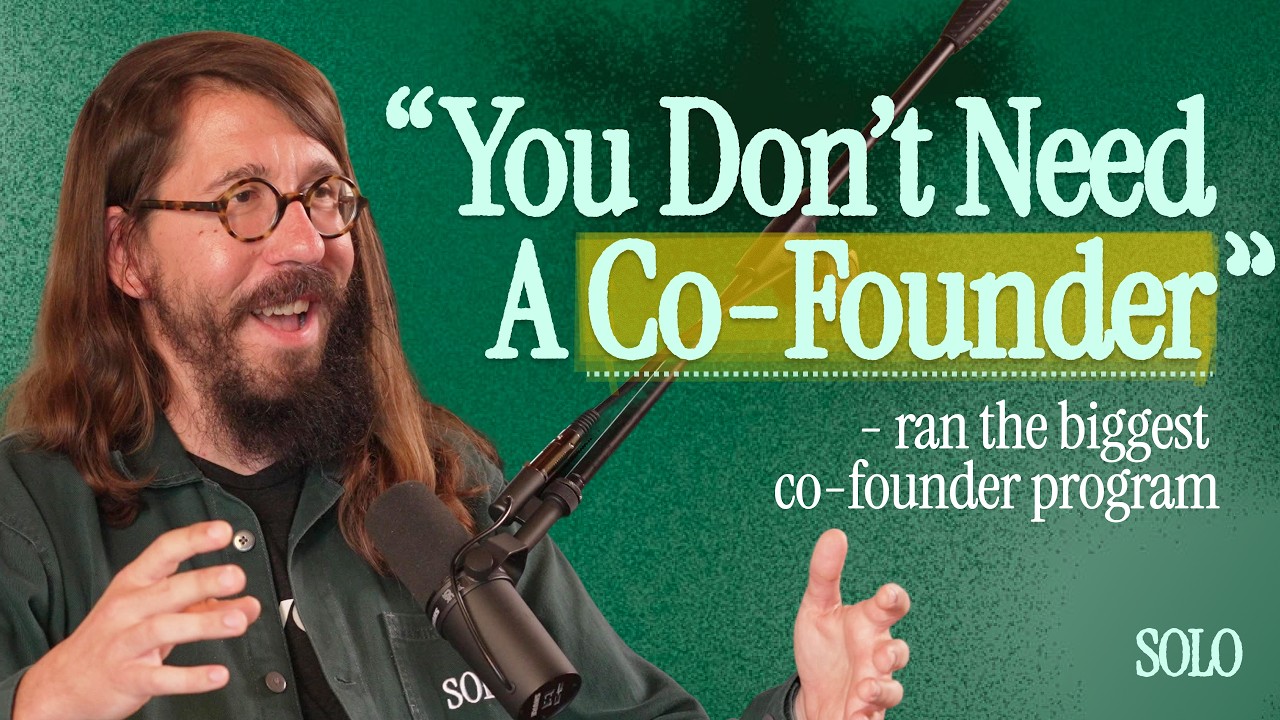
Julian Weiser, founder of Solo Founders and former creator of On Deck’s ODF (On Deck Founders), argues that the startup industry’s default assumption—that you need a co-founder to build a great company—is one of its most damaging myths. He’s launching a new cohort of the Solo Founders program that now includes a $100,000 investment per founder, and he believes solo founding is on the verge of becoming the default rather than the exception.
The Co-Founder Myth and How ODF Challenged It
When Julian started ODF (On Deck Founders), the prevailing belief was that co-founders could only come from two places: prior work experience or school. Any other method was considered odd.
ODF’s premise was that bringing together people in an exploratory stage—thinking about what to build and with whom—could produce great co-founder pairings outside those traditional channels. It worked, and many successful companies came out of it.
Over time, Julian noticed a pattern: some people joined ODF not looking for co-founders at all. They were already planning to go solo. At first these were anomalies, but they kept appearing.
This observation, combined with the rise of AI tools that give individual founders enormous leverage, led Julian to question whether the co-founder requirement was the next big industry assumption that was simply wrong.
Why Co-Founders Kill Companies
Julian’s core argument is not that co-founders are inherently bad, but that the average company with a co-founder is impaired by having one.
Most failed startups had co-founders. People look at the numerator—successful companies like Google or Apple with co-founders—but ignore the denominator: the vast majority of companies with co-founders also fail, and many fail because of co-founder conflict.
Companies run out of hope long before they run out of money. Co-founder disputes, misaligned motivation, and “doom loops” where both founders drag each other down are among the most common causes of startup death.
Julian calls people who take on a co-founder just to be taken seriously or because they believe they can’t start alone “co-founders of convenience”—and he argues this is worse than not starting at all.
The one exception: a truly exceptional co-founder can be a massive positive. But you should never force it.
The Adeel Khan Story: What Sparked Solo Founders
Julian worked closely with Adeel Khan, a former high school principal with no startup experience, who built Magic School (an AI tool for teachers) as a solo founder.
Adeel went from hacking together a prototype on Replit over a weekend to getting 100 users the next week, 1,000 the week after, and eventually reaching at least one teacher in every school in America.
Julian realized there were many more people like Adeel out there who either thought they needed a co-founder to start or lacked a support system—and that building for them was the next big opportunity.
The Solo Founders Program and the $100K Investment
The Solo Founders program brings together 10 solo founders for a 3-month residency in San Francisco. Julian works with them directly, and they get a built-in community of ambitious peers.
The new addition: each accepted founder receives a $100,000 investment.
Julian’s reasoning for the amount:
For international founders building in the US, having $100K in the bank can help with visa qualification.
For all founders, it provides runway so they don’t have to worry about rent or basic survival, and gives them a position of strength if they later choose to raise from VCs—they can raise from a position of optionality, not desperation.
Julian is deliberately not doing a demo day. He believes demo day is a “factory” concept that forces all companies into the same fundraising timeline regardless of whether it’s right for their business.
Against the “Factory” Model of Startups
Julian wrote an essay called “You Weren’t Meant for the Factory” arguing that the startup industry pushes a one-size-fits-all playbook: get a co-founder, raise a round, hire a team, do demo day, scale.
The best companies often don’t follow this path. They arrive at success by doing what’s right for their specific business—what Julian calls “the shape of the business.”
The median company is a dead company. The factory model contributes to failure by making founders contort themselves to fit a mold that isn’t right for them.
Julian extends this critique to VCs: the average VC is a “dead VC” who hasn’t run a company and gives generic advice based on a small sample size. Great VCs, especially those who were founders themselves, understand that every winning company looks different.
Founders are complicit in the factory model too—they walk in voluntarily because they don’t know what else to do and assume the standard path is the right one.
Three Types of Solo Founders
True Solo: No human teammates at all. Ben from Pulsia runs his company entirely with AI agents and orchestration, reaching $6M in annualized run rate. This is still an outlier but may become more common.
Free Solo: Bootstrapped with human teammates but no outside funding. Yasser from Chatbase grew to $9M+ ARR over 3 years organically, maintaining complete control over his company’s future.
Juiced Solo: Solo founders who have raised outside capital. Julian notes that raising money is a commitment to a specific type of outcome, and founders should be very aware of who they’re raising from and why—not just when.
Julian’s view on fundraising: it depends entirely on the business. Yasser would have been mistaken to raise early; the money would have cost him control before he needed it. Some companies genuinely need capital before revenue. The key is being intentional.
The Data: Solo Founding Is Rising Fast
According to data Julian compiled with Carta, more than one in three companies were solo-founded last year—the first time that’s ever been true. Five years ago it was under 25%.
Julian believes solo founding has always been possible (e.g., eBay, Amazon, Craigslist), but it’s now more possible than ever due to AI and better tooling.
What’s holding it back is purely the belief that you need a co-founder—a belief he calls “denominator dilution”: people see successful companies with co-founders but don’t account for the massive number of failed companies that also had co-founders.
He predicts a “flippening” within the next few years where solo founding becomes the default.
The Bear Case for Solo Founding
It’s extremely hard to self-motivate without a co-founder. The best co-founder relationships involve positive competition—each trying to outdo the other for the mission. Without that, you have to generate all motivation yourself.
Life outside startups is real and hard. When something difficult happens externally, having no one fully “ride or die” with you on the company side means you’re managing everything alone.
You’ll always have a “co-founder shaped hole” in your life. It’s playing on hard mode, and some people simply can’t handle it.
The Bull Case for Solo Founding
The company only dies if you do. Since companies die from running out of hope, and it’s easier to manage your own hope than someone else’s, solo founders have a structural advantage in survival.
You can build something truly one-of-one, representative of who you are, without contorting yourself to match a co-founder’s vision or the factory model’s expectations. Julian compares startups to art—they should be an expression of the founder.
You get started immediately. No convincing, no searching, no compromising. Just build something people want.
Eugenia from Replika made a point Julian often references: co-founder companies have three layers (CEO co-founder, other co-founders, founding team), while solo companies have two (founder and founding team). Removing that middle layer gives the founding team more authorship, authority, and closeness to the founder.
You can offer much larger equity grants to early team members since you’re not splitting the company with co-founders.
Solo Together, Not Solo Alone
The most important thing for a solo founder is having people in your corner—not co-founders, but other founders and supporters who understand what you’re doing, will push you hard, and won’t pull punches.
Julian describes Solo Founders as “as much a political organization as a business.” The mission is to normalize solo founding and bring forward a future where going solo is the default.
The program’s residency model is designed to create this: 10 ambitious solo founders pushing each other in San Francisco, with Julian working alongside them directly.