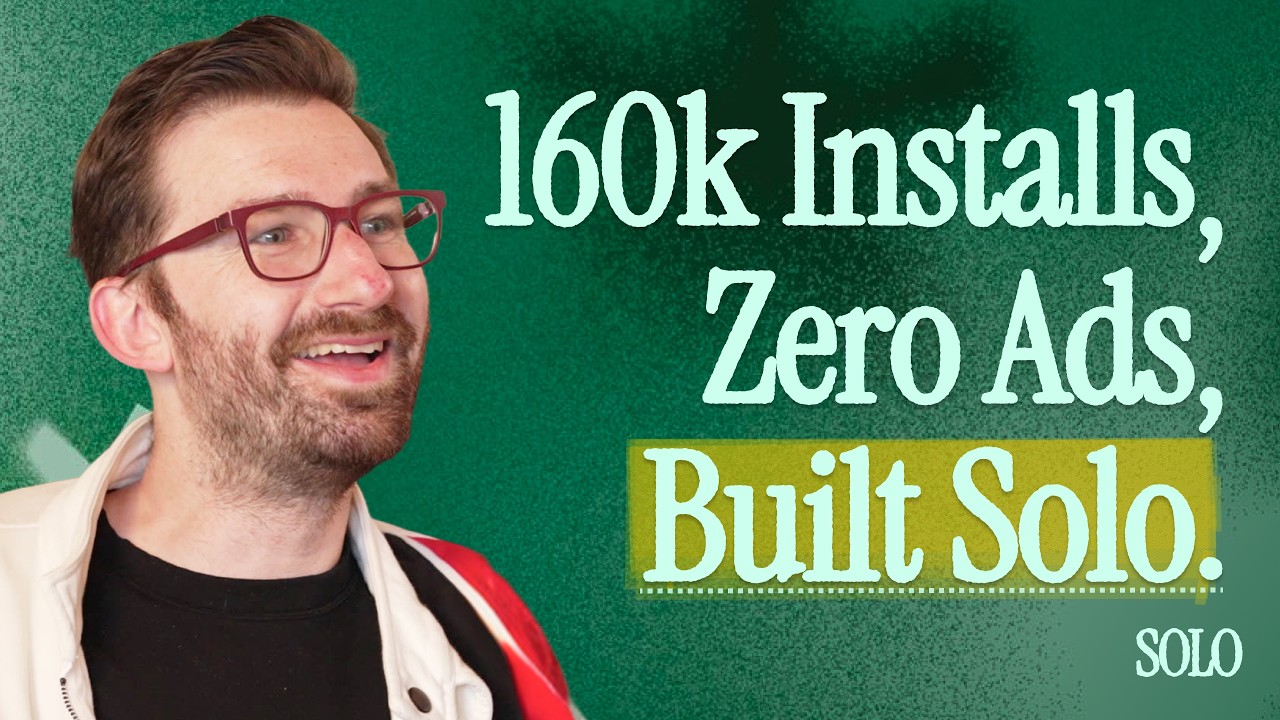
Paul Bakaus, founder of Renaissance Geek and creator of Impeccable (an AI coding-agent skill for design), shares his journey from a teenager in Germany’s Black Forest to building jQuery UI, a game-engine startup acquired by Zynga, and roles at Google — then explains why he chose solo founding with AI, how Impeccable keeps AI-generated design on-brand, and why human judgment (editing, subtraction, taste) remains the irreducible bottleneck in an era of abundant generation.
Background and early path to the open web
Grew up in the Black Forest, Germany, far from tech hubs; the early web was a “normalizing factor” that let him reach the frontier from his basement.
Started a consulting business at age 11–12, requiring a special hearing at the city office with his mother present.
Discovered jQuery as a teenager; it lowered the gate for non-programmers to build interactive experiences, and he became a core contributor.
Created jQuery UI to solve the lack of rich UI components (drag-and-drop, accordions, etc.), giving him a front-row seat to the Web 1.0 → 2.0 transition.
Game-engine startup and Zynga acqui-hire
Co-founded a game-engine startup (~2010) with a former agency colleague to let every web developer become a game developer; built an isometric engine that ran on the original iPad.
Distribution and monetization were unsolved; European investors (Samwer brothers) only backed proven copycat models, making fundraising nearly impossible despite strong inbound interest from Microsoft, Zynga, and others.
Ended in an acqui-hire by Zynga; spent two years in R&D, learning virality mechanics (K-factor, whale economics, forced social loops) at massive scale.
Why solo founding this time
After climbing to upper-middle management at Google and other roles, realized he missed building; didn’t want to become a middle manager again.
Wanted to test the “solo unicorn” hypothesis: can one person 100x their output with AI agents?
Built extensive scaffolding tooling and took on contract projects meant for 5–10-person agencies to prove the model; confirmed it works, but attention is the new bottleneck.
Peter Steinberger’s “attention is the only thing you can’t scale” insight resonated: optimize for bursty, high-leverage creative work.
Hiring a chief of staff, not engineers
First hire is a chief of staff / operations hybrid — deliberately not an engineer, designer, or PM.
Rationale: if you’re the best builder, giving that up to manage people is a trap; hire someone to remove operational clutter so you stay on the tools.
Job description emphasizes low ego, willingness to do grunt work, and ability to scale from “set up bank accounts” to “negotiate strategic partnerships.”
Warns that big-company operations specialists often fail in early-stage chaos because they’ve only owned one narrow slice.
What Impeccable is and how it works
Impeccable is a “skill” (extension) for coding agents (Claude Code, Codex, GitHub Copilot) that makes them better at design.
Two goals: raise the floor (decent baseline design for non-designers) and raise the ceiling (help experts go from good to great).
On init, runs a product interview (audience, intent, context — e.g., kids vs. parents for a Lego app) and generates/updates a design.md (tokens, typography, components) based on Google’s Design MD spec.
Uses design hooks (linting) that run after the agent writes code: detects off-brand colors, fonts, AI slop, and forces the agent to self-correct transparently.
Every rule is ablation-tested in an eval harness; rules that don’t reliably improve output are removed.
From side project to a16z-backed company
Two parallel signals: (1) conversations with partner Anish at a16z convinced him his idea arsenal had enough surface area for something to work; (2) organic “why is this free? I want to pay” tweets on Impeccable — a rare, strong PMF signal.
Released multiple OSS projects earlier in the year; Impeccable was the one that caught fire.
Free-first growth strategy
After years of neglecting Twitter, found the algorithm ignored his new AI/design content because his follower base was from jQuery/creator-economy eras.
Strategy: create maximum value, give it away free, optimize for momentum and organic K-factor (what users say when you’re not in the room).
No paid ads, no influencer campaigns; FireShip video and other coverage were fully organic.
Believes forced virality (Zynga/Facebook style) is unpleasant and misaligned with a craft-focused business; prefers a smaller, loyal core over a leaky funnel of drive-by users.
Integrity, quality, and “be kind, not nice”
Personal integrity > growth hacks: would feel like a “snake oil salesman” if someone used his tool based on a claim that didn’t hold.
Most AI skills are “vibe-coded” — tested once or twice on the author’s machine, then shipped; Impeccable is rigorously eval-tested.
“Be kind, not nice”: give real, sometimes uncomfortable feedback rather than empty pleasantries; respects the recipient’s growth.
Where humans belong in the loop
Three phases where human judgment is critical:
What phase (product): defining the problem, audience, intent — if you don’t know why you’re building, why delegate to an agent?
Building phase: agents drift randomly over long horizons; periodic check-ins prevent catastrophic divergence.
Polishing phase (last 10–20%): subtraction, simplification, taste — “the most important skill right now is to remove things.”
Steve Jobs wasn’t a “creative genius” in the generative sense; he was the greatest editor — said no to 99%, shipped the 1%.
Analogy: working with LLMs is carving software out of marble (or navigating latent space) — the model contains everything; your job is to reveal the right shape by cutting away.
Artisan vs. factory defaults
“Pretty good” is a moving target (Bootstrap → Squarespace → Claude defaults); in a sea of vibe-coded sameness, standing out requires intentional, opinionated design.
Context matters: enterprise tools should feel familiar (system fonts, copied patterns); consumer landing pages have 5 seconds to differentiate.
Impeccable’s visual iteration mode lets humans steer variants rapidly — keeping the human in the loop for the judgment calls AI can’t make.
Bear case for solo founding
“It takes a certain type of crazy to found something… not knowing whether you’re actually crazy or not” — lack of a sounding board is the biggest risk.
Mitigate: find objective peers, not just friends/family.
Protecting attention is harder alone; contracting helps but doesn’t fully solve it.
Case for solo founding
You only account to yourself; move at the speed of your own thought.
Don’t wait for the “right co-founder” to appear — start now; the right people (chief of staff, collaborators) come later.
Momentum cures burnout: focus daily on “what value did I create today?” and hire only people who create daily value without middle management.
Closing thought
The era of the “renaissance geek” (40-year-old founder with cross-functional intuition + AI leverage) is here: less energy than a 20-year-old, but far fewer unknown unknowns, and the tools to shape whatever you want directly.