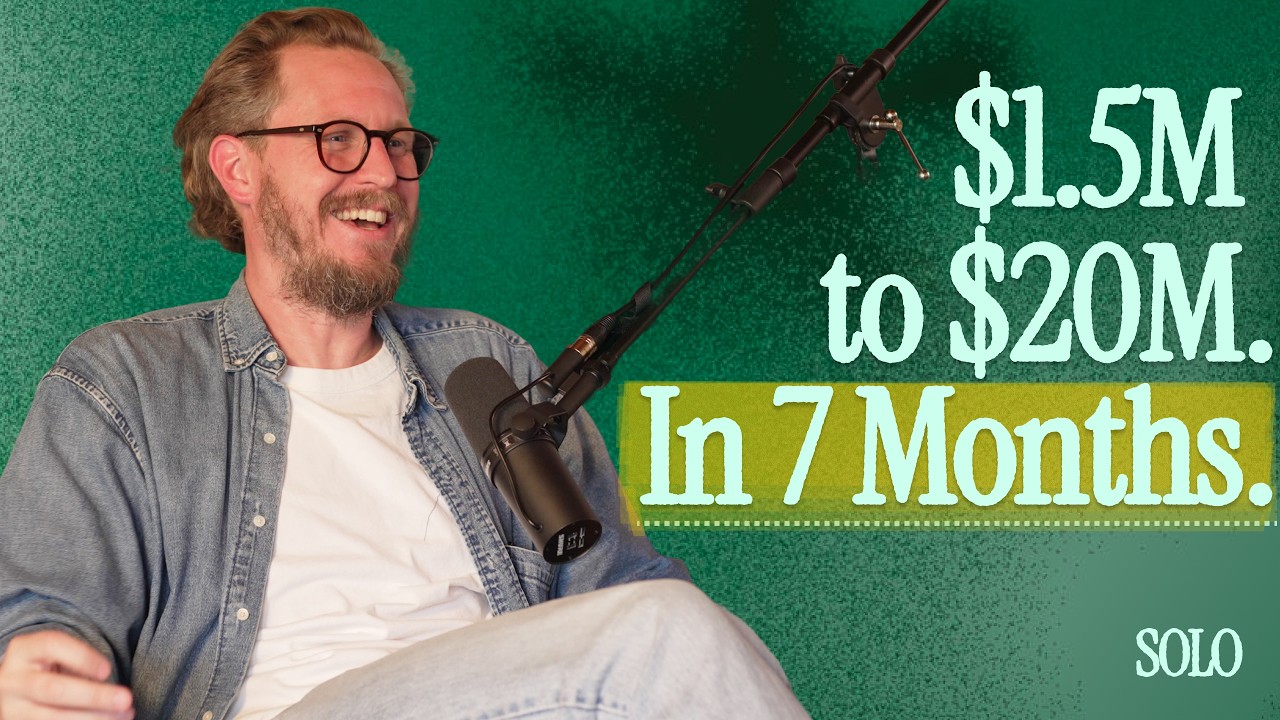
This episode of the Solo Founders podcast features Ben Sarah, solo founder and CEO of Pulsia, an AI company builder that has grown from $1.5M to over $20M in annualized revenue in seven months. Ben returns to discuss solo founding as a creative practice, building with AI agents as “digital humans,” why co-founders of convenience kill companies, and how Pulsia attracts non-traditional founders by removing friction from entrepreneurship.
Solo founding as artistic practice
Ben approaches building Pulsia as a creative endeavor rather than a conventional startup playbook, letting taste and subjectivity guide product, marketing, and naming decisions.
After building four to five SaaS products quickly with AI, he realized speed alone wasn’t inspiring; he wanted to build something that felt like an artistic project — an AI that could autonomously build and run companies.
The name “Pulsia” came from spelling “AI slop” backwards during a late-night incorporation filing; he kept it because it was distinctive and memorable, like Amazon or Apple.
He designed the product to look like the niche game Universal Paperclips, embracing a weird aesthetic that customers never complained about — proving design and naming matter less than delivering value.
With AI as a multiplier, the feedback loop of making and correcting mistakes is dramatically faster solo than with a team, since he doesn’t need to explain tasks to engineers who would just prompt Claude Code anyway.
The one-person company trajectory
Ben is now a solo founder at roughly $250M valuation (one-quarter of the “one-person billion-dollar company” milestone) after raising a small round that forced acceleration on marketing and infrastructure.
He argues the CEO role is inherently solitary: even with co-founders, one person ultimately makes final decisions, raises money, hires, and finds customers.
The organizational form — solo + AI + contractors vs. solo + thousands of employees — doesn’t matter to customers; they only care that the product works and delivers.
Raising $1M initially pushed him to use agencies for marketing and an engineering firm for infrastructure, but as product focus intensified, the “solo narrative” became less relevant than the product itself.
Co-founders: when they help and when they hurt
Ben’s previous company had two co-founders (CTO and CMO) who debated constantly, paralyzing decisions; he realized he’d added them for fundraising optics, not genuine partnership.
Co-founder relationships work when built on years of tested collaboration (e.g., schoolmates who argued and built together); they fail when assembled from convenience or credential-checking.
His litmus test: “Would you get married?” — you’ll spend more time with a co-founder than a spouse, and disagreement on direction is more damaging than making a wrong two-way-door decision.
For solo founders, the risk is decision paralysis; the remedy is recognizing that most early decisions are reversible and speed beats perfection.
Building with AI agents as digital humans
Ben treats agents as digital humans with personality, communication style, decision-making authority, and specialized vibes — not just task executors.
The product creator defines how agents talk (short vs. long sentences), what actions they’re authorized to take, and how they approach problems (build vs. hire vs. use a tool).
Verticalized agents will proliferate because users prefer a niche agent that does one thing exceptionally well over a general agent that’s slow or error-prone.
Trust, pricing, communication style, and specialization will differentiate agents, just as human service providers differentiate.
Pulsia’s unexpected customer base
Nearly 50,000 paying customers skew older (40+), industry-experienced people attempting entrepreneurship for the first time, plus younger users (e.g., a 17-year-old) who find traditional dev tools intimidating.
Many customers use multiple AI tools (Claude, Cursor, Replit) but treat Pulsia as the “company OS” — the central hub where everything connects.
Only ~10-15% of humanity uses free chatbots; <1% knows tools like Cursor; ~2% of Americans pay for AI — the market is extraordinarily early.
Marketing works by conveying a feeling (“you can be an entrepreneur”) rather than feature lists; customers self-select based on emotional resonance.
Product as promise: removing friction to create more founders
Every step in a traditional startup funnel (Stripe setup, hosting, email, compliance) loses potential founders; Pulsia compresses this to minutes, letting people feel like founders immediately.
The $20/month price point and instant live site create a psychological shift: “I’m a founder now” — even if the first idea fails, they’ve entered the game.
Ben compares this to AI democratizing filmmaking: kids who’d never attempt a short film can now produce one with an iPhone and AI, creating a gateway to the craft.
Carta data shows solo-founded companies doubled from 20% to 40% in five years, driven by the same infrastructure abstraction that AWS and Vercel enabled.
Founders as creative directors
The CEO has always been a creative director — making yes/no choices on name, pricing, landing page, vibe — while others execute.
AI agents become the “30 famous artists” contributing to a Kanye album: the founder curates, directs, and takes final credit; the output is still theirs.
Visual, interactive outputs (vs. raw code) let founders operate at the vibe/holistic level: “more left, change the color, less of this” — riffing with the agent rather than specifying implementation.
This raises creativity rather than replacing it; the human remains the taste-maker and decision-maker.
Misconceptions about solo founding
The YC bias against solo founders (requiring technical + business co-founders) is outdated when AI fills the technical gap.
Loneliness is a choice: solo founders have friends, family, and communities; co-founder conflict creates a deeper, more paralyzing loneliness because your supposed partner becomes the source of friction.
Bad co-founder dynamics force you to navigate personal/legal drama instead of business problems — “like a bad marriage where you’re deciding whether to divorce.”
The case for solo founding: just start
Any excuse not to act is a trap; “I need a technical co-founder” is the most common one, and AI eliminates it.
Finding a co-founder is networking, not building; building can happen tonight with Cursor, Lovable, or Pulsia.
Analogy: if you want to run, put on your shoes and go — don’t join a run club first.