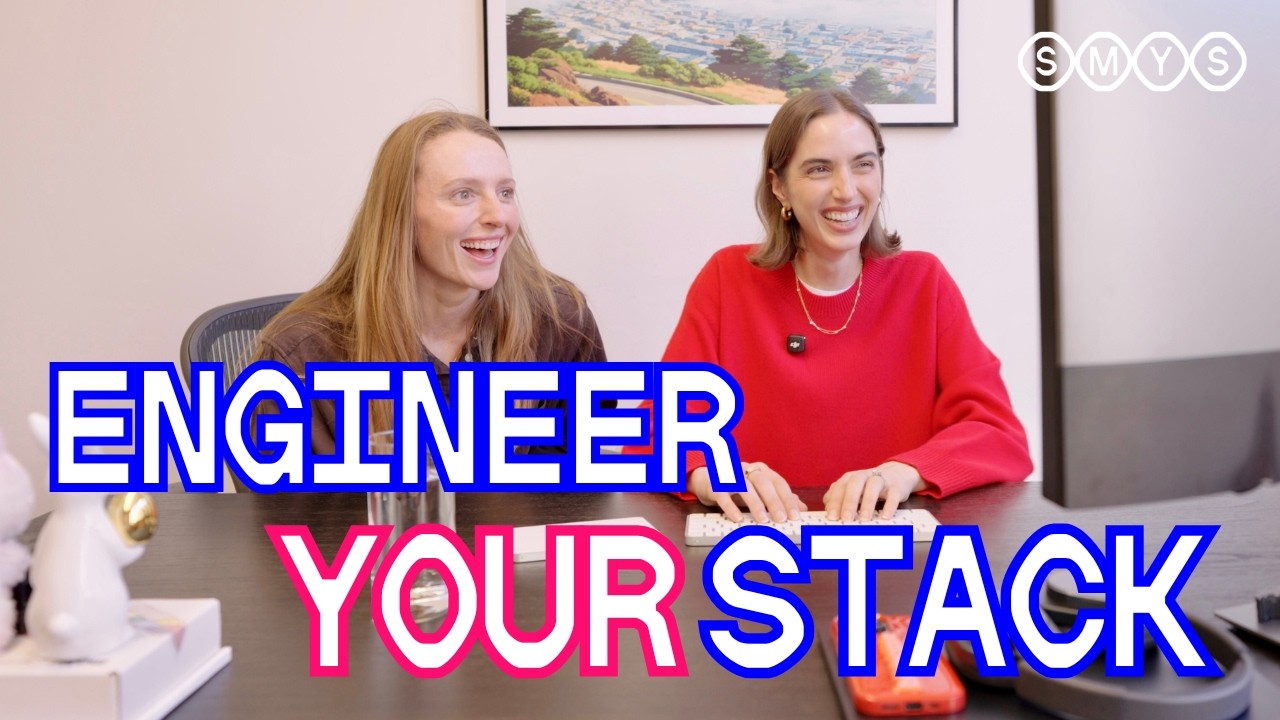
Alana Goyal is a solo VC investor and founder of Basecase Capital who operates at the intersection of engineering and investing. She runs a pre-seed, pre-company fund where she meets interesting people before they even start companies, and she builds software daily as both a personal practice and a way to deeply understand founders. The episode explores how she uses AI coding tools, automation, and personal projects to optimize her workflow while deliberately preserving the human elements she considers most important.
Daily routine and calendar philosophy
Mornings are protected for building and experimenting. Alana codes every day, treating it like exercise — if she doesn’t do it daily, she won’t do it at all. She uses her mornings to explore new tools, try new models, and tinker with her personal website.
Afternoons are reserved for in-person meetings only, strictly one hour with 30-minute buffers on each end. She takes relatively few meetings and avoids pitch-style interactions. Instead, she wants to hear someone’s life story and build genuine relationships. She describes this as optimizing for meeting interesting people rather than evaluating companies.
Personal website as an infinite test bed
Her personal website functions as a living playground and portfolio. It uses close to a dozen portfolio company products (Supabase, Braintrust, Resend, Vercel, etc.) and serves as a place where she can immediately try any new tool, model, or IDE she encounters.
The site has become a collaborative project with open-source contributors. Someone contributed a notification center feature, which she then riffed on, and they iterated back and forth — adding weather, for example. She describes this as “a love note in GitHub.”
The goal is for visitors to understand her aesthetic, taste, and personality — her favorite music, books, and real photos — making it both a personal OS and a way to get to know someone before meeting them.
Current AI coding stack
She uses Cursor, Claude Code, and Codex (OpenAI’s coding agent) as her primary AI coding tools. She got particularly excited about Codex because its new model “thinks for a long time,” producing more deliberate and capable outputs.
tmux (running on Ghostty terminal) is her workspace manager for multi-agent workflows. She runs multiple agents simultaneously across different projects, and tmux gives her notifications when agents complete tasks — something she describes as especially helpful for the “ADHD brain” so she doesn’t lose track of what each agent is doing.
She maintains a style guide document in Paper (a portfolio company) that her AI tools can reference via MCP. This lets her tell Claude Code or Cursor to “use Paper to create a diagram” and have consistent visual output. She jokes that her Figma files are just screenshots she needs to remove backgrounds from.
Her philosophy on AI-assisted coding
She is critical of “vibe coding” as a blanket approach. While she celebrates that non-coders can now build things, she believes the best engineers in the AI age are those who “engineer their setup” — obsessing over how they architect their workflow with agents rather than just prompting for outputs.
She deliberately lets AI help shape ideas, not just execute them. Instead of writing hyper-specific prompts, she’ll ask an agent “Does this make sense? What else would be good?” — treating it as a creative collaborator.
She is self-aware about the risk of losing the ability to articulate thoughts. She uses voice dictation with ChatGPT for unstructured brainstorming but is careful not to let it dull her ability to think and write clearly on her own.
Running a solo VC fund with automation
She automates the mechanical parts of investor updates but keeps the human parts manual. Her LP updates follow a fixed structure: past events, upcoming events, new investments, portfolio company updates, and acknowledgments.
She uses BrowserBase (a portfolio company) to automatically scrape portfolio company blog posts — grabbing content and Open Graph images — and drops them into her update doc throughout the month as things happen, rather than reconstructing everything from memory at month’s end.
She deliberately does NOT automate the intro to her updates. Writing a personal TLDR about how her month was and what she’s thinking is the part she wants to spend her energy on. The automation frees her to make that intro more thoughtful and human.
Building empathy by shipping real products
Shipping her own product — even a personal website — gives her real empathy for founders. When something breaks or looks “a little funky,” she experiences the same stress founders feel, which she says makes her a better investor.
She tests portfolio company products and gives direct feedback to founders. She described messaging Guillermo (Rauch, co-founder of Vercel) about something that looked off, and he responded within seconds sending it to the team. She considers this kind of extreme responsiveness to user feedback one of the defining traits of great founders.
The human stack: where she draws the line on automation
She is deliberate about not letting AI come between her and other people. She avoids automated outreach, AI-sent calendar invites, and anything that removes the personal touch from relationships.
She cites Danny Meyer’s Unreasonable Hospitality as a guiding philosophy — the idea that making people feel special comes from small, human details, and that’s something she refuses to automate away.
The episode frames her approach as having both a “digital stack” and a “cognitive stack” — she uses AI and automation heavily but with intentional boundaries to preserve writing, articulation, deep presence with people, and genuine relationship-building.