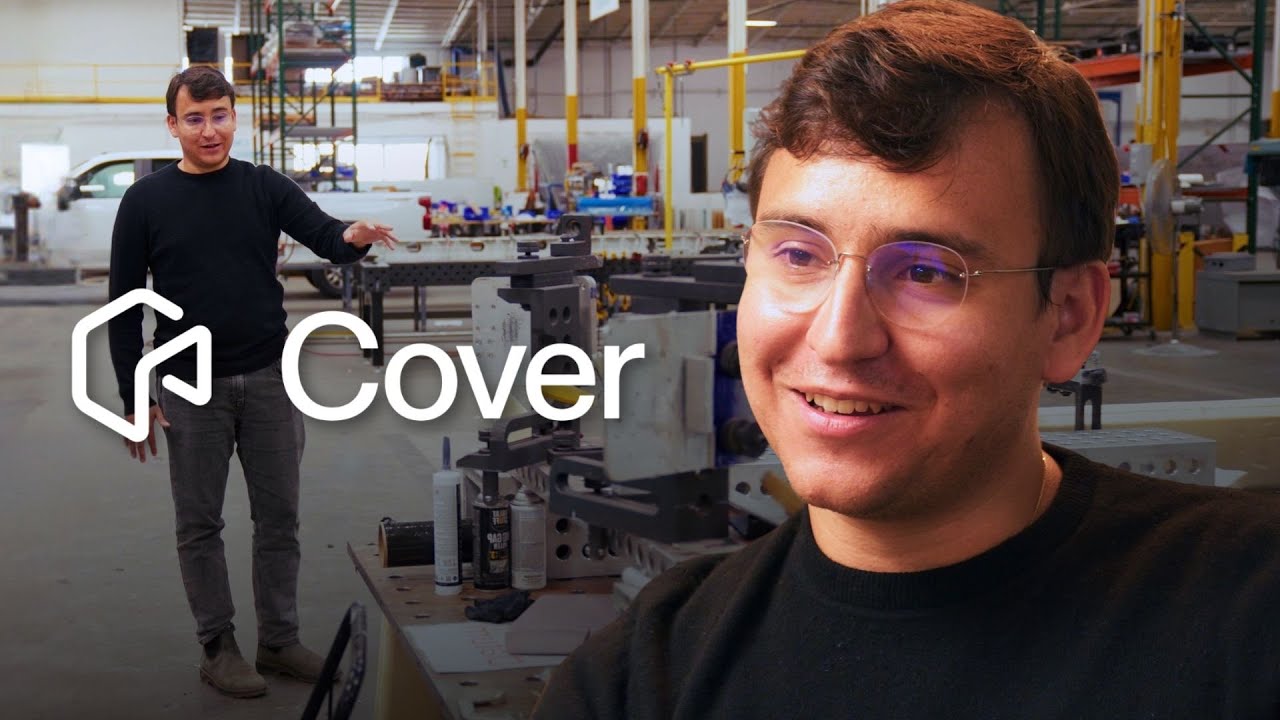
Cover is a vertically integrated homebuilder that manufactures custom homes in a factory and assembles them on-site, aiming to solve the US housing shortage (estimated at 5–10 million homes) by building better, faster, and at scale.
The US faces a structural housing deficit driven by population movement, regulatory barriers, and a fragmented, inefficient construction industry that has not modernized in decades.
Alexis Rivas, Cover’s co-founder and CEO, studied architecture and worked in the industry before concluding that meaningful change requires full vertical integration—controlling design, engineering, manufacturing, and assembly under one roof.
Why conventional construction fails
Building a custom home conventionally involves dozens of disconnected consultants and subcontractors—architects, engineers, surveyors, expediters, general contractors, electricians, framers, painters—creating a fragmented process that is slow, expensive, and resistant to innovation.
Any single participant in this chain can only make incremental improvements; transformative change requires owning the entire stack.
The result is that homes cost far more than they should: a Toyota Camry costs roughly $280 per square foot, while building a home in LA for that price is nearly impossible, despite the home being geometrically simpler.
Cover’s strategy: prove quality first, then scale
Cover deliberately started at the high end of the market in Southern California—the best place in the world to build high-end homes—to overcome the stigma that factory-built homes are low-quality, akin to mobile homes.
The thesis: if you can deliver multi-million-dollar-home quality through manufacturing, you can later bring that quality to more people at lower price points.
The company spent roughly its first decade focused exclusively on ADUs (Accessory Dwelling Units)—small backyard units—to maximize learning velocity, iterating rapidly across many small projects rather than a few large ones.
Iterating through three generations of product
First iteration: Built too quickly, designing while constructing; caught basic errors like tolerance stackups that proper modeling would have prevented. Nobody lived in it.
Second iteration: Directionally correct and visually beautiful (published in magazines), but bespoke in a way that didn’t scale—essentially one-off architecture masquerading as a repeatable product.
Third iteration: Achieved a one-bedroom home assembled in 8 days (working unsustainably long hours, roughly 3 weeks of labor compressed). This version was shippable and repeatable, and people are living in these homes today.
After shipping many units, Cover rolled out another major revision informed by accumulated data—mostly invisible improvements to how parts fit together, precision, tooling, and factory process.
The factory and the kit-of-parts system
Cover’s factory in Gardena, CA (80,000 sq ft, up from an initial 10,000 sq ft) produces wall, floor, and roof panels using a standardized kit-of-parts—like Lego blocks for real homes.
The system supports practically infinite configurations from a finite set of standardized components, enabling mass customization: ~85% of homes have custom floor plans, with further options for finishes, appliances, awnings, and bug screens.
Standardization allows compounding quality improvements—each part is built, learned from, and iterated on repeatedly, unlike conventional construction where every custom home is a one-off.
A key recent improvement: plumbing and electrical chases (channels cut into foam panels) were the most labor-intensive step, so Cover developed tooling to mold the chases directly into panels during fabrication, eliminating an entire process step.
On-site assembly: the current bottleneck
The factory can currently produce faster than Cover can install, making on-site assembly the primary constraint.
Cover has reduced on-site assembly from ~120 days to under a month (and as low as 3 weeks), targeting less than a week for a home like the one discussed—at normal working hours, not around-the-clock sprints.
The goal is to move materials to the right spot and have them “click together like Legos”; some parts work this way today, others are designed to but don’t yet.
Assembly crews don’t need decades of specialized trade experience—Cover actively recruits from outside construction—but the work is physically demanding and requires attentiveness and care.
Crews find the work highly rewarding because they see a project from empty foundation to move-in-ready home, unlike conventional tradespeople who only see their narrow slice.
Permitting: a bigger bottleneck than building
The fastest Cover has gone from permit submittal to certificate of occupancy is 104 days; more than half that time is regulatory (permitting and inspections).
Permitting timelines are unpredictable: sometimes 3 months, sometimes a year, depending on which of eight or more departments has a backlog—and which department is slow changes over time.
California’s zoning landscape is extraordinarily complex: LA County alone has ~80 cities, each with multiple zoning districts, totaling hundreds of zoning codes and roughly 1,000+ pages of regulations to navigate.
Cover mitigates this by submitting comprehensive documentation upfront, following up persistently, and escalating to elected officials at city, county, and state levels when needed.
Recent state-level reforms help: California now requires zoning codes to be objective (measurable standards like height limits) rather than subjective (“match neighborhood character”), but the system still needs fundamental overhaul—Rivas compares it to needing open heart surgery, not incremental fixes.
Less than 10% of permitting time is safety-critical; the rest is process accumulated over decades, each piece well-intentioned individually but collectively forming a broken machine.
Why so many housing startups fail
Common failure modes include lack of focus, going too big too quickly, and spreading geographically before proving the model in one market.
Rivas cites companies that found a working product but chased the wrong growth and collapsed, and others that tried to roll out nationwide before mastering a single region.
Cover’s discipline: prove the model in Southern California (a multi-billion-dollar market large-scale on its own), then expand methodically—first ADUs, then single-family homes, then eventually multifamily (the system scales to 4–6 stories).
The construction supply chain is relatively efficient at scale because everyone does things the same way, so Cover’s approach must be dramatically more efficient to overcome the incumbents’ scale advantages—similar to how new energy sources must overcome trillions of dollars in existing infrastructure.
Scaling toward 10,000+ homes per year
The roadmap: (1) scale up pilot production, proving the product and process work; (2) invest in a large, highly automated factory capable of thousands to tens of thousands of homes per year, approaching median home price points; (3) further reduce material and labor costs through continued manufacturing innovation to build below conventional cost.
Cover’s team combines top talent from construction (e.g., the lead structural engineer for Apple Campus 2, a hospital on a fault line, a stadium) with people from Tesla, SpaceX, Ferrari, and automated manufacturing—because the solution doesn’t come from doing construction better, but from bringing manufacturing discipline into an industry that has seen very little of it.
Rivas draws direct inspiration from automotive factories—the pinnacle of engineering, scale, efficiency, and repeatability—and sees deep structural parallels between cars and homes (climate control, structural loads, fit and finish, fire safety, moving parts).
The hardest thing
Rivas notes that the difficulty isn’t any single technical or interpersonal problem—it’s the sustained, daily commitment to solving an enormously hard problem over many years, compounded by regulatory friction where the people controlling the bottlenecks have no stake in the company’s success.