-
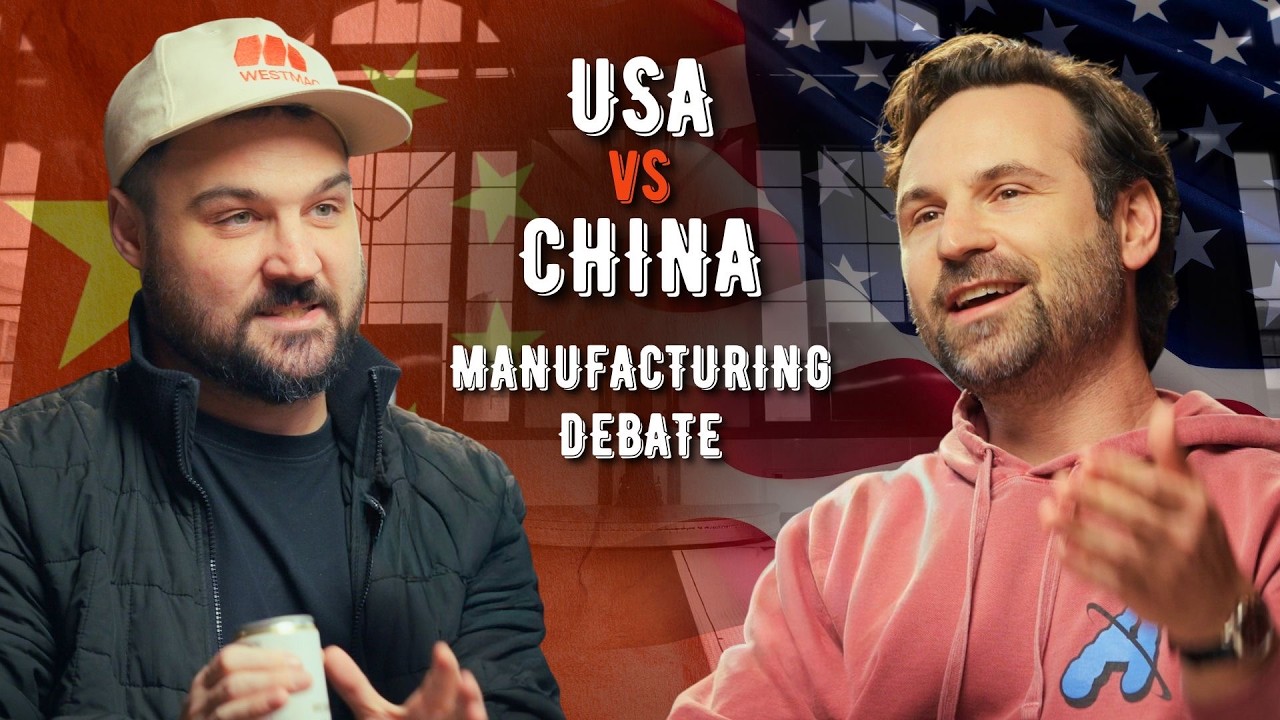
The US has gone from producing roughly 30% of the world’s manufactured goods in the 1980s to around 16% today, while China has risen from almost nothing to nearly 30%, representing one of the largest transfers of power in human history. This episode features a debate between Aaron Slidov (founder of Atomic, a company trying to marry Silicon Valley engineering with Detroit manufacturing talent) and Sam De Miko (founder of Impulse, who has deep experience building hardware supply chains in China) about what this shift means and whether it can be reversed.
- Aaron’s background: Grew up in Cleveland, worked on hardware projects including Whimo, and tried to build a consumer product in the US only to find American suppliers squeezed to the margins and indifferent. This led him to launch a national movement called “Re-industrialize” focused on preserving America’s remaining tribal manufacturing knowledge before it disappears entirely.
- Sam’s background: Worked on Google Glass at Google, then joined Oculus during its Facebook acquisition, where he witnessed China’s manufacturing evolution firsthand, from low-end toy factories to world-class facilities with full engineering teams that co-design products around their supply chains. He now builds consumer hardware through Chinese supply chains.
-
The core problem is not just cheap labor but accumulated tacit knowledge that functions like reinforcement learning
- Aaron argues that manufacturing expertise is like training a neural network: you can design the best product on paper, but the implicit weights, the process parameters, the settings on machines, the chemical formulations, all of that is only learned through high-volume production feedback loops. China has been running these loops for decades and the knowledge compounds.
- Once this tribal knowledge is gone from the US, it cannot be downloaded or reconstructed from documents. It requires people doing the work at scale.
- Sam adds that Chinese contract manufacturers are not just factories with cheap workers. They are full engineering organizations that co-design products, source supply chains, and optimize around existing tooling. The analogy is like having an LLM that can build hardware, communicated through Google Slides and design reviews.
-
Sam’s framework for what to onshore: the “electric stack”
- Sam argues that the next generation of devices, from EVs to robots to consumer electronics, all depend on four to five core technology pillars: lithium-ion batteries, power electronics, embedded compute, electromagnetics, and computer vision hardware.
- His strategy is to pick a portfolio of products that exercise all of these muscles, ensure volumes are high enough to justify bringing at least one of every process machine needed in the supply chain onshore at full capacity, and selectively onshore from there.
- The only US industrialist who has recently done this successfully is Starlink, which had enough consumer demand to justify a lights-out manufacturing line. But even Starlink started with a manual production line and automated later, following Elon’s principle that automation comes last.
-
California’s regulatory environment has effectively made it illegal to do chemistry with metals
- Sam explains that California, once an industrial superpower that built half the world’s battleships and had semiconductor fabs throughout the Bay Area, has layered environmental regulations over 50 years that now make it functionally impossible to do core manufacturing processes like anodizing metals, injection molding plastics, or doing battery chemistry.
- This happened reactively in response to real pollution problems like trichloroethylene contamination and radium-painted markers at old naval shipyards, but the regulations are never revisited or updated proactively.
- The result is that California, despite being at the forefront of the EV and solar revolutions and having many of the best engineers in these fields, has banned itself from competing at a vertically integrated level in these technologies.
- Meanwhile, consumer electronics factories have a similar industrial profile to Amazon warehouses and cloud kitchens, which are permitted and built without issue. The regulatory apparatus has not updated its priors on this.
-
The structural barriers to reshoring go beyond regulation
- Capital markets: In the early 1900s, local banks invested in local manufacturers because they were the only game in town. Today’s venture funds are structured for software returns and are poorly suited for funding factories. The financial incentives in US capital markets push toward software, not hardware.
- Engineering-manufacturing co-location: The superpower of companies like BYD is that the factory and engineering office are on the same campus. Design decisions are immediately informed by manufacturing constraints. In the US, engineers in California do not want to move to the Midwestern towns where factories get tax breaks, creating a split-brain problem.
- Defense procurement is not a substitute: The US defense industry produces almost nothing at volumes above 10,000 units per year. Companies like Anduril end up as product portfolio companies building options for the next F-35 program rather than learning high-volume manufacturing. Defense demand alone cannot sustain the reinforcement learning loops needed.
- Housing and workforce: In China, factory campuses include high-rise housing for workers. In the US, even where factories could be built, the housing and workforce infrastructure does not exist nearby. Starbase is one of the only recent examples of a US manufacturing facility being built with adjacent worker housing.
-
The data center boom is a missed opportunity to pull advanced manufacturing onshore
- Sam argues that hyperscalers are ordering tens of thousands of data center racks worth $3-4 million each, containing the full electric stack at the most advanced node: energy storage, advanced power supplies, photonics, injection molding, stamping, and more.
- These are being installed in the US, but there are no tariffs on them, so there is no incentive to build American supply chains to service this demand. Meanwhile, consumer goods like stoves face full tariffs.
- Sam sees this as an enormous missed opportunity comparable to how the EV revolution pulled some battery technology onshore. Five to ten years from now, he believes the US will regret not using this capex boom to onshore advanced manufacturing capabilities.
-
Apple exports engineering expertise, not just files
- Sam pushes back on the narrative that Apple simply sends design files to China. Apple is United Airlines’ largest customer by business class spend, reflecting how many engineers they fly to factories worldwide.
- Apple’s Cupertino ID offices have copies of every core process machine they use, and they pioneer new manufacturing processes internally before pushing them through scaling partners like Foxconn. The factories are effectively Apple facilities, micromanaged to an extraordinary degree.
- Tim Cook’s famous statement that he can fill a football field with tooling engineers in China but not a conference room in the US reflects decades of accumulated tacit knowledge that cannot be quickly replicated.
-
Google tried and failed to reshore consumer electronics
- Google Glass was manufactured in San Jose, with Sergey Brin correctly identifying that precision optical alignment would be core IP that should be developed in-house. Google also bought Motorola to get a vertically integrated phone partner.
- The problem was that the components still came from Asia, the supply chain was not fully subsidized, and the organization lacked the long-term coherent vision to sustain the effort through management changes over 10 years. The gradient descent of optimization always led back to China.
-
Humanoid robots could be a decisive inflection point
- Aaron argues that whoever achieves high-volume production of humanoid robots first will set up a self-perpetuating learning loop that compounds their advantage. If China gets there first with 100,000 units, the reinforcement learning from that production will be nearly impossible to catch up with.
- Sam notes that the humanoid supply chain does not yet exist and is being rebuilt from scratch, which is both a risk and an opportunity. The companies building actuators for Optimus and Figure are gaining the valuable manufacturing knowledge, and they are not in the US.
-
The path forward requires treating this as a full system problem
- Both Aaron and Sam agree that reversing de-industrialization is ultimately a matter of will, but more specifically a structural problem requiring cohesive, durable industrial policy that survives across administrations, unlike China’s consistent five-year plans.
- Sam encourages aspiring hardware entrepreneurs to go to China, learn Mandarin, live at a factory, and absorb the tacit knowledge that is nearly impossible to gain in the US. The most advanced manufacturers in the world are there, and choosing not to engage with that reality is a form of self-sabotage.
- Aaron emphasizes that this is not zero-sum. Trade is good, but dependency on an adversary is not. The US has the talent and the capital markets. What is missing is the urgency, the regulatory reform, the capital structures, and the willingness to treat manufacturing as a dignified, advanced profession rather than a relic of the past.
The US vs. China Manufacturing Debate
Relentless • • 1h16 → 6 min • #81