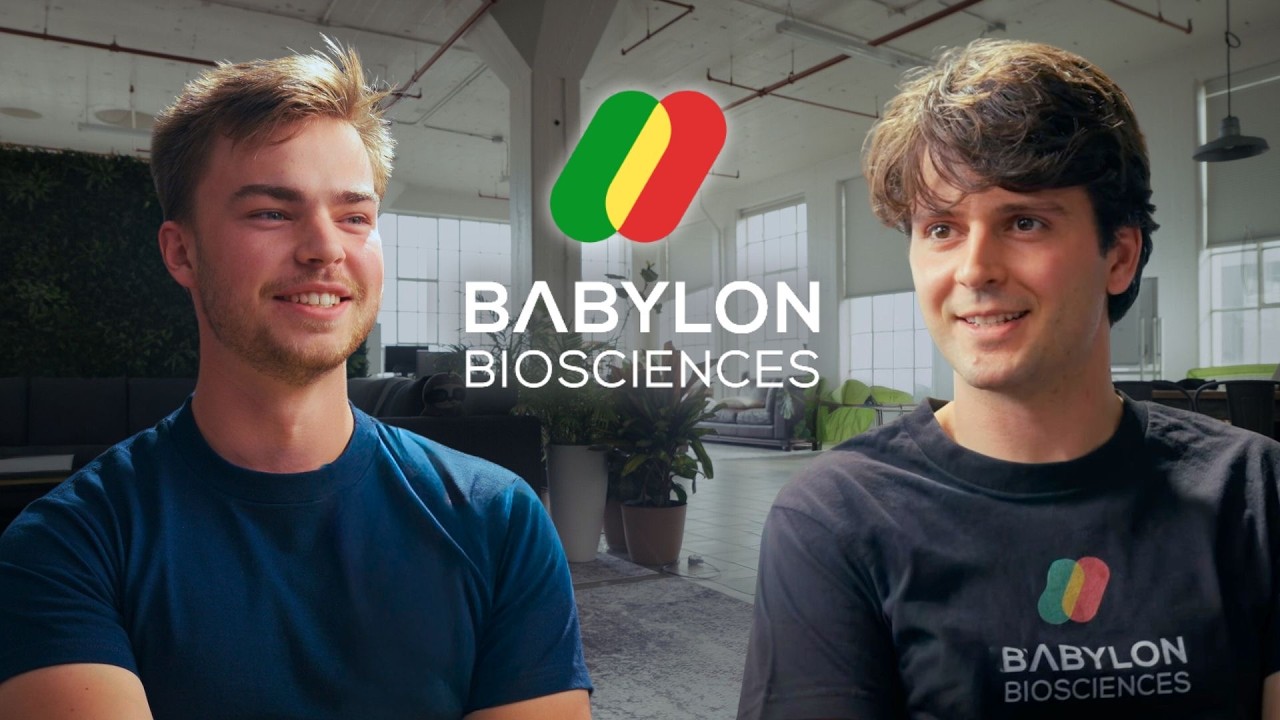
Sacha Schermerhorn is the founder and CEO of Babylon Bio, a company attempting to cure Alzheimer’s disease. He argues that the problem is solvable but has been misapproached for decades, and that the clues to a cure already exist across disparate fields of science. Babylon is structured to survive many failures by pursuing a portfolio of drug programs and self-financing through commercial intermediates, while Sacha maintains focus through extreme distraction elimination and a team filtered purely for mission alignment.
Why Alzheimer’s is still unsolved
The field has been dominated for decades by the amyloid hypothesis: the idea that beta-amyloid plaques cause Alzheimer’s. This was based on Dr. Alois Alzheimer’s 1906 observation of plaques and neurofibrillary tangles in a patient’s brain.
Dr. Alzheimer himself was largely ignored during his lifetime. His landmark presentation was met with indifference; attendees walked out for a break and returned for a talk on chronic masturbation instead.
Modern anti-amyloid drugs (aducanumab, lecanemab, donanemab) have successfully cleared amyloid from the brain, sometimes by 76% or more, but have shown minimal to no cognitive benefit.
Sacha’s view: amyloid is necessary but not sufficient. It begins depositing 20–30 years before symptoms, so by the time patients are symptomatic, targeting the original cause is like trying to determine what started a house fire while the house is already burning. The field has been slow to update this prior.
The real predictor of cognitive impairment onset is tau pathology, specifically a fragment called p-tau 217, which correlates far more closely with symptom onset than amyloid does.
Babylon’s scientific approach
Sacha’s core theory: tau fibrils (which look like stacked celery stalks under cryo-EM) are not toxic simply by existing. Instead, they act as a sponge or black hole, sequestering essential soluble proteins that neurons need to function. It is the loss of these soluble proteins, not the presence of the fibrils themselves, that causes neurodegeneration.
He also draws a provocative parallel between Alzheimer’s and concussions: both present with disorientation, short-term memory loss, and inability to form new memories. Concussion symptoms emerge within seconds, which implicates neuroinflammation as the rapid mechanism. He hypothesizes neuroinflammation may explain a large share of cognitive impairment in Alzheimer’s too, with tau merely being the trigger.
Babylon is pursuing multiple orthogonal biological targets simultaneously, hedging risk at the portfolio level rather than betting everything on one mechanism.
Self-financing the moonshot
Sacha recognized early that no single Alzheimer’s program can be existential for the company. Babylon’s solution is to pursue commercial intermediates: existing drugs already sitting on shelves that can be repurposed for other indications.
These are not necessarily blockbuster opportunities, but they generate revenue that flows back onto Babylon’s balance sheet rather than to external investors.
This lets Babylon fund its own Alzheimer’s moonshots end-to-end, avoiding the need to partner or give away 50% of a drug at the finish line.
He compares it to Google’s model: a cash cow that siphons money into research.
The strategy is enabled by the fact that many drugs already have known targets and safety data; the challenge is often pharmacology (e.g., whether a drug crosses the blood-brain barrier) rather than biology.
The role of AI and Swanson linking
Sacha is inspired by Swanson linking (named after information scientist Don Swanson): the idea that undiscovered connections between existing bodies of knowledge can yield new treatments without generating new data. Swanson famously linked fish oil to Raynaud’s syndrome via blood viscosity.
He believes LLMs now make this tractable at scale: training models on the scientific knowledge graph to connect disparate clues (e.g., the shingles vaccine reducing dementia risk by 20% in a Welsh cohort study) and identify the right drug targets.
Babylon worked with OpenAI on a project to fine-tune models to predict clinical trial outcomes, using phase 3 readouts as a binary loss function. The long-term dream: given a successful clinical outcome, reverse-engineer the biology that was drugged.
More practically, LLMs compress the iteration loop: instead of reading papers sequentially and losing context, Sacha can deploy bots to retrieve and synthesize relevant information from hundreds of papers simultaneously.
Structuring the company for a multi-decade journey
Hiring for missionaries, not mercenaries: Sacha explicitly rejects the Boston biotech model of competing on compensation. He filters for people who are willing to jam on science for hours, unscripted, over many months, without negotiation. Money is a secondary byproduct for the right people.
His first hire, LA, the founding scientist, set the tone: she helped evaluate labs across the San Francisco area without pay before joining full-time.
He specifically sought out “secret geniuses” behind celebrated drug programs—the medicinal chemists, not the executives. John Mor, lead inventor of Biohaven’s rimegepant (sold to Pfizer for $11.6B), came out of retirement to join because of the mission.
He believes the best people “fail retirement” multiple times because they love the work too much to stop.
Keeping the team small: Sacha believes burnout comes from a lack of agency, not from hard work. A small team means each person’s contribution is a large fraction of total output, preserving agency. He points to the same dynamic at SpaceX.
Scrappiness as DNA: Babylon was bootstrapped on Sacha’s personal savings and credit cards. He wired $59,000 for a high-throughput screen from his personal account. This forced extreme thoughtfulness about every dollar and served as a filter against mercenary talent.
He argues that companies launched with billions in funding often have lower impact-per-dollar because bureaucracy scales faster than talent.
Personal operating system
No cell phone for three years: Sacha eliminated his phone to maximize “life minutes” deployed toward Babylon. He navigates travel by speaking to humans and printing paper tickets. He sees phones as tools that have passed the inflection point of serving the company’s interests over the user’s.
Distraction minimization as a philosophy: He spent two weeks in rural Scotland with no inputs—sleeping on a cabin floor, chopping wood—which he credits with giving him the clarity to start Babylon. He describes most thoughts as “reactions in thought space” subliminally primed by inputs.
Internalizing pain from bad decisions: When he makes a wrong call, he sits with the pain rather than rejecting it, treating it as a necessary signal for gradient descent. He dumps gut-punch moments into a rolling Notion stream-of-consciousness document.
Time to last embarrassment as a growth proxy: If he’s embarrassed by how he was thinking two months ago, he’s in a high-learning-rate environment. If it takes two years to feel embarrassed, growth is too slow.
Recovery from setbacks: He allows himself 12–24 hours to feel terrible, sometimes playing video games for three days straight to fully reset, then returns at 100%.
What keeps him up at night
The rate of improvement of foundation AI models may outpace any company’s ability to fine-tune on top of them. If a fine-tuned model is obiated every few weeks by a new release from OpenAI, the application-layer strategy faces diminishing returns.
He remains convinced that fine-tuning will define the next decade of AI, but acknowledges the infrastructure and effort required may become intractable for smaller players.
The human mission
Babylon’s website doesn’t lead with “cure Alzheimer’s.” It leads with giving families more time with their loved ones. Sacha’s grandmother had Alzheimer’s, and he watched her final years be horrible. He is firmly in the healthspan camp, not the lifespan-at-any-cost camp.
The team volunteers at memory clinics to stay close to the patients. Sacha frames the thought experiment: if your parent had a 100% chance of developing Alzheimer’s in 10 years, could you live with yourself if you didn’t work as hard as possible to prevent it?
He believes the process of pursuing Alzheimer’s will inevitably produce spin-off discoveries for other neurodegenerative diseases (tauopathies like frontotemporal dementia, Pick’s disease, PSP) and beyond, even if the primary goal takes decades.