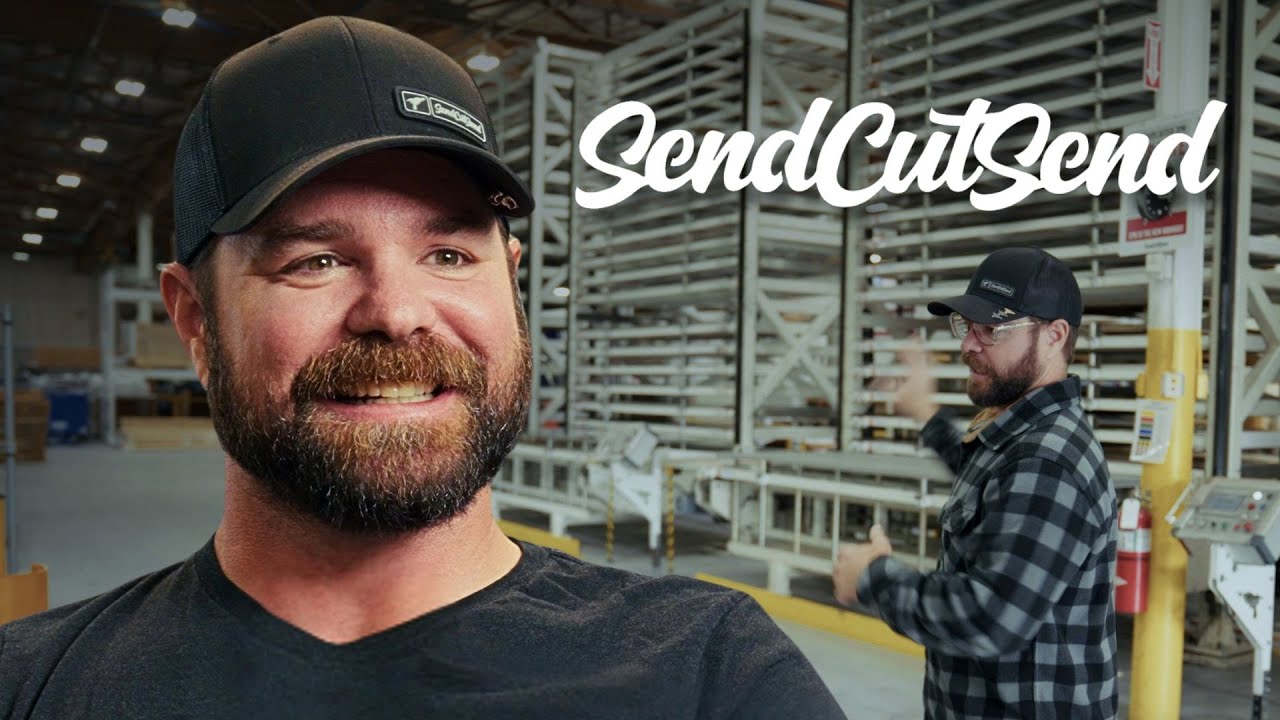
Jim Belosic founded SendCutSend in 2018 as a self-funded, bootstrapped on-demand sheet metal and CNC manufacturing company based in Reno, Nevada, starting with a single $750,000 laser he financed through the equipment vendor after banks refused to lend to him. The company now serves 250,000–300,000 customers, operates multiple facilities across the US, and has grown into a multi-million-dollar business by prioritizing customer experience, employee care, and long-term endurance over rapid VC-backed growth.
Manufacturing in America is resurging, but the real story is deeper than the hype
Manufacturing in the US has gained significant momentum, with a cultural shift toward making things domestically again, driven by conferences, social media, and national pride.
Jim argues this resurgence is overstated in some ways — many legacy manufacturers have been operating in the US for decades but lacked online visibility or marketing savvy, so younger engineers assumed domestic manufacturing had disappeared.
The new wave is exciting because it includes basics like cutlery, fasteners, and steel — foundational products — not just aerospace or ITAR-controlled work.
SendCutSend benefited from serendipitous timing rather than strategic foresight; Jim started the company out of a personal need for parts while running a software business.
Core philosophy: don’t save money — be frugal, not cheap
The company’s early motto, laser-engraved on stainless steel, was “Don’t save money.”
Being frugal means making smart, thoughtful purchases even if they’re expensive; being cheap means cutting corners that cost more in downtime, maintenance, or lost customers.
Jim learned this the hard way: he bought a $3,000 packaging machine on eBay instead of the $30,000 proper one, which caused $35,000 in headaches before he threw it in a dumpster and bought the right one.
The philosophy extends to customer experience: include stickers, candy, overnight shipping — small costs that generate outsized loyalty and word-of-mouth growth.
Jim compares this to Jeff Bezos’s early Amazon decision to warn customers about duplicate orders, sacrificing short-term revenue for long-term trust.
Building trust through generosity and the “beer test”
Jim treats vendors, delivery drivers, and suppliers like employees, not transactional counterparts.
The “beer test”: if you wouldn’t want to have a beer with a vendor, find a different one.
“Fun coupons” — cash tips from recycling revenue — are given to FedEx drivers, delivery guys, and others who go above and beyond, creating a culture of reciprocity.
One FedEx driver put on tire chains in a snowstorm to make his delivery because he felt valued by the company.
An early act of generosity — rushing a single part to a hobbyist in his garage — led that customer to refer SendCutSend to a major rocket company, which onboarded 200–300 engineers.
Customer experience as the primary marketing strategy
Jim claims marketing “sucks” and that the company has spent millions on Google Ads with poor returns compared to investing in a magical customer experience.
Word-of-mouth is the best advertising; many legacy manufacturers survived 40 years without websites because their product and relationships were strong enough.
The goal is to create an experience so good that customers naturally tell others — what Jim calls “gone all in” on generosity.
Customer support is overstaffed intentionally: the team is made up of enthusiasts, makers, and designers who are themselves customers, enabling genuine empathy and technical depth.
There are no rigid metrics for support interactions; some tickets have 85 responses because the staffer and customer spent weeks talking about cars.
For problematic customers who remain unhappy despite every effort, the company gently parts ways with a full refund and a referral elsewhere — “I just want happiness for you.”
The “gaslight launch” and secret menu
When SendCutSend adds a new capability — CNC machining, carbon fiber, welding — they don’t announce it.
They call it the “gaslight launch”: by the time customers discover the new offering, it appears as though it’s always been there.
New services go through a “secret menu” phase where select customers (chosen for either positive or negative feedback) test the capability.
Refinement takes anywhere from four to five weeks for a new material to four to five months for something like CNC, and some projects have been in development for two years with multiple start-stop cycles.
The goal is to be proud of the offering before any public-facing announcement — by launch, it’s typically version four or five.
Competing with China through speed, relationship, and constraints
Jim’s biggest competitive fear is that China could offer overnight shipping at one-tenth the cost, erasing SendCutSend’s advantage.
His response is to build a moat through relationship and speed: if price, quality, and shipping are equal, customers should choose SendCutSend because of the experience, the sticker, the sponsorship of their robotics team.
He pushes back on the narrative that US manufacturing can’t compete: raw material costs (e.g., $3/lb for aluminum) are a small fraction of the final part price, so subsidized Chinese aluminum isn’t the decisive factor.
The real competitive levers are better machines, better processes, better training, and creative use of constraints.
People say they’ll buy American, but when price is half, many go offshore — so SendCutSend must win even when things aren’t equal.
Walking the floor over reading dashboards
Jim believes manufacturing companies cannot be run on spreadsheets or remotely; you have to walk the floor, hear the machines, and see what’s being made.
He gauges business health by observing physical cues: how many totes are queued, how low the FedEx truck sags from the weight of steel shipped that day.
Data complements floor presence, but if forced to choose, Jim would choose walking the floor with no data over dashboards with no floor time.
This hands-on approach also helps identify employee morale, equipment issues, and process improvements in real time.
Learning from unrelated industries
Jim tours factories outside of sheet metal — food processing, flower distribution, Amazon fulfillment centers, cosmetics trade shows — to borrow novel solutions.
High-mix, low-volume manufacturing like SendCutSend’s has no direct analog, so cross-industry inspiration is critical.
Their packaging equipment was originally designed for keeping steaks fresh in the food industry.
He admires Sam Walton and Les Schwab for their blue-collar, no-nonsense approach to business — doing the basics really well without fancy vocabulary or pretension.
Focus on what you can control; build redundancy for what you can’t
The company motto is to focus on constraints — the things within their control — and treat external problems as their own to solve.
Weather, supply chain disruptions, and carrier failures are mitigated through geographic diversification (facilities in Kentucky, Texas, and a secret fourth location), multiple carriers (FedEx, UPS, DHL), and at least three suppliers per material.
During COVID, Jim was prepared to burn through cash keeping employees paid for six weeks before the ventilator parts boom saved the company.
Inventory strategy balances cash constraints against the cost of running out: for long-lead-time materials, they may carry a year’s supply plus surge buffer, even though a CFO would hate the capital tied up.
Vertical integration as an aspirational goal
Jim thinks about owning more of the supply chain — from bauxite mines to aluminum mills to rail delivery — inspired by John Rockefeller’s vertical integration of oil barrel production.
For now, the company relies on strong vendor relationships, like selling their old building to Coast Aluminum (a supplier) at below market value to ensure a cooperative neighbor who can deliver metal by forklift in emergencies.
The practical next step is acquiring a service center rather than a mine.
Hiring problem solvers, not credentials
Jim hires based on proof of work, not GPA or resume buzzwords.
He looks for experimentalists who build things: a job candidate who showed an app he built on his iPhone, another who built a bacon-monitoring robot at a Starbucks sandwich factory.
Diversity of background is intentional: an ex-rocket scientist, a biologist, and a psychologist will solve problems differently than a room full of sheet metal veterans.
He avoids hiring experienced machinists because 20 years of industry habits can prevent novel thinking; fresh eyes are valued over entrenched expertise.
The company also hires its own customers — people who already use and love the product and want to contribute.
Jim himself maintains “fresh eyes” by not doing any single job every day, allowing him to notice things others miss.
Self-funding as a strategic advantage
SendCutSend has never taken VC money, which Jim considers essential to its survival and culture.
He argues that with $10 million in VC funding, he would have bought the wrong equipment, hired the wrong people, and been pressured to prioritize growth over endurance.
Constraints force honest decisions; abundance leads to waste and misallocation.
The company throttles its own marketing to avoid outpacing capacity — a luxury VC-backed companies don’t have.
Jim aims to build a generational, enduring business, not a flip.
Creating a workplace people actually want to work in
Jim rejects the narrative that “nobody wants to work anymore” — the problem is that nobody wants to work for bad bosses in bad conditions at low pay.
SendCutSend pays well (e.g., $40/hour for machine operators vs. $13/hour elsewhere), invests heavily in training, and provides good lighting, climate control, noise reduction, and lunches.
Well-paid employees care about the equipment, catch problems early, and recruit their talented friends — creating a virtuous cycle.
The company has families working together (husbands, wives, sons, daughters) and clusters of former coworkers who followed each other from old jobs.
Jim sees 350 employees as 350 families whose livelihoods depend on his decisions, which makes him cautious about overhiring and committed to avoiding layoffs even at the cost of overtime expenses.
How Jim thinks about risk
Risk is subjective: the same action is rated differently by 10 different people.
Jim is naturally risk-tolerant but always calculates the worst-case scenario before taking a leap — as long as it doesn’t mean jail or layoffs, he’s willing to proceed.
The CNC expansion was a calculated risk: no existing CNC customers, but clear market demand and personal need, with a known downside (banks can repossess the machines).
He plans using three scenarios — high, medium, low — and makes investment decisions based on the low (worst case), never the high.
He criticizes pitch decks that assume perfect conditions and ignore real-world failures like ice storms, machine fires, and supply chain breakdowns.
Legacy and long-term thinking
Jim wants SendCutSend to be a lifetime customer company — someone discovers it in high school robotics at 16 and still uses it at 45, the way people have used McMaster-Carr for 40 years.
This means expanding capabilities alongside customers: from quantity-one prototypes to stamping, casting, and injection molding for customers who outgrow laser cutting.
He’s proud when customers outgrow SendCutSend because it means they succeeded — but he also wants to grow with them.
His personal legacy is building a company he’d want to interact with, run on instinct and “gym math” rather than spreadsheets, and proving that generosity and good business aren’t mutually exclusive.
He jokes that people will only appreciate his approach after he’s dead — but he’s having too much fun to wait.