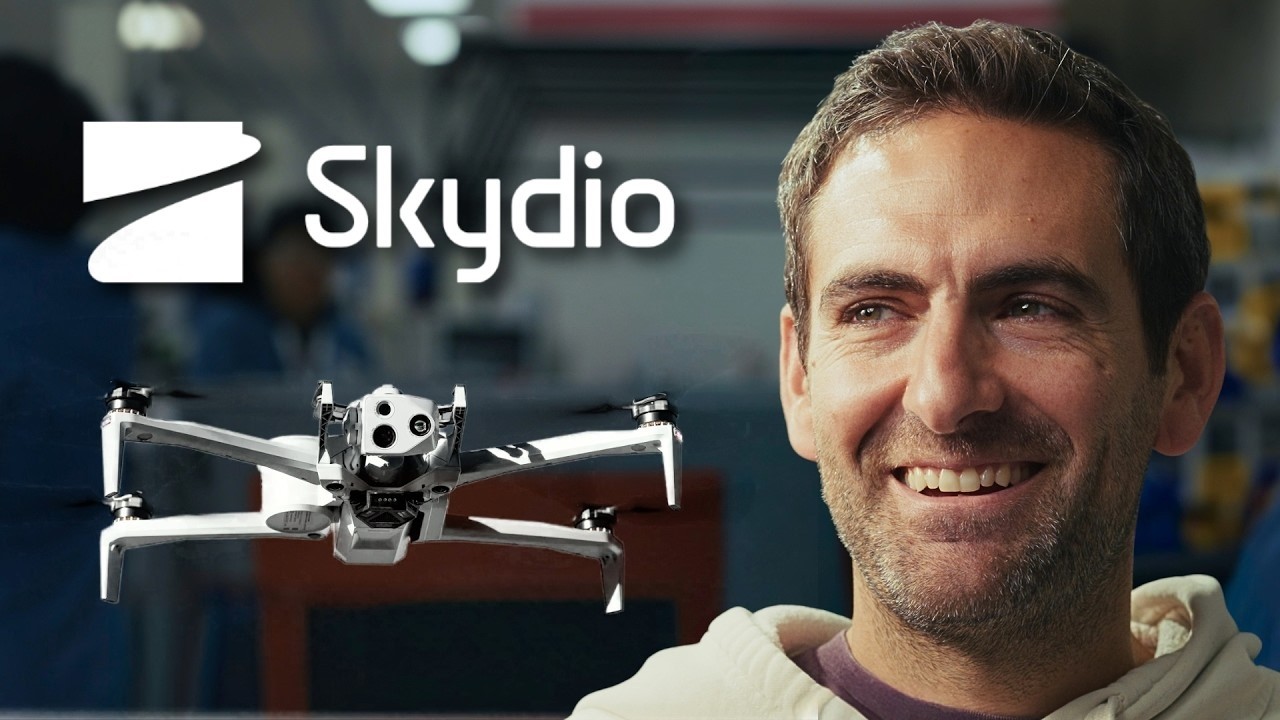
Skydio, founded in 2014, is the largest U.S. drone manufacturer and now outsells DJI in the U.S. professional market by focusing on autonomous, dock-based systems for enterprise and government customers rather than consumers; the company’s 13-year journey moved from a failed consumer launch (R1) through a capital-intensive pivot to autonomy and docks, a Chinese supply-chain sanction that forced full domestic reshoring, and finally to exponential growth with 2 million annual customer flights and profitable product lines.
Competition with DJI and the shift to autonomous docks
Skydio competes head-to-head with DJI in the U.S. and will exceed DJI’s U.S. civilian sales this year despite DJI still selling pre-2024 models.
The market is shifting from manually flown drones (DJI’s strength) to network-connected, dock-based autonomous solutions where the drone lives in a charging base, is operated remotely, and is entirely software-defined.
Skydio made this dock bet early (heavy investment from 2021) when no market existed, no customers asked for it, and the company was burning cash with skeptical investors.
DJI has copied Skydio’s innovations: fisheye omnidirectional cameras, computer-vision-centric architecture, and dock concepts.
Bry welcomes competition as a forcing function to be the best partner for customers; the goal is to win on overall solution quality, not regulatory protection alone.
Company history: from consumer failure to enterprise scale
Founded 2014; took 4 years to ship first product (R1), a “technology marvel but commercial failure” — great autonomy, everything else lacking.
Pivoted to enterprise/government in 2020; 3–4 years to get product-market fit right; last 2 years have gone exponential.
Online (non-military) customers now average ~2 million flights/year (~40k/week), doubling YoY; each flight represents a concrete mission (missing person, de-escalation, infrastructure inspection).
Factory output will triple in 2024; Bry estimates ~1% penetration in mature markets, so massive runway remains.
Early years were “baking period” akin to SpaceX/Tesla: long R&D before revenue inflection.
Manufacturing, supply chain, and the China sanction crisis
Skydio manufactured in-house from day one (counter to Silicon Valley wisdom to outsource to China) to keep R&D close to production for speed and quality.
As geopolitical tensions rose, Skydio moved supply chain out of China; in 2022 the Chinese government sanctioned Skydio and Bry personally, shut down their battery supplier, and seized equipment — an explicit attempt to kill the company.
Response: “game on” mindset; burned the boats, rationed batteries (one per drone), and stood up new cell/pack manufacturing in record time — emerging with better flight time.
Now rebuilding entire supply chain to zero China dependence; committing ~$1B to U.S. suppliers over 5 years to build domestic base (batteries, motors, cameras).
Biggest scaling risk remains upstream supplier fragility; Skydio integrates deeply with partners to help them reach required scale.
Product development philosophy: “Love the problem, get to the essence”
Design starts from the fundamental customer problem and physics, not legacy architectures.
F10 fixed-wing drone: camera gimbal placed on wingtip (not center) so banking turns never block the field of view — delivers “magic camera floating in the sky” experience; requires tight hardware/software co-design (motion planning, robotics).
Product decisions blend deep usage data (flight patterns, mission profiles, time between flights) with conviction bets on new paradigms (e.g., F10’s 2-hr endurance, 100 mph speed for rural first response).
Battery-swapping docks rejected: marginal utility (5% more flight time) vs. added complexity and reliability cost; customers prefer simple, reliable charging.
Bry drills into “why” in reviews to build his own understanding and push teams to deepest level of thinking; treats each problem contextually — low-cost experiments get quick tries, $50M hardware programs get rigorous upfront aiming.
Business economics, profitability, and lean scaling
Skydio tracks per-program P&L: R10 (new indoor drone) broke even on development + unit costs within 8 months at tens of millions in revenue.
Company at hundreds of millions revenue, growing fast, with strong unit economics; achieved via exceptionally lean, high-leverage teams (headcount ½–¼ of public hardware peers for far more complex products).
After over-hiring in 2020–21 “free money” era, Skydio deliberately froze headcount for years while output grew exponentially — rebuilt “lean muscle” as core identity.
Capital no longer a constraint, but headcount growth capped at pace that preserves exceptional, aligned, high-velocity teams; prioritization is the discipline.
Government/public safety market, privacy, and community accountability
Sells to federal/military, state/local public safety, and commercial (energy, construction); public safety is the first dock use case to reach scale and serves as lighthouse for others.
Drone-as-first-responder: docked drone launches on 911 call, arrives in minutes vs. hour for ground units — de-escalates, finds missing persons, spots fires.
Privacy/civil liberties baked in: product features for transparency, model policies for agencies, no blanket surveillance; Bry does not want to live in or build a 24/7 spy world.
Community is the ultimate customer; political pushback is healthy accountability — Skydio aligns with agencies on “only deploy if it serves the community.”
R10 tactical drone routinely takes violence (thrown, batted, shot) — Bry sees this as success because it spares humans; terms of service replace drones lost in line of duty.
Leadership: talent, operational excellence, and frontiers
Three time allocations: 1) talent (foundation of everything — every good outcome traces to exceptional people), 2) operational excellence (right motions, rhythms, targets), 3) frontiers (new tech, products, markets where ambiguity is highest).
Travels heavily to immerse in customer reality; weekly staff meeting starts with 30 minutes reviewing field failure videos to feel customer pain and align fixes.
Competitive drive sharpened by enterprise sales (“cage match” dynamics); loves existential challenges — back-against-the-wall mode is “happy place.”
Agrees with Michael Dell: competition is a focusing forcing function; cites Google’s renewed focus post-Anthropic/OpenAI as example.
Key bet-the-company decisions (one-way doors)
2014: Computer-vision autonomy on a drone — experts said impossible; if wrong, no Skydio.
2018 (Skydio 2): Switched from global-shutter to rolling-shutter cameras before algorithms were solved — no turning back; yielded step-change improvement.
2021+: Massive dock investment with zero market, zero customers, burning cash — conviction that docks were the only path to a valuable company.
2022ish: All-in on public safety/emergency response as first dock beachhead — worked superbly.
Vertical integration strategy: control what matters, partner for the rest
Vertical integration is relative; no one mines their own ore. Goal: control everything that determines product excellence.
Do it in-house when no supplier exists for a critical capability (cameras — now world-class internal team; mechanical nuances).
Partner when best-in-class ecosystems exist (lens grinding, silicon — aligned with AR/VR/robotics volume).
Sanctions accelerated insourcing where gaps appeared; $1B supplier investment fills those gaps.
Culture and scaling forward
Still 1% penetrated; market is not zero-sum like smartphones — must keep inventing new workflows while scaling core business.
Heterogeneous operating model: some teams optimize scale/efficiency (X10 successor), others invent (new frontiers) — both need exceptional owners.
Bry’s CEO lens: “provide value to civilization” — most business value comes from doing useful things for humans; “what can we build better than anyone else?” is the same question.
Avoids over-hiring traps seen in peers; LinkedIn headcount doubling YoY in hardware = guaranteed internal dysfunction — Skydio won’t repeat.